Introduction
SaaS startups face constant pressure: ship features faster, keep operational costs lean, and maintain customer satisfaction—all while preparing for the next funding round. The traditional scaling playbook of hiring proportionally to growth no longer holds up economically. When customer support tickets double or sales pipeline management becomes bottlenecked, simply adding headcount erodes margins and delays profitability.
Gartner projects that 40% of enterprise applications will feature task-specific AI agents by 2026, up from less than 5% in 2024. This rapid adoption reflects a fundamental shift: SaaS startups are increasingly deploying custom AI agents to scale operations without scaling headcount proportionally.
This guide covers what custom AI agents actually do, where they deliver measurable ROI for SaaS teams, and how to build or procure them without burning runway.
TLDR
- Custom AI agents autonomously plan, decide, and execute multi-step workflows—not just route tickets or follow rigid rules
- SaaS startups see the highest ROI in customer support automation, sales operations, product analytics, and internal knowledge retrieval
- Build custom when workflows are proprietary, data is sensitive, or compliance and deep integrations are non-negotiable
- Expect 6–10 weeks for a focused pilot; production-grade agents typically take 3–6 months depending on complexity and integration scope
- Choose partners with vertical experience, a clear path from pilot to production, and transparent pricing
What Custom AI Agents Actually Mean for SaaS Startups
Custom AI agents are software systems powered by large language models (LLMs) that perceive inputs, reason through tasks, call external tools and APIs, and take actions autonomously.
Unlike chatbots that follow rigid decision trees or RPA tools that replay recorded steps, AI agents dynamically plan their approach based on context.
The key word is "custom"—these agents are built around your specific workflows, proprietary data, and existing systems. They're not plug-and-play solutions.
From Automation to Autonomy
Consider a traditional support chatbot: it reads a ticket, matches keywords, and routes it to the right team. An AI agent goes further—it reads the ticket, retrieves relevant product documentation, checks the customer's account history and billing status, identifies the root cause, and resolves it end-to-end without human intervention.
According to McKinsey's 2024 Global AI Survey, 65% of organizations now regularly use generative AI in at least one business function, and 50% have adopted AI in two or more functions. For SaaS startups, this adoption curve has real implications. Agents let you scale operations without proportional headcount growth — a concrete answer to investor pressure on unit economics and margins.
Custom vs. Off-the-Shelf AI Features
Adding a ChatGPT plugin to your support portal isn't the same as building a custom AI agent. Custom agents are:
- Trained on your data — product docs, historical tickets, and internal playbooks your generic tool has never seen
- Integrated with your stack — CRM, billing systems, and product databases, not isolated in a sandbox
- Governed by your business logic — escalation rules, compliance requirements, and brand voice built in from day one
Off-the-shelf tools provide generic capabilities. Custom agents operate within your defined guardrails and deliver outcomes aligned with your specific business processes.
Core Components of a Custom AI Agent
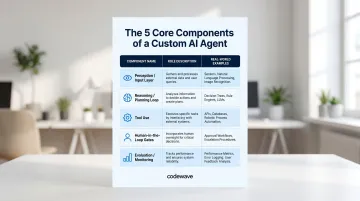
Understanding these building blocks helps you evaluate what you're actually commissioning — and where complexity (and cost) lives.
| Component | Role | Examples |
|---|---|---|
| Perception / Input Layer | What the agent reads | Support tickets, CRM records, usage logs, billing events |
| Reasoning / Planning Loop | How the agent decides what to do next | Step decomposition, context retrieval, adaptive replanning |
| Tool Use | What systems the agent can act on | APIs, internal databases, third-party services |
| Human-in-the-Loop Gates | Where humans stay in control | High-value transactions, sensitive decisions, ambiguous cases |
| Evaluation / Monitoring | How you measure performance | Task completion rate, accuracy, latency, cost per interaction |
Where AI Agents Deliver the Most Value in SaaS
AI agents address three core pressure points for SaaS startups: faster product delivery, cost efficiency, and customer retention. Here's where they deliver measurable impact.
Customer Success and Support Agents
AI agents handle Tier-1 support tickets end-to-end—not just routing them. They resolve common issues using product knowledge, account history, and troubleshooting logic autonomously.
Intercom's Fin 2 agent averages 51% resolution rate out of the box with 99.9% accuracy, at $0.99 per successful resolution. Zendesk customers report outcomes including 66% automation rates and $14,000 in monthly savings for mid-sized support teams.
Beyond reactive support, agents monitor customer health signals proactively:
- Usage drops or declining feature adoption
- Billing issues or failed payment attempts
- API call failures or integration errors
- Support ticket patterns indicating frustration
When thresholds are crossed, agents trigger outreach, escalate to account managers, or initiate retention workflows automatically.
Sales and Revenue Operations Agents
AI agents automate lead qualification, CRM data enrichment, follow-up email sequencing, and meeting scheduling—so sales reps spend their hours on active deals, not administrative overhead.
McKinsey reports that agentic AI is expected to power 60% of AI-generated value in marketing and sales. Case studies include a European insurer achieving 2-3x higher conversion rates and a homebuilder seeing 3x conversion-to-appointment improvement.
Outreach adapts to each prospect based on:
- Prospect's product usage or trial behavior
- Company signals (funding, hiring, tech stack changes)
- Prior conversations and expressed pain points
- Engagement patterns across channels
Product and Engineering Agents
Small engineering teams lose the most time to tasks that don't directly ship features:
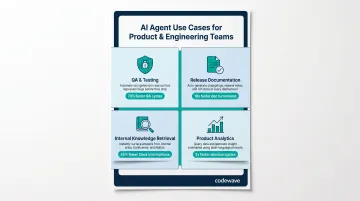
- QA and testing: Agents run continuous test suites, flag failures, and suggest fixes from error patterns. Gartner projects 80% of enterprises will use AI testing tools by 2027, up from 15% in 2023.
- Release documentation: Agents generate changelogs, update API docs, and draft knowledge articles from commit messages and pull request descriptions.
- Internal knowledge retrieval: Engineers ask questions in natural language and get answers pulled from code comments, design docs, Slack threads, and past incident reports.
- Product analytics: Agents surface usage insights, cohort behavior, and churn signals automatically—reducing the burden on product managers without dedicated data science support.
Custom Build vs. Off-the-Shelf Platforms: The Right Call for Your Startup
Not every workflow needs custom development. Here's how to decide.
When Off-the-Shelf Platforms Work
No-code tools like Zapier AI Agents, Make, or Lindy are the right call when:
- Your workflow is standard (common support scenarios, basic lead routing)
- Data is not sensitive (no PII, PHI, or proprietary algorithms)
- Speed-to-value matters more than customization
- You're validating whether AI agents solve the problem at all
These platforms are excellent for early-stage startups testing hypotheses before committing to custom development.
That calculus changes quickly once your workflows, data, or compliance requirements get specific.
When Custom Development Becomes Necessary
Build custom when you face:
Unique Multi-Step Workflows — Proprietary processes that platforms can't replicate with pre-built actions
Deep System Integration — Legacy systems, proprietary APIs, or custom data models that generic connectors can't handle
Compliance and Data Privacy — HIPAA, SOC 2, GDPR, or industry-specific regulations that require custom security controls. The EU AI Act mandates strict governance for high-risk AI systems, with fines reaching €35 million or 7% of global turnover for violations.
Fine-Tuned Models — Performance improvements from training on your proprietary data that off-the-shelf models can't deliver
Multi-Agent Orchestration — Complex workflows requiring coordination between specialized agents
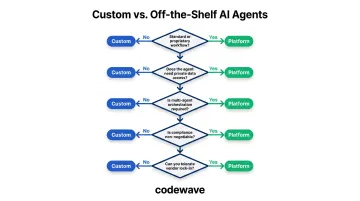
Practical Decision Framework
Ask yourself:
- Is your workflow standard or proprietary? Standard = platform; proprietary = custom
- Does the agent need access to private data? Yes = likely custom with controlled data access
- Do you need multi-agent orchestration? Yes = custom development required
- Is compliance non-negotiable? If so, build custom — audit trails and governance need to be architectural decisions, not afterthoughts
- Can you tolerate vendor lock-in? No = custom with portable architecture
The Hybrid Approach
Many startups use off-the-shelf tools for standard workflows (basic support routing, meeting scheduling) while building custom components for differentiated product features (proprietary data analysis, unique customer workflows).
For startups navigating this split, the key is making the build-vs-buy call quickly and with confidence. Codewave's QuantumAgile™ methodology is built for exactly that — simulating multiple solution paths and shipping the validated one, so custom investment goes toward components that drive product differentiation rather than reinventing what platforms already handle well.
How Custom AI Agent Development Works: From Discovery to Deployment
Most SaaS startups underestimate how structured the build process needs to be. A custom AI agent isn't a feature you ship in a sprint — it's a system with moving parts that needs validation at every stage before it touches production data or user workflows.
Key Development Phases
Discovery (2–4 weeks)
- Use case mapping and prioritization
- KPI definition and success metrics
- Data access audit and integration assessment
- Compliance requirements review
Pilot (4–6 weeks)
- Narrow workflow in controlled environment
- Baseline metrics collection
- Iterative prompt and logic refinement
- Human-in-the-loop validation
Production (6–12 weeks)
- Full system integration across your stack
- Governance and permission implementation
- Monitoring and alerting setup
- User training and documentation
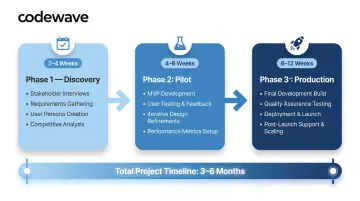
If your pilot can't hit baseline accuracy and latency targets within 6 weeks, that's a signal to revisit the use case — not push forward into production.
Essential Technical Deliverables
Once the pilot validates the approach, your development partner should hand off documented artifacts — not just working code. Expect:
- Orchestration graph: Visual decision flow showing how the agent breaks down tasks, which tools it calls, and when it escalates to humans
- Tool catalog with permission scopes: Which APIs the agent can access, what actions it can take, and the role-based controls enforcing those limits
- Retrieval and grounding plan: How the agent fetches data (vector search, SQL, API calls), how it cites sources, and how it handles conflicts
- Evaluation benchmarks: Agreed-upon success rate, accuracy, latency targets, and cost budgets — documented before launch, not after
Cost and Timeline Expectations
These deliverables directly affect your cost and timeline. Based on industry data, SaaS startups typically see:
Basic Agents — Narrow customer support or internal knowledge retrieval
- Cost: $25,000–$75,000
- Timeline: 6–10 weeks
- Scope: Single workflow, limited integrations
Mid-Level Agents — Multiple system integrations, complex decision logic
- Cost: $100,000–$300,000
- Timeline: 3–6 months
- Scope: Multi-step workflows, CRM/billing/product integrations, custom models
Integration complexity is usually the biggest cost driver — the more systems your agent needs to read from or write to, the more the bill grows.
Guardrails in Practice
Getting the cost and timeline right matters less if the agent misbehaves in production. Startups need enterprise-grade safety controls without the overhead of a full MLOps team:
- Permission scopes — Agent can only access what it needs, enforced at API level
- Adversarial testing — Simulate jailbreak attempts and edge cases before launch
- Human-in-the-loop gates — High-risk actions (refunds, account changes, contract modifications) require approval
- Cost and latency budgets — Prevent runaway API usage with hard limits and alerts
OWASP's Agentic Skills Top 10 documents critical security risks across major AI agent platforms—use it as a checklist during development.
Measuring AI Agent ROI for SaaS Startups
Key Metrics to Track
Focus on outcomes, not vanity metrics:
- Task Success Rate — Tasks completed without human intervention; your primary signal of agent reliability
- Containment Rate — Support queries resolved end-to-end, with no handoff required
- Average Handle Time Reduction — Time saved per interaction compared to your manual baseline
- Cost Per Interaction — API calls, infrastructure, and maintenance costs divided by successful outcomes
Uptime and raw interaction volume tell you nothing about business value. Track what the agent actually resolves.
Realistic Pilot Baselines
Set achievable targets for your pilot:
- 60–70% task success rate consistently over 4–6 weeks for standard workflows
- 85%+ task success rate before scaling to production for mission-critical processes
- Under 15% escalation rate to human agents during pilot phase
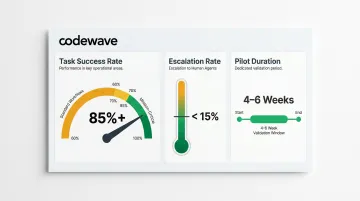
These thresholds matter because most pilots fail for the same reason: no predefined success criteria. Deloitte's 2025 AI ROI Performance Index found that 91% of organizations plan to increase AI spending, yet 80% report no significant bottom-line gains — largely due to fragmented pilots without clear targets. Codewave clients who define measurable criteria upfront consistently report 40% productivity increases and 25% cost reductions within the first production cycle.
Observability for Ongoing Improvement
Agents need dashboards showing:
- What inputs they received — Request type, data quality, context completeness
- What actions they took — Tool calls, decision branches, API requests
- What outcomes resulted — Success/failure, user feedback, escalation reasons
This visibility enables teams to improve prompts, retrain on new data, adjust permissions, and expand use cases as the product evolves.
How to Choose the Right AI Agent Development Partner
Critical Evaluation Criteria
Start by asking for two live production examples in your industry — not case studies, not demos. A partner worth hiring can show you agents handling real traffic in workflows similar to yours.
From there, verify three things:
- Vertical experience: Do they understand your compliance requirements and integration constraints, or are they learning on your dime?
- Proof of Concept (PoC)-to-production track record: Many shops build impressive prototypes that collapse under real load. Ask specifically how they've handled scaling and edge cases post-launch.
- Tech stack fit: Confirm hands-on experience with your CRM, billing system, analytics platform, and communication tools. Generic integration promises break down fast when real edge cases appear.
Startup-Specific Concerns
General evaluation criteria matter for any buyer. For startups, four additional concerns tend to make or break the partnership:
- Pricing flexibility: Most startups can't absorb $500K+ enterprise contracts. Look for phased engagements, milestone-based payments, or outcome-based pricing that ties cost to value delivered.
- Iteration speed: You need a partner who moves in weeks, not quarters — one who'll adapt scope based on what pilot data actually shows, not what the original spec assumed.
- IP ownership: Confirm you own the code, models, training data, and integration logic outright. Clarify data export rights upfront and avoid lock-in mechanisms that restrict future flexibility.
- Knowledge transfer: Post-launch, your team needs to operate, monitor, and improve the agent without calling the vendor for every change. Scrutinize their documentation standards and handoff process before signing.
Outcome-Based Partnerships
Top-performing partners now tie compensation to business results, not just delivery milestones. Codewave's ImpactIndex™ model works this way: clients pay for measurable outcomes — containment rate improvements, cost savings, productivity gains — rather than hours logged or features shipped. For startups managing tight budgets, that accountability shift meaningfully reduces engagement risk.
Frequently Asked Questions
How much does custom AI agent development cost for a SaaS startup?
Basic agents for narrow use cases (Tier-1 support, knowledge retrieval) typically run $25,000–$75,000 and take 6–10 weeks. Mid-level production systems with multiple integrations range from $100,000–$300,000 over 3–6 months. Scope, compliance requirements, and integration depth account for most of that range.
What's the difference between a custom AI agent and using an off-the-shelf platform?
Off-the-shelf platforms like Zapier or Make work well for standard, low-risk workflows with minimal customization needs. Custom agents are built around proprietary data, unique business processes, and deep system integrations that generic tools can't replicate. Choose custom when compliance, data privacy, or differentiated workflows are critical.
How long does it take to build and deploy a custom AI agent?
A basic production agent runs 6–10 weeks from discovery to deployment, with a 4–6 week pilot available to validate approach first. Complex systems with multiple integrations and compliance requirements take 3–6 months. Data readiness and integration scope are the main variables.
Which SaaS workflows are best suited for AI agent automation?
Start with high-volume, repetitive tasks that have measurable outcomes: Tier-1 customer support resolution, lead qualification and CRM enrichment, internal knowledge retrieval for engineering teams, and product usage monitoring for customer success.
How do I avoid vendor lock-in when building a custom AI agent?
Four practices reduce lock-in risk from the start:
- Use swappable model components that support multiple LLM providers
- Maintain portable data indexes with standard vector database export formats
- Implement adapter layers between your agent and external systems
- Confirm contractual clarity on data export rights and IP ownership before signing
Avoid proprietary frameworks that make migration impractical later.
What does my SaaS startup need before starting AI agent development?
Define a clear use case with measurable KPIs (target success rate, cost savings, time reduction). Ensure accessible and reasonably clean data sources (structured databases, documented APIs, organized knowledge bases). Confirm API or integration access to relevant systems. Assign internal ownership for who monitors, manages, and improves the agent post-launch.