Introduction
The pressure on enterprises to deploy conversational AI has never been higher. A recent MarketsandMarkets report values the conversational AI market at $17.05 billion in 2025, with projections to reach $49.80 billion by 2031. Yet despite this growth, many organizations struggle with a fundamental challenge: most platforms perform well in controlled demos but fail in production environments.
Common failures include collapsing under traffic surges, lacking governance controls for regulated industries, or requiring months of custom development just to handle basic integrations. Gartner confirms this: at least 50% of generative AI projects were abandoned after proof of concept by early 2026, primarily due to poor data quality and missing governance frameworks.
That failure rate makes platform selection critical. This guide evaluates the 10 best enterprise conversational AI platforms based on what actually matters in production: integration depth, governance controls, deployment flexibility, scalability under real load, and documented business outcomes. The focus is on platforms that have proven themselves in regulated, high-volume, multi-region deployments.
TL;DR
- Enterprise conversational AI goes beyond chatbots — it executes real workflows, connects to CRM/ERP systems, and holds context across multi-turn conversations
- Leading platforms target different needs: CRM-native AI, self-hosted governance, contact center ops, and developer-first frameworks
- Evaluate platforms on deployment model, integration depth, governance controls, multi-channel support, and total cost of ownership
- Most deployments fail due to weak enterprise integration, poor data governance, or platforms that can't scale
- Platform selection must align with your industry's compliance requirements, existing tech stack, and AI roadmap
What Is Enterprise Conversational AI?
Enterprise conversational AI refers to platforms designed for large organizations to deliver intelligent, multi-turn conversations across voice and digital channels at scale. Unlike basic chatbots that follow scripted decision trees, these systems combine natural language processing (NLP), large language models (LLMs), and multi-turn dialogue management to handle complex, high-volume interactions.
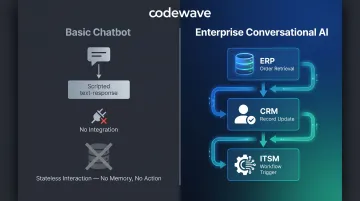
The fundamental difference lies in integration and execution capability. Enterprise platforms connect directly with CRM, ERP, ITSM, and knowledge bases. They maintain conversation context across multiple exchanges, enforce role-based access controls, and execute real transactions — not just answer questions.
The contrast is concrete: a basic chatbot responds "Your order status is being checked." An enterprise platform retrieves the order from your ERP, updates the customer record in your CRM, and triggers a workflow in your service management system — all within the same conversation.
According to Grand View Research, the conversational AI market is valued at USD 14.29 billion in 2025 and projected to reach USD 41.39 billion by 2030, representing a compound annual growth rate of 23.7%. That trajectory is driven by organizations in regulated industries — healthcare, fintech, insurance — that need platforms capable of scaling without sacrificing compliance or auditability.
The platforms below were selected because they demonstrate proven production-readiness across regulated, high-volume, and multi-region deployments, with verified deployment track records rather than demo-stage feature claims.
Top 10 Enterprise Conversational AI Platforms for Businesses
Platforms were selected based on five criteria:
- Enterprise deployment maturity and production track record
- Integration depth with existing enterprise systems
- Governance and compliance controls
- Multi-channel capability (voice, chat, digital)
- Documented outcomes verified by analyst recognition or customer results
Salesforce Agentforce
Salesforce Agentforce is the agentic AI layer built natively into the Salesforce Customer 360 platform, extending CRM data into autonomous conversational experiences across sales, service, and marketing channels.
Differentiator: Deep native integration with Salesforce CRM and Data Cloud creates unified real-time customer profiles that enable AI agents to act on live customer data without external orchestration. Asymbl reported annual savings of $575,000 with lead engagement increasing 427% after deployment.
| Attribute | Details |
|---|---|
| Key Features | Agentic AI workflows, Data Cloud-powered profiles, adaptive AI reasoning, Journey Builder, omnichannel deployment |
| Best For | Enterprises standardized on Salesforce that want marketing, service, and sales AI unified in one governed ecosystem |
| Pricing Model | Consumption-based Flex Credits; pay-as-you-go, pre-commit, or pre-purchase options |
IBM watsonx Assistant
IBM watsonx Assistant is an enterprise AI infrastructure platform where organizations build, govern, and deploy conversational AI solutions with model lifecycle management and data sovereignty controls.
Differentiator: Strong AI governance tooling designed for regulated industries. watsonx.governance was named a Leader across IDC, Forrester, and Gartner reports for AI governance platforms — a useful signal for banking, healthcare, and government teams where audit trails are non-negotiable.
| Attribute | Details |
|---|---|
| Key Features | AI model development, lifecycle governance, retrieval-augmented generation (RAG), multi-channel deployment, enterprise data management |
| Best For | Enterprises in regulated industries requiring custom AI solutions with strict data governance and audit trails |
| Pricing Model | Subscription and usage-based; enterprise agreements available |
Microsoft Copilot Studio
Microsoft Copilot Studio is a low-code platform for building and deploying conversational agents within the Microsoft ecosystem, giving enterprises a fast path to AI-powered experiences across Teams, Microsoft 365, and Azure.
Differentiator: Tight Microsoft ecosystem integration allows organizations standardized on Teams and M365 to deploy conversational agents rapidly with minimal engineering effort, using pre-built connectors and native governance through Azure Active Directory.
| Attribute | Details |
|---|---|
| Key Features | Low-code agent builder, native Teams/M365 integration, Azure security controls, API connectors, voice and chat channels |
| Best For | Enterprises standardized on Microsoft infrastructure seeking internal-facing conversational AI for IT, HR, or employee support |
| Pricing Model | $200/month for 25,000 Copilot Credits; tenant-wide licensing |
Google Dialogflow CX
Google Dialogflow CX is Google Cloud's enterprise-grade conversational AI development framework, providing visual flow builders and advanced natural language understanding to create complex, multi-turn agents for chat and voice channels.
Differentiator: State-based dialogue management and Google's NLU engine give development teams precise control over conversation flows across 133 languages. Google was named a Leader in the 2025 Gartner Magic Quadrant for Conversational AI Platforms, positioned furthest on Completeness of Vision.
| Attribute | Details |
|---|---|
| Key Features | Visual state-based flow builder, Google NLU, Contact Center AI (CCAI) telephony integration, 133-language support, webhook-based integrations |
| Best For | Enterprises on Google Cloud with development teams needing custom-built, multilingual conversational agents for complex journeys |
| Pricing Model | Pay-as-you-go; $0.007/chat request, $0.001/voice second; enterprise agreements available |
Kore.ai XO Platform
Kore.ai's Experience Optimization (XO) Platform offers no-code and low-code agent building, pre-built industry solutions, and multi-engine NLP for complex workflow automation across customer service, HR, and IT.
Differentiator: Named a Leader in the 2025 Gartner Magic Quadrant for Conversational AI Platforms, Kore.ai provides pre-built industry agents for banking, healthcare, and retail that cut deployment timelines while supporting both cloud and on-premises deployment for regulated environments.
| Attribute | Details |
|---|---|
| Key Features | No-code/low-code bot builder, pre-built industry agents, multi-engine NLP, voice and chat, 100+ enterprise connectors |
| Best For | Large enterprises needing rapid deployment of complex conversational workflows with pre-built industry solutions and on-prem options |
| Pricing Model | Custom enterprise pricing; usage-based options available |
Rasa
Rasa is a developer-first enterprise conversational AI platform offering self-hosted deployment, a patented Orchestrator for governed LLM behavior, and native voice-chat parity — built specifically for regulated industries that cannot use cloud-only SaaS vendors.
Differentiator: Rasa is the only platform in this list with full on-premises deployment and architectural separation between LLM understanding and business logic execution. Rasa explicitly states it "does not host customer data, systems, or applications." That means complete data sovereignty, full audit trails, and voice/chat parity from a single runtime.
| Attribute | Details |
|---|---|
| Key Features | Self-hosted/on-prem deployment, patented Orchestrator, CALM framework, Rasa Voice (Twilio, AudioCodes, Genesys), Python-level extensibility |
| Best For | Enterprises in regulated industries (banking, healthcare, government) requiring full data sovereignty, governance, and voice-digital parity |
| Pricing Model | Free Developer Edition (1,000 conversations/month); Enterprise: custom annual volume-based pricing |
NICE CXone
NICE CXone is an enterprise contact center AI platform combining conversational AI, agentic experience automation, omnichannel routing, and workforce management into a unified cloud platform for large-scale customer service operations.
Differentiator: 11 consecutive years as a Gartner Magic Quadrant Leader for Contact Center as a Service. CXone is designed for high-volume contact centers, with AI agents that handle intent recognition, route intelligently, and escalate to human agents with full conversational context preserved.
| Attribute | Details |
|---|---|
| Key Features | Agentic AI for self-service, omnichannel routing, IVR automation, workforce management, interaction analytics, knowledge management |
| Best For | Enterprises with high-volume contact centers needing integrated conversational AI, agent assist, and workforce management in one platform |
| Pricing Model | Custom enterprise pricing; modular capability licensing |
ServiceNow Now Assist
ServiceNow Now Assist brings generative AI and virtual agent capabilities natively into the ServiceNow platform, so employees and customers can resolve IT, HR, and service requests through conversational interfaces wired directly to enterprise workflows.
Differentiator: Unlike standalone conversational AI tools, Now Assist operates within ServiceNow's service management engine. Every conversational action — ticket creation, approval, status check — executes directly within governed enterprise workflows without custom integration code. ServiceNow reported Now Assist represents the "largest net new ACV contribution of any new product family launch" for the company.
| Attribute | Details |
|---|---|
| Key Features | Generative AI replies, Virtual Agent, ticket summarization, intelligent routing, cross-department workflow automation, enterprise governance |
| Best For | Organizations using ServiceNow as their core ITSM/HRSD platform that want conversational AI embedded in existing service delivery workflows |
| Pricing Model | Add-on to ServiceNow platform licenses; enterprise custom pricing |
Amazon Lex
Amazon Lex is AWS's managed conversational AI service providing automatic speech recognition (ASR) and natural language understanding (NLU) to build voice and text chatbots at enterprise scale, with native integration across AWS services and contact center platforms.
Differentiator: Scalability and AWS ecosystem depth. Lex integrates natively with Amazon Connect for contact center use cases, Lambda for custom actions, and the full AWS cloud stack — giving enterprises on AWS a path to scalable conversational experiences with pay-as-you-go pricing and no infrastructure management.
| Attribute | Details |
|---|---|
| Key Features | ASR and NLU, Amazon Connect integration, Lambda for custom actions, multi-language support, AWS IAM security controls |
| Best For | Enterprises on AWS infrastructure seeking a scalable, managed conversational AI service with deep cloud integration and flexible pricing |
| Pricing Model | Pay-as-you-go: $0.00075/text request, $0.004/speech request; free tier: 10,000 text + 5,000 speech requests/month for 12 months |
Intercom (Fin AI Agent)
Intercom's Fin AI Agent is a managed conversational AI product designed to autonomously resolve customer support queries by training on help center content, achieving high resolution rates with minimal engineering effort for digital-first businesses.
Differentiator: Intercom reports Fin achieves a 67% average resolution rate across all customers, with top deployments reaching up to 93% at scale. Rapid deployment — live within hours using existing help center content — and unified inbox across chat, email, WhatsApp, and phone make it attractive for SaaS companies, though cloud-only deployment limits suitability for regulated industries.
| Attribute | Details |
|---|---|
| Key Features | Fin AI Agent (autonomous resolution), Fin AI Copilot for agents, unified inbox, 45+ language support, Salesforce/HubSpot integrations |
| Best For | SaaS, ecommerce, and digital-first companies seeking fast deployment of high-resolution customer support AI without heavy engineering investment |
| Pricing Model | $0.99/resolution; seat-based plans from $29/seat/month (annual); no free plan |
How We Chose the Best Enterprise Conversational AI Platforms
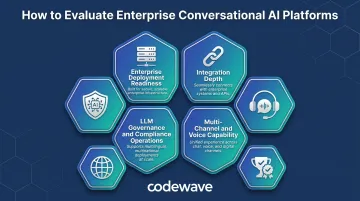
Platforms were assessed on six weighted criteria that reflect production realities, not demo performance:
| Criterion | What We Evaluated |
|---|---|
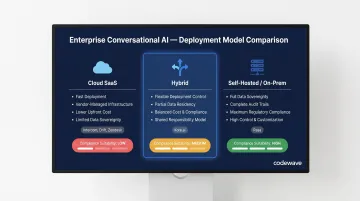
| Enterprise Deployment Readiness | Cloud, on-premises, and hybrid support. Rasa and Kore.ai offer verified on-premises options; Intercom is cloud-only. |
| Integration Depth | Native action execution within CRM, ERP, and ITSM systems. ServiceNow Now Assist runs natively inside ServiceNow workflows; Salesforce Agentforce uses Data Cloud for real-time profiles. |
| LLM Governance and Compliance | Audit trails, role-based access, and policy enforcement. Rasa's Orchestrator separates LLM understanding from business logic — enabling governance at the architecture level. |
| Multi-Channel and Voice Capability | Consistent quality across digital chat and voice telephony. Dialogflow CX connects to Contact Center AI; NICE CXone provides unified omnichannel routing. |
| Scalability and Global Operations | Traffic surge handling and multilingual support. Amazon Lex runs on AWS-scale infrastructure with pay-as-you-go pricing; Dialogflow CX supports 133 languages. |
| Documented Enterprise Use Cases | Proven production deployments and analyst recognition. Kore.ai and Google hold Leader positions in the 2025 Gartner Magic Quadrant; NICE CXone has held its Gartner CCaaS Leader position for 11 consecutive years. |
The biggest mistake enterprises make is selecting platforms based on feature count rather than production reliability, governance maturity, and total cost of ownership at scale. Many organizations treat conversational AI as a standalone chatbot project — rather than a system that must integrate into data, security, and workflow layers.
Hidden costs surface later: poor integrations requiring constant maintenance, missing audit trails that block compliance, or cloud-only vendors that fail regulatory requirements.
These failure patterns are what shaped this evaluation. Codewave has worked with 400+ businesses across 15+ industries — Healthcare, Fintech, Insurance, and Retail among them — and these criteria reflect what actually determines success after go-live. Codewave's QuantumAgile™ methodology takes enterprises from platform selection to deployed, measurable conversational AI solutions by simulating multiple futures and shipping what works.
Conclusion
The best enterprise conversational AI platform integrates with your existing systems, enforces the governance your industry requires, scales reliably under real production load, and delivers measurable outcomes. Feature count is the wrong scorecard.
Before signing any contract, run three checks:
- Pressure-test on real use cases — not scripted demos designed to hide edge-case failures
- Verify deployment model and data sovereignty early — cloud-only platforms are often disqualified in regulated industries before evaluation even begins
- Calculate total cost of ownership — implementation effort, ongoing maintenance, and switching costs can dwarf the license fee
Platform selection decisions made now will determine competitive advantage during a period of rapid market expansion. Choose platforms that align with your industry's compliance requirements, existing tech stack, and long-term AI strategy — not just today's feature checklist.
If your organization is evaluating enterprise conversational AI platforms or needs help moving from strategy to implementation, Codewave's team works with businesses to design and build AI solutions that launch, perform, and drive real business value. With ZeroDX™, the engineers you talk to in the first meeting are the ones writing the code — no handoffs, no account managers in between.
Frequently Asked Questions
What is enterprise conversational AI?
Enterprise conversational AI platforms are purpose-built for large organizations to handle intelligent, multi-turn conversations across voice and digital channels at scale. Unlike basic chatbots, they integrate with CRM, ERP, and other backend systems to execute real workflows, enforce compliance controls, and support enterprise governance requirements.
What is an example of Enterprise AI?
A few real-world deployments illustrate the range:
- Salesforce Agentforce autonomously handles customer service cases using live CRM data and Data Cloud profiles
- IBM watsonx Assistant manages loan inquiries in banking with full audit trails and governance controls
- ServiceNow Now Assist resolves IT tickets conversationally within existing ITSM workflows
Which conversational AI is best?
The right platform depends on your use case and infrastructure. Rasa leads for regulated industries requiring self-hosted governance and data sovereignty. Salesforce Agentforce suits CRM-native enterprises, Microsoft Copilot Studio fits Microsoft-standardized organizations, and Kore.ai handles complex workflow automation with pre-built industry agents.
How is enterprise conversational AI different from a regular chatbot?
Regular chatbots follow scripted rules and handle simple queries. Enterprise conversational AI understands natural language across multi-turn conversations and integrates with CRM, ERP, and ITSM systems to execute real actions. It also enforces governance and role-based access controls, and scales across regions and high interaction volumes.
What features should enterprises prioritize when choosing a conversational AI platform?
Key factors to evaluate:
- Deployment model — cloud vs. on-prem based on your regulatory requirements
- Integration depth — compatibility with existing CRM, ERP, and ITSM systems
- LLM governance — audit trails, access controls, and compliance tooling
- Multi-channel support — including voice, not just chat
- Scalability — capacity for global operations and high interaction volumes
- Total cost of ownership — implementation and maintenance, not just licensing fees
How much does enterprise conversational AI cost?
Pricing models vary significantly across platforms:
- Per resolution: ~$0.99/resolution (Intercom Fin)
- Per request: $0.00075/text (Amazon Lex), $0.007/chat request (Google Dialogflow CX)
- Per credit pack: $200/25,000 credits (Microsoft Copilot Studio)
- Custom enterprise contracts: Rasa, Kore.ai, Salesforce, NICE CXone
Implementation, integration, and ongoing training costs frequently exceed the base license fee.