Introduction
Real estate firms manage thousands of lease agreements, monthly payments, compliance checks, and maintenance requests every month. When portfolios grow from 500 to 5,000 units, manual processes don't just slow down—margins shrink, decisions stall, and errors compound before anyone catches them.
RPA is already delivering measurable results across property management, leasing, compliance, and financial reporting. JLL reduced property data collection time from 60 days to under 7 days. HOAS cut tenant application processing time by 50% across 8,400+ annual applications. Both results came from automating high-volume workflows that staff previously handled by hand.
What follows covers why RPA matters for real estate operations, the specific advantages it creates, and where those advantages have the most impact.
TL;DR
- RPA uses software bots to automate repetitive, rule-based tasks: tenant onboarding, lease processing, invoice handling, and compliance reporting—all without replacing existing systems
- Core advantages include operational accuracy, compliance control, and the ability to scale portfolio operations without proportional headcount growth
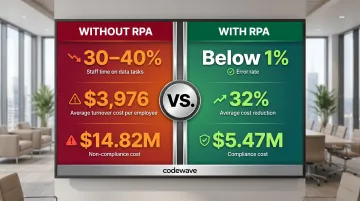
- Real estate firms report processing time reductions of 85-88%, error rates below 1%, and 32% average cost reductions across operations
- RPA delivers the highest ROI when deployed on high-volume workflows (invoice processing, tenant screening) and integrated with existing property management platforms like Yardi or MRI
- Firms that delay automation on growing portfolios typically see error rates and operational costs compound faster than headcount can absorb—making early deployment significantly cheaper than late correction
What Is RPA in Real Estate?
RPA is software that mimics human actions to complete repetitive tasks faster and without manual errors. It logs into systems, extracts data from emails, fills forms, routes documents, and posts transactions — all without human input. Gartner defines RPA as software that automates tasks using scripts that emulate human interaction with application interfaces.
Where RPA Applies in Property Operations
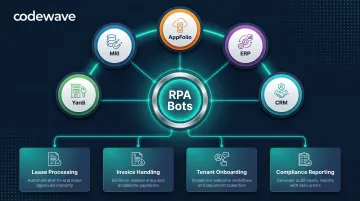
Real estate and property management operations depend on high-volume, rule-based workflows that are currently handled manually:
- Extracts MLS data, validates contract clauses, and generates renewal documents automatically
- Tenant screening and onboarding: Runs background checks, credit verification, KYC compliance, and application approvals
- Invoice processing: Matches invoices to purchase orders, posts to accounting systems, and handles AP/AR workflows
- Automates rent reminders, payment reconciliation, and late fee calculations without manual intervention
- Bank reconciliation: Matches daily transactions, flags discrepancies, and posts to finance systems
- Compliance documentation: Handles AML checks, data protection requirements, audit trail generation, and tax reporting
- Aggregates performance data across properties, calculates NOI, and produces investor-ready reports
RPA integrates directly with platforms already in use: Yardi, MRI, AppFolio, ERPs, and CRMs. That frees teams from repetitive processing overhead, so they can focus on judgment-driven work — negotiating leases, resolving tenant disputes, and managing client relationships.
Key Advantages of RPA in Real Estate
Real estate operations run on volume—thousands of lease transactions, invoices, compliance checks, and reconciliations processed every month. When that volume grows, manual workflows break down: errors accumulate, timelines slip, and headcount costs rise. RPA directly addresses each of these pressure points. The advantages below tie to outcomes firms track: cost per transaction, processing time, error rate, compliance exposure, and portfolio scalability.
Advantage 1: Operational Speed and Accuracy Across High-Volume Workflows
Manual data handling creates inefficiency at every handoff. When bots process lease data, run tenant checks, match invoices, and reconcile accounts, they do it consistently and at speeds no human team can sustain at volume.
Where the time savings come from:
- Pulls applicant data from forms and emails, cross-references background and credit checks automatically
- Populates lease templates from source systems, eliminating manual data entry
- Extracts invoice data, matches it to purchase orders, and posts reconciled figures to finance systems
- Runs bank reconciliations daily without manual intervention
Manual operations introduce errors at every handoff—wrong figures in lease agreements, late invoice postings, missed reconciliation discrepancies. RPA eliminates these by executing identical steps every time.
Property managers spend 30-40% of their time on manual data entry and reconciliation. That's time unavailable for client-facing work or revenue-generating activities.
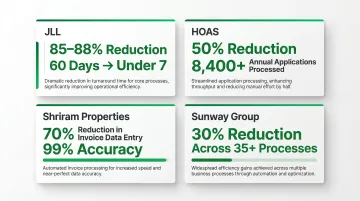
Real estate processing time reductions:
- JLL: 85-88% reduction in property data collection time (60 days reduced to under 7)
- HOAS: 50% reduction in tenant application processing time across 8,400+ annual applications
- Shriram Properties: 70% reduction in manual invoice data entry with 99% data accuracy
- Sunway Group: 30% reduction in processing times across 35+ automated processes
Impact on revenue:
Speed and accuracy translate directly to cash flow. Average multifamily turnover costs $3,976 per move-out, with 10-20 days of lost rent — every day saved in lease processing cuts vacancy duration. Beyond leasing, the downstream gains compound:
- Faster invoice processing improves vendor relationships and avoids late payment fees
- Cleaner reconciliations reduce audit exposure and finance team rework
- RPA achieves 99.8% accuracy in data entry tasks, compared to significantly higher human error rates
KPIs impacted:
- Data error rate
- Processing time per transaction
- Invoice cycle time
- Vacancy duration
- Manual hours per workflow
- Employee capacity freed for value-added tasks
Portfolio size context:
Accuracy gains scale with volume. At 100 units, manual errors are manageable. At 5,000 units, they become systemic and costly — making RPA essential rather than optional for growth-stage portfolios.
Advantage 2: Compliance Control and Audit Readiness Without Additional Overhead
Real estate is heavily regulated—AML requirements, data protection laws, lease contract enforcement, zoning rules, financial audit obligations. These require consistent documentation and process discipline that manual teams struggle to maintain at scale.
How bots enforce compliance consistently:
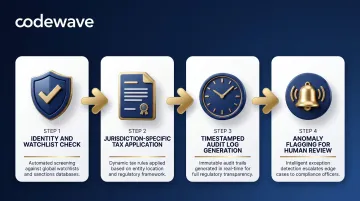
- Enforces identical compliance steps on every transaction—running identity and watchlist checks during tenant onboarding
- Applies jurisdiction-specific tax rules during financial reporting without variance
- Timestamps every action in an auditable log
- Flags anomalies for human review before they become violations
rose 45% over the past decade. Human error contributed to 95% of data breaches in 2024.
RPA reduces the human error and inconsistency behind most inadvertent compliance gaps. Every automated check that runs without deviation lowers the firm's exposure — and the audit trail bots generate cuts the time and cost of responding to regulatory reviews.
KPIs impacted:
- Compliance error rate
- Audit preparation time
- Number of regulatory exceptions flagged
- Documentation completeness
- Time spent on KYC/AML verification per transaction
When compliance automation has the greatest impact:
This advantage is most pronounced for firms operating across multiple jurisdictions, managing high transaction volumes, or facing growing regulatory scrutiny in AML, data privacy, and tenant rights — where manual tracking becomes structurally unreliable.
Advantage 3: Scalable Operations Without Proportional Headcount Growth
As real estate portfolios grow—through acquisition, new developments, or seasonal leasing spikes—manual operations require proportional headcount increases. RPA breaks this relationship by allowing the same team to handle significantly higher volumes.
What scalability looks like in practice:
- Bots operate 24/7 without downtime
- Handle peak periods (end-of-month rent collection, annual lease renewals) without additional staffing
- Maintain consistent performance across all properties regardless of geography or system complexity
- Scale across portfolio-wide reporting and analytics aggregation without manual consolidation
Where this advantage is most immediate:
Scalability gains are sharpest for firms with rapidly growing portfolios, those going through M&A activity, or operations with predictable seasonal peaks — student housing and vacation rentals, where volume spikes are dramatic and temporary staffing is both costly and inconsistent.
What Happens When RPA Is Missing or Ignored
Without automation, real estate operations don't just slow down — they accumulate risk. Each manual process creates a compounding chain of errors, delays, and costs that widen over time.
Here's what that looks like in practice:
- Manual data entry produces costly error cycles. Variations across leases, invoices, and compliance documentation require repeated correction. Property managers spend 30-40% of their time on manual data tasks — time that never reaches tenant experience or growth work.
- Errors multiply exposure. Data mistakes drive audit risk, vendor disputes, and tenant conflicts. Average turnover costs $3,976 per move-out; slow processing extends vacancy and compounds those losses.
- Teams stay locked in firefighting mode. Chasing late payments, correcting reconciliation errors, resolving onboarding delays — there's no capacity left for improvements or strategic work.
- Headcount grows, margins don't. Firms hire more people just to sustain the same volume. Non-compliance costs average $14.82M versus $5.47M for maintaining compliance — that's 2.7x the cost of proactive compliance.
- Competitors widen the gap. When other firms automate standard workflows and reduce their cost-to-serve, manually operated firms can't compete on price, speed, or service quality at the same scale.
How to Get the Most Value from RPA in Real Estate
RPA delivers compounding returns when deployed thoughtfully—starting with the highest-volume, most error-prone workflows and expanding as teams build confidence and governance structures mature.
Start with high-ROI workflows:
- Lease processing
- Invoice handling
- Tenant onboarding and screening
- Bank reconciliation
- Rent collection follow-ups
Three conditions determine how much value RPA actually delivers once those workflows are identified:
- Well-defined processes before automation starts — Bots enforce the same steps every time. Don't automate chaos; map and clean the process first.
- Consistent outcome reviews — Track error rates, processing times, and exception volumes, then act on what the data shows. Monitoring without follow-through wastes the insight RPA generates.
- Integration with platforms teams already use — RPA delivers more connected to Yardi, MRI, AppFolio, ERPs, and CRMs than it does standing alone. 70-80% of RPA integrations use APIs, with the remainder using UI automation for legacy systems.
Automating the wrong processes first—or building bots that break when systems update—creates more disruption than it solves. Codewave works with real estate and property management teams to design, build, and scale RPA solutions that hold up in production. Reported outcomes include 90% fewer data errors, 50% faster invoice processing, and 40% productivity gains. A process audit typically reveals the fastest path to measurable return within the first engagement.
Conclusion
Real estate firms that run RPA consistently gain on three fronts: operational speed and accuracy, compliance control, and portfolio-scale growth without proportional cost increases. Manual processes can't deliver all three simultaneously — especially not at volume.
The compounding effect matters. Firms that start with one or two high-ROI workflows — lease abstraction, rent reconciliation, compliance reporting — and expand methodically build operational infrastructure that widens as their portfolios do.
RPA is an ongoing operational practice, not a one-time implementation. Firms that commit to that distinction consistently run leaner, close faster, and scale without the headcount drag their competitors carry.
Frequently Asked Questions
What is RPA in real estate?
RPA uses software bots to automate repetitive, rule-based tasks in real estate operations—such as lease processing, tenant screening, invoice handling, and compliance reporting—without replacing existing property management systems or teams.
Will RPA be replaced by AI?
RPA and AI serve different functions—RPA handles structured, rule-based workflows while AI handles judgment-driven tasks. The trend is toward combining both (Intelligent Process Automation), not replacing RPA with AI. 58% of enterprises plan to integrate RPA with AI/ML by 2026.
What are the three types of RPA?
Attended automation runs alongside humans and is triggered by user action. Unattended automation runs independently on schedules, while hybrid automation combines both—supporting workflows that require human decision points at specific stages.
What are the most common use cases of RPA in real estate?
The highest-ROI applications include:
- Tenant onboarding and screening
- Lease generation and management
- Invoice processing and AP/AR
- Bank reconciliation and rent collection follow-ups
- Compliance reporting and portfolio performance aggregation
Can RPA integrate with existing property management software?
Yes. RPA is designed to work alongside existing platforms—including Yardi, MRI, AppFolio, and similar property management systems—via APIs, direct database connections, or UI automation where APIs are unavailable.
How long does it take to implement RPA in a real estate business?
Timelines vary by complexity. Low-complexity bots (invoice processing, rent reminders) deploy in 3-4 weeks; medium-complexity projects take 6-7 weeks. Enterprise-scale deployments—especially those involving legacy system integration—typically require 10-12 weeks to 6 months.