Introduction
Construction generates more data than almost any other industry—schedules, costs, RFIs, procurement logs, safety reports—yet most of it goes unanalyzed until a problem is already visible. According to a 2023 KPMG survey, only 50% of construction project owners complete projects on time, and 37% miss budget or schedule targets by 20% or more. The gap isn't a lack of information. Traditional processes simply can't turn that volume of information into decisions fast enough to matter.
That's where AI changes the equation. Not in demos or whitepapers, but in practice — when a project manager catches a cost overrun three weeks early, or a safety flag surfaces before an incident occurs. This article covers the measurable, operational advantages AI delivers in construction project management: the specific outcomes it produces and where it makes the biggest difference.
TL;DR
- AI analyzes project data across schedules, costs, safety feeds, and resource usage to help teams make faster, better-informed decisions
- Delivers the highest impact in predictive risk management, resource optimization, and real-time site monitoring
- Projects applying AI report measurable improvements in schedule adherence, cost control, and safety compliance
- Works best when embedded into existing workflows, not treated as a standalone tool
- Firms that delay adoption are taking on compounding operational risk as the performance gap widens
What Is AI in Construction Project Management?
AI in construction project management is the use of machine learning, computer vision, predictive analytics, and automation to process project data and surface insights that help teams plan better, respond faster, and reduce preventable errors.
Research consistently shows AI is applied across the full project lifecycle:
- Planning and scheduling — cost forecasting, bid estimation, resource allocation
- Risk and cost management — early warning systems, change order analysis
- Procurement — lead time forecasting, vendor performance tracking
- Site monitoring — progress tracking, safety compliance, work-in-sequence verification
- Reporting and documentation — automated status updates, contract review
What makes AI valuable here isn't that it replaces project managers — it handles the volume and pattern recognition no human can do manually at scale. Processing thousands of data points across active projects, it flags risks and surfaces issues early enough to act on. Project managers stay focused on the decisions that actually require judgment: negotiating with subcontractors, reading site dynamics, managing stakeholder relationships.
Key Advantages of AI in Construction Project Management
The three advantages below directly affect the KPIs construction firms track most closely: project cost, schedule performance, safety outcomes, and resource efficiency. Each reflects how AI is being applied in real projects across planning, execution, and monitoring phases.
Advantage 1: Predictive Risk Management and Cost Control
AI detects early warning signals across cost, schedule, and procurement data before risks materialize into delays or overruns—rather than waiting on lagging indicators or monthly reports.
It does this by continuously analyzing historical project data alongside live inputs such as:
- RFI volumes and response times
- Procurement lead times and change order activity
- Resource burn rates and subcontractor performance
- Material cost volatility and weather patterns
By identifying patterns that precede budget and schedule problems, AI gives project managers early warnings weeks before manual review cycles would catch the same signal.
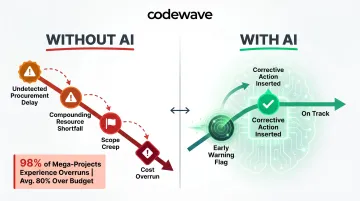
Most construction cost overruns don't happen suddenly. They build through undetected warning signs: a procurement delay that isn't flagged, a resource shortfall that compounds, a change order pattern that signals scope creep. McKinsey analysis found that 98% of mega-projects experience cost overruns, with the average increase at 80% of original value. When a project manager receives an AI-flagged risk three weeks earlier than manual detection would allow, the corrective action is cheaper, faster, and less disruptive.
AI also improves bid-stage cost estimation by analyzing comparable past projects—narrowing the gap between estimated and actual costs from the start. The 2023 KPMG survey found that 83% of respondents identified improving material and equipment estimating accuracy as their top priority.
KPIs impacted:
- Cost overrun rate
- Schedule variance
- Change order frequency
- Risk response time
- Estimate-to-actual accuracy
Predictive risk management delivers the highest impact on large, multi-phase projects with complex dependencies, tight margins, or high material cost volatility—where a single undetected risk can cascade across the entire timeline.
Advantage 2: Smarter Resource Allocation and Scheduling Optimization
AI optimizes how labor, equipment, and materials are assigned and sequenced across a project—reducing idle time, trade stacking, and last-minute reallocation decisions.
By learning from past project performance and monitoring current job signals in real time, AI systems:
- Forecast where labor or equipment shortfalls are likely to occur
- Recommend schedule adjustments before handoffs break down
- Optimize sequencing to protect critical path milestones
- Model multiple scenarios—testing different crew configurations, material delivery windows, or subcontractor sequences—to identify which plan is most resilient to disruption
Traditional scheduling depends on planner experience and fixed assumptions. AI introduces a dynamic model that adjusts as conditions change—catching imbalances before they affect the schedule.
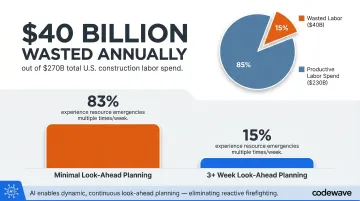
FMI's 2023 Labor Productivity Study puts the cost of this in stark terms: the U.S. construction industry loses $30–$40 billion annually to poor labor productivity. Of $270 billion spent on construction labor in 2022, roughly $40 billion was categorized as waste, with 60% of respondents reporting that 11% or more of field labor costs are wasted.
The planning gap compounds the problem. The same FMI study found that 83% of contractors doing minimal look-ahead planning experience resource emergencies multiple times per week—compared to just 15% among contractors who plan three or more weeks ahead.
KPIs impacted:
- Resource utilization rate
- Schedule adherence
- Labor productivity
- Equipment downtime
- Days lost to rescheduling
Scheduling optimization delivers the highest ROI on projects with multiple concurrent workstreams, complex subcontractor dependencies, or tight delivery windows—where small sequencing inefficiencies compound into significant delays.
Advantage 3: Real-Time Site Monitoring and Safety Compliance
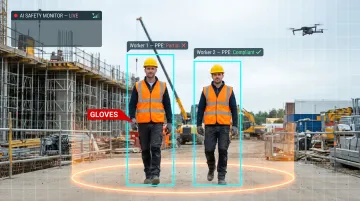
AI continuously monitors construction sites using computer vision, drones, IoT sensors, and wearables—giving project managers real-time visibility into safety conditions, work progress, and compliance gaps that would otherwise surface only through manual site walks or end-of-day reports.
Cameras and sensors feed data into AI systems that:
- Detect missing PPE and flag unsafe proximity to equipment
- Track work-in-progress against the BIM model
- Log compliance incidents automatically
- Provide a live, objective picture of site conditions across large or multi-site projects
Construction is one of the most hazardous industries in the country. According to the Bureau of Labor Statistics, 1,034 construction workers died on the job in 2024—roughly 1 in 5 of all U.S. workplace fatalities. The industry's fatality rate of 9.2 deaths per 100,000 FTE workers is nearly three times the national average of 3.3.
AI monitoring provides the consistency that human supervision cannot maintain across large jobsites. In a case study with Suffolk Construction and Smartvid.io, AI predicted 20% of all safety incidents over three years with 80% accuracy—and at higher sensitivity, 40% of incidents with 66% accuracy. With safety-related costs averaging $36,000 per incident, a firm running 50 projects annually stood to save an estimated $1.4–$3.6 million per year.
Beyond safety, AI-driven prevention reduces both direct costs (medical, legal, remediation) and indirect ones (work stoppages, crew morale). Real-time progress tracking through computer vision also catches scope drift and out-of-sequence work earlier, reducing rework and protecting schedule integrity.
KPIs impacted:
- Safety incident rate
- PPE compliance rate
- Rework cost
- Site audit frequency
- Progress-to-plan variance
Real-time monitoring delivers the highest value on large jobsites with multiple active trades, infrastructure or data center builds with strict compliance requirements, and projects where delayed progress visibility has historically caused schedule surprises.
What Happens Without AI in Construction Management
When construction projects rely entirely on manual data collection, lagging reports, and reactive decision-making, risks go undetected until they become delays. Cost overruns are only visible after budget lines are already breached. Safety incidents occur because hazards weren't flagged in time.
The data makes this concrete. According to PlanGrid and FMI's 2018 Construction Disconnected study, construction professionals spend only 65% of their time on productive work. The remaining 35%—roughly 14 hours per week—breaks down as follows:
- 5.5 hours hunting for project data
- 4.7 hours on conflict resolution
- 3.9 hours dealing with mistakes and rework
- 15.84 hours lost per week for project managers specifically to non-optimal activities
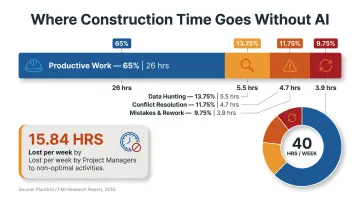
Without AI, teams spend more time collecting and reconciling data than acting on it. The result is reactive decision-making, inconsistent scheduling, and a management capacity that can't scale across multiple projects.
As project complexity and client expectations grow, this becomes a structural disadvantage. Firms operating without AI take longer to bid accurately, are slower to surface problems, and struggle to demonstrate consistent delivery — exactly where competitors with AI-driven workflows pull ahead.
How to Get the Most Value from AI in Construction
AI in construction delivers compounding returns when applied consistently and connected to actual project workflows—not deployed as a standalone module that teams bypass in favor of familiar manual processes.
Start with one high-friction area:
- Identify where delays in information cause the most expensive consequences: scheduling, risk tracking, or site monitoring
- Pilot on one project and measure impact against baseline KPIs
- Build adoption before expanding to additional workflows or projects
Review outputs and act on them regularly:
- Teams that use AI dashboards to brief weekly planning meetings or flag risks in OAC meetings extract far more value than those who treat it as background reporting
Integrate outputs into decision workflows:
- Connect predictive risk alerts to your existing risk register
- Link scheduling recommendations to resource allocation meetings
- Route safety flags directly to site supervisors
For construction firms ready to move beyond manual reporting, Codewave helps organizations build and integrate custom AI solutions across project management, site operations, and field data workflows—from predictive analytics architecture to real-time risk alerting.
Conclusion
Experienced construction teams don't get replaced by AI — they get better information, faster. Earlier risk flags, tighter resource allocation, and live site data mean decisions land before problems do, not after.
The three advantages covered—predictive risk management, resource optimization, and real-time monitoring—compound over time when applied consistently. Every project generates data that makes the next forecast more accurate, the next risk flag more precise, and the next resource recommendation more reliable. The practical starting point: pick one area — risk, resources, or monitoring — and measure the delta on your next project. That single dataset becomes the foundation for every improvement that follows.
Frequently Asked Questions
How can AI be used in construction project management?
AI is used across the full project lifecycle—from predictive risk scoring and automated scheduling in planning phases, to computer vision-based site monitoring and real-time progress tracking during construction. The goal is to help teams catch problems earlier and make better decisions faster.
What are the biggest challenges of adopting AI in construction?
The most common barriers are fragmented or poor-quality historical data that limits model accuracy, resistance from teams unfamiliar with AI tools, high upfront implementation costs for smaller firms, and the lack of standardized data collection practices across projects.
Does AI replace construction project managers?
No. AI supports project managers by processing more data, faster, than any individual can manage manually. Decisions involving contractor relationships, scope negotiation, site judgment, and stakeholder management still require human expertise.
How does AI improve construction site safety?
AI safety tools use computer vision, IoT sensors, wearables, and drones to monitor sites in real time—automatically flagging missing PPE, unsafe equipment proximity, and hazardous conditions to supervisors before incidents occur.
What types of AI are most commonly used in construction?
Machine learning is the most widely used AI type in construction—particularly for predictive analytics, cost estimation, and scheduling. Computer vision is increasingly used for site monitoring and progress tracking, while natural language processing is applied to contract review and RFI management.
How do I start implementing AI in my construction projects?
Start with one high-friction workflow—such as risk flagging, schedule forecasting, or site safety monitoring—rather than a full-platform overhaul. Pilot it on one project, measure the impact against baseline KPIs, then scale adoption based on what works.