Introduction
Every learner processes information differently, yet most educational systems still deliver identical content to entire classrooms, lecture halls, or training cohorts. This one-size-fits-all approach leaves fast learners bored and struggling students overwhelmed. AI-powered personalized learning solves this tension by adapting content, pace, and assessments to individual needs in real time.
Institution-wide AI adoption in higher education surged from 49% in 2024 to 66% in 2025, a 17-point jump signaling the shift from experimentation to strategic integration. Corporate L&D departments are moving in the same direction: 34% of companies have already implemented AI in training programs, with another 32% planning to deploy within two years. Together, these numbers reflect a decisive move away from standardized instruction toward learner-centric models built on machine learning, natural language processing, and adaptive algorithms.
This article breaks down how adaptive AI systems work, what the evidence says about their impact, where they're being deployed today, and what it takes to implement them responsibly.
What Is AI-Powered Personalized Learning?
Personalized learning tailors content, pace, and assessments to individual learner needs, strengths, and goals. Unlike traditional standardized instruction that treats every student identically—same lecture, same homework, same timeline—personalized approaches recognize that learners vary in prior knowledge, learning speed, preferred formats, and ultimate objectives.
Personalized learning vs. adaptive learning:
While often used interchangeably, these terms describe related but distinct concepts. Personalized learning is the broader pedagogical framework encompassing learner goals, interests, career aspirations, and contextual factors like accessibility needs.
Adaptive learning specifically refers to systems that modify content difficulty and sequence based on real-time performance data. AI enables both: it analyzes behavioral patterns to recommend relevant content (personalization) while adjusting challenge levels based on quiz scores and engagement signals (adaptation).
Why scaling was impossible before AI:
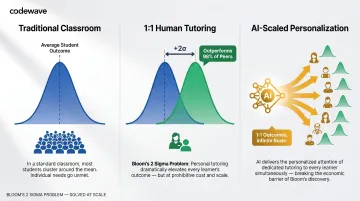
Benjamin Bloom's landmark 1984 study found that students tutored one-on-one performed two standard deviations better than classroom-taught peers—meaning the average tutored student outperformed 98% of conventionally taught peers. Bloom called this the "2 sigma problem": replicating 1:1 tutoring results at group scale. His conclusion? Individual tutoring is "too costly for most societies to bear on a large scale."
Teachers managing 30+ students can't realistically track all of this in parallel:
- Which concepts each student is struggling with
- Which topics they've already mastered
- What remediation or acceleration each person needs next
AI removes this bottleneck by automating analysis and adjustment at scale, making 1:1 tutoring economics viable for entire cohorts.
How AI Adapts Learning to Every Learner
The Data Layer
AI systems collect continuous learner data: quiz scores, time-on-task, interaction patterns, errors made, content skipped, mouse movements, and even keystrokes. This behavioral data becomes the raw input for personalization. The richness and granularity make AI-driven personalization a clear departure from traditional LMS tracking, which typically captures only completion status and final grades.
Modern adaptive platforms use xAPI (Experience API) standards to track learning events across systems. Whether a learner watches a video on one platform, completes a simulation in another, or discusses concepts in a forum, all events flow into a Learning Record Store (LRS), creating a unified behavioral profile.
Machine Learning Recommendation Engines
Adaptive algorithms function like the recommendation engines powering Netflix or Spotify. They map learner profiles to content by identifying patterns: if students who struggled with Topic A but excelled at Topic B benefited from Resource X, the system recommends Resource X to new learners showing similar performance patterns.
A scoping review of 69 studies found that 59% reported improved academic performance from personalized adaptive learning systems. The most effective interventions used adaptive difficulty adjustment, followed by adaptive scaffolding and remediation techniques.
Natural Language Processing for Assessment
NLP allows AI systems to understand free-text learner responses, evaluating written answers for depth of understanding rather than just keyword matching. Modern automated essay scoring systems assess:
- Coherence — how logically ideas connect across a response
- Argumentation structure — whether claims are supported with evidence
- Conceptual grasp — accuracy and depth of understanding beyond surface recall
This goes far beyond multiple-choice limitations. It also enables Socratic dialogue: instead of delivering direct answers, AI tutors ask probing questions that guide learners toward solutions while surfacing gaps in reasoning.
Retrieval-Augmented Generation for Trust
Generic AI chatbots trained on internet data risk hallucinations — confident but inaccurate responses. Retrieval-Augmented Generation (RAG) solves this by grounding AI outputs in curated course materials.
Dartmouth's NeuroBot TA study found students overwhelmingly trusted AI grounded in 145 instructor-curated documents over general-purpose chatbots. Among 190 medical students across two cohorts, 26.3% of feedback specifically cited "Trust and Reliability" as a key advantage. One student stated: "Knowing answers came from actual course materials rather than random internet data made all the difference."
The trade-off: 36.8% of feedback cited "Limited Scope" as a frustration, revealing tension between reliability and comprehensiveness.
Real-Time Path Adjustment
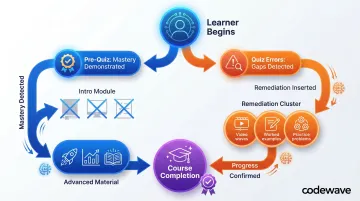
Adaptive AI recalibrates a learner's journey in real time: accelerating past mastered concepts, dwelling on weak areas, and inserting targeted remediation content — all without instructor intervention.
When a learner demonstrates mastery on a pre-quiz, the system skips introductory modules and routes directly to advanced material. When quiz errors reveal conceptual gaps, it inserts explanatory videos, worked examples, or practice problems before allowing progression. Every learner ends up on a distinct path, even within the same course.
Key Benefits of AI in Personalized Learning
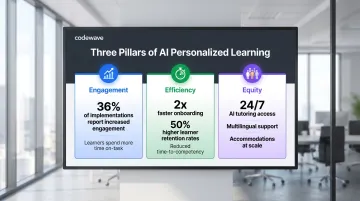
AI-powered personalization delivers measurable improvements across three pillars: engagement, efficiency, and equity.
Improved Learner Engagement and Retention
When content feels relevant to a learner's role, interests, or goals, engagement improves in ways generic content cannot replicate. A nursing student studying pharmacology sees clinical case studies from emergency care scenarios; a finance professional learning data analysis gets examples from equity markets, not manufacturing.
Gamification and adaptive challenges sustain motivation: the system increases difficulty when learners demonstrate readiness and provides scaffolded support when they struggle, maintaining flow state rather than frustration or boredom. Studies show 36% of adaptive learning implementations reported increased engagement, with learners spending more time on-task and completing courses at higher rates.
Faster Skill Development and Gap Closure
AI identifies and prioritizes skill gaps early—before they snowball—and routes learners toward targeted remediation. Traditional assessment models catch gaps only at fixed checkpoints: midterms, finals, annual reviews. By then, foundational misunderstandings are already embedded.
Adaptive systems diagnose gaps in real time and intervene immediately. This reduces time-to-competency, particularly in onboarding and upskilling contexts where speed directly impacts productivity. Codewave's adaptive learning implementations demonstrate 2x faster onboarding and 50% higher learner retention rates through personalized experiences that eliminate wasted time on already-mastered content.
Equity and Accessibility at Scale
AI personalization extends high-quality, individualized instruction beyond elite institutions. Dartmouth researcher Thomas Thesen noted that while Dartmouth enjoys low instructor-to-student ratios, many global institutions face overcrowded classrooms.
In those resource-constrained environments, AI tutoring tools provide the individual attention that would otherwise require far more staff than most institutions can afford.
Accessibility benefits extend to accommodations:
- Multilingual content generation for non-native speakers
- Text-to-speech and speech-to-text for students with reading or motor difficulties
- Adjustable difficulty and pacing for IEPs and 504 plans
- Alternative content formats (video, audio, interactive simulations) matched to learning preferences
These accessibility gains also extend to instructors. Real-time dashboards give educators visibility into progress across entire cohorts, and predictive analytics flag at-risk learners before they fall behind — shifting support from reactive to proactive.
Real-World Applications: AI Personalized Learning Across Contexts
K-12 Education
AI supports differentiated instruction in classrooms by leveling reading texts across Lexile ranges, generating standards-aligned assessments tailored to individual readiness, and embedding IEP/504 accommodations directly into curriculum materials.
KnowledgeWorks identifies educators using AI for differentiation and student agency. Teachers across grade levels use AI to:
- Generate alternative explanations for struggling students
- Create extension activities for advanced learners
- Automate progress tracking against individualized learning plans
- Analyze multi-step problem-solving to pinpoint specific conceptual breakdowns
Codewave builds adaptive learning platforms for K-12 institutions that adjust content difficulty and pacing in real time based on each student's demonstrated performance.
Higher Education and Professional Training
AI teaching assistants like Dartmouth's NeuroBot TA operate 24/7, grounded in curated course materials, supporting exam preparation and concept review at scale. This is particularly valuable in large lecture courses where one-on-one faculty time is limited.
The data shows how students actually used it: conversation volume jumped 329.6% in the three days before exams, primarily for fact-checking and quick reference rather than deep tutoring. Overall adoption reached 31.4%, with usefulness ratings of 2.8–3.3 out of 5 — a signal that tools designed around Socratic questioning may drive stronger engagement than passive answer delivery.
Corporate Learning and Development
AI personalization in enterprise training includes:
- Adaptive onboarding paths that skip content employees already know
- Automated skill gap detection through performance analytics
- Role-specific content recommendations aligned with career development goals
- Real-time performance insights for L&D teams
These capabilities cut wasted training hours and make learning investment more targeted. Codewave's corporate L&D solutions use xAPI data analytics to adjust course sequences and recommend targeted modules, achieving 60% reduced training costs through optimized learning paths.
Challenges and Ethical Considerations
Data Privacy Risks
AI personalization requires collecting detailed learner behavioral data, raising compliance obligations under FERPA (U.S. education records), GDPR (European data protection), and COPPA (children under 13 in the U.S.).
The FTC updated COPPA in April 2025, prohibiting indefinite retention of children's data for algorithm training and requiring separate parental consent to share data with third parties for AI development. Audio/voice data collected by AI tools must be deleted immediately after responding and cannot be used for training.
Before deploying any AI learning system, institutions need a data governance framework covering:
- Clear data retention policies
- Transparent disclosures about data usage
- User consent mechanisms compliant with applicable regulations
- Encryption and access controls protecting learner records
AI Bias and Hallucinations
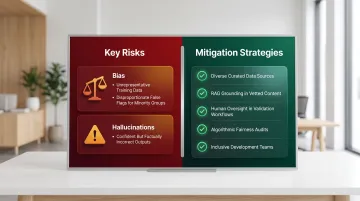
AI models trained on unrepresentative data perpetuate inequities in content recommendations. Wisconsin's AI dropout prediction system had a 42% higher false alarm rate for Black students than White students, flagging them as "high risk" at disproportionate rates despite similar actual outcomes.
Bias in training data isn't the only risk. Generative AI tools can also produce confident but factually wrong information — a separate failure mode that undermines learner trust. Addressing both requires:
- Curated data sources representative of diverse learners
- RAG-based grounding in vetted institutional content
- Human oversight in content validation
- Algorithmic audits to detect and mitigate bias
- Inclusive development teams reflecting learner demographics
Illusion of Mastery
Dartmouth researcher Thomas Thesen observed: "There is an illusion of mastery when we cognitively outsource all of our thinking and learning to AI, but we're not really learning." When learners use AI as an answer service without genuine cognitive engagement, they feel they've learned without retaining knowledge.
Well-designed AI personalization counters this by building in active engagement:
- Socratic questioning that guides rather than tells
- Spaced retrieval practice reinforcing long-term retention
- Reflection prompts encouraging metacognition
- Problem-solving challenges requiring application, not recall
The mode matters too: direct answers have a place during time-sensitive exam prep, but regular study sessions should default to guided inquiry — keeping learners in the cognitive driver's seat.
How to Build and Implement AI for Personalized Learning
Foundational Prerequisites
AI amplifies what's already in place—it doesn't replace sound instructional design. KnowledgeWorks identifies four essential personalized learning practices that must precede AI adoption:
- Designing for variability: Recognize different student experiences, strengths, and needs
- Establishing classrooms that support agency and independence: Create clear procedures and co-created norms
- Building ownership and mastery: Ensure students take responsibility for learning progress
- Purpose-driven design: Connect learning to meaningful outcomes
Institutions need clearly defined learning objectives, structured data collection practices, and existing pedagogical frameworks before deploying AI.
Build vs. Buy Decision
Organizations can integrate third-party AI learning platforms (faster deployment, lower upfront cost, less customization) or build custom AI solutions tailored to specific curriculum, learner populations, and institutional data.
Third-party platforms offer:
- Rapid implementation (weeks to months)
- Proven functionality and vendor support
- Lower initial investment
- Limited customization and data control
Custom builds provide:
- Complete control over data governance
- Model tuning for institutional priorities
- Proprietary content integration
- Tailored user experiences
Custom solutions require partners who understand both education and technology — not just the technical stack.
Key Technical Components
A custom AI personalized learning system requires:
- Learner data layer: LMS or xAPI integration that captures behavioral events across platforms and stores them in a Learning Record Store
- Recommendation engine: ML algorithms that analyze performance patterns to suggest next-best content, adjust difficulty, and flag remediation paths
- NLP module: Assesses free-text responses, enables Socratic dialogue, and delivers contextual feedback beyond multiple-choice limitations
- Analytics dashboard: Gives educators real-time visibility into cohort progress, at-risk learners, and content effectiveness — integrating with tools like Power BI or Tableau
Codewave has built AI solutions across 400+ businesses, including education clients, using QuantumAgile™ — a methodology that moves teams from concept to validated outcome in days, not months. That speed matters when you're piloting with live learners and need to iterate fast.
Implementation Checklist
- Define learner personas and data requirements — What behaviors need tracking? What privacy constraints apply?
- Choose or build the personalization engine — Third-party platform or custom development?
- Establish data privacy and compliance guardrails — FERPA, GDPR, COPPA compliance from day one
- Pilot with a defined cohort — Test with 50-200 learners before full rollout
- Measure outcomes against baseline — Track completion rates, assessment scores, time-to-competency, learner satisfaction
- Iterate based on feedback — Refine algorithms, content, and user experience
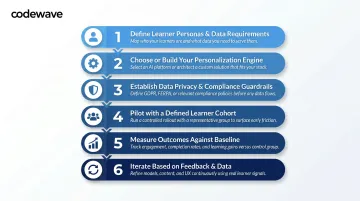
Measurement must be built into the plan from day one. Track baseline metrics before launch — otherwise, there's nothing to prove ROI against.
Frequently Asked Questions
How can AI personalize learning for students?
AI collects data on individual learner behavior, performance, and preferences, then uses machine learning algorithms to recommend content, adjust difficulty, and provide targeted feedback in real time. This creates a learning path unique to each student rather than a fixed curriculum everyone follows identically.
What is the difference between personalized learning and adaptive learning?
Personalized learning is the broader concept encompassing learner goals, interests, and preferences. Adaptive learning specifically refers to systems that modify content difficulty and sequence based on performance data. AI powers both, often within the same platform.
Can AI replace teachers in personalized learning environments?
No. AI is designed to augment teachers, not replace them. It handles data analysis, content recommendations, and routine feedback so educators can focus on higher-order instruction, emotional support, and complex problem-solving that requires human judgment and empathy.
What are the biggest challenges of implementing AI for personalized learning?
Three challenges stand out: data privacy compliance (FERPA, GDPR, COPPA), the risk of AI bias or hallucinated content when systems aren't grounded in curated materials, and passive consumption replacing active learning when tools don't require genuine cognitive engagement. Addressing all three requires deliberate platform design, not just policy.
How do institutions measure the ROI of AI personalized learning?
Start by establishing baseline metrics before deployment: completion rates, assessment scores, time-to-competency, and learner satisfaction. Track the same metrics post-implementation and supplement with qualitative signals like instructor time savings and learner feedback. Together, these give a complete picture of what the system is actually delivering.
Ready to build AI-powered personalized learning for your organization? Codewave builds custom adaptive learning solutions for K-12, higher education, and corporate L&D teams. Schedule a consultation to talk through your specific use case.