

Introduction
Traditional pricing models charge for access, time, or inputs—you pay for a software license whether you use it, for consulting hours whether they produce results, or for API calls whether they drive revenue. Outcome-based pricing reverses this logic: payment is triggered only when a specific, agreed-upon business result is delivered.
The numbers back this up. 77% of business leaders report customers increasingly demanding outcome-based pricing, yet only 32% of businesses currently define "usage" as a specific outcome in their pricing models, according to Stripe's 2025 research.
That gap creates both opportunity and urgency. Companies that solve the measurement problem gain competitive advantage, while those relying on promise-based models risk losing deals to competitors who align cost with verified value.
This article covers what outcome-based pricing is, how it works step by step, where it fits compared to other models, and the conditions that make it the right (or wrong) choice for your business.
Key Takeaways
- Outcome-based pricing charges only when measurable results are delivered, shifting performance risk from buyer to vendor
- Payment hinges on precise outcome definitions, measurement infrastructure, and clear attribution rules
- Hybrid models (base fee plus per-outcome variable) reduce revenue volatility while preserving performance incentives
- Works best when outcomes are measurable, attributable, and the vendor controls execution
- Directly addresses the $19.8M average annual SaaS waste enterprises absorb from unused capacity
What Is Outcome-Based Pricing?
Outcome-based pricing is a model where payment is triggered only when a specific, agreed-upon business result is delivered—not when a product is accessed, a seat is assigned, or usage is logged. The defining feature is shared risk: if the result doesn't materialize, neither does the charge.
Contrast this with traditional models:
- Seat-based pricing: Pay per user regardless of activity (dropped from 21% to 15% of companies in a single year, per HighRadius)
- Consumption-based pricing: Pay per API call, transaction, or compute hour regardless of whether those actions produce business value
- Outcome-based pricing: Pay only when the defined result occurs—a resolved ticket, a fraud-free transaction, an uptime hour
Four Core Principles
These four principles separate outcome-based pricing from every other model:
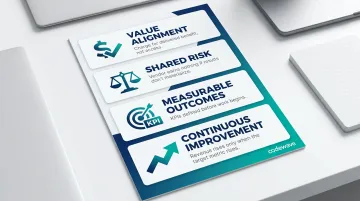
- Value alignment: Charge for delivered benefit, not provisioned access. A support automation vendor charges per ticket resolved—not per seat licensed.
- Shared risk: Vendor and buyer are co-invested in success. If results don't materialize, the vendor earns nothing. This eliminates the dynamic behind shelfware—enterprise organizations waste $19.8M annually on unused SaaS licenses, according to Zylo's 2026 data.
- Measurable outcomes: KPIs are defined before work begins. Vague targets like "improved customer experience" don't qualify; "ticket closed and not reopened within 72 hours" does.
- Continuous improvement incentive: Revenue rises only when the target metric rises, so vendors stay focused on performance long after launch—not just at the point of sale.
Industry Applications
Outcome-based pricing already operates across sectors:
- Healthcare: CMS value-based care programs tie hospital reimbursement to readmission rates and patient safety metrics rather than service volume (CMS.gov)
- Manufacturing: Rolls-Royce's "Power by the Hour," launched in 1962, charges airlines per engine uptime hour—operators pay only for engines that perform (Rolls-Royce)
- SaaS: Intercom Fin charges $0.99 per resolved support ticket on a $49/month base plan (Intercom)
- Fintech: Riskified charges only for successfully approved, fraud-free transactions (L.E.K. Consulting)
- Consulting/Marketing: Fees tied to qualified leads generated or measurable revenue lift
How Outcome-Based Pricing Works
Step 1 — Define the Outcome and Success Criteria
Before any contract is signed, both parties must agree in writing on the exact result that triggers payment. Ambiguity is the most common source of disputes later.
What "defined" means in practice:
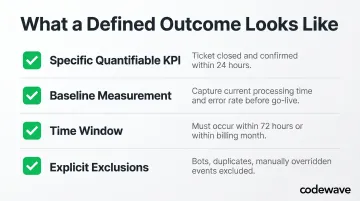
- Specific, quantifiable KPI: "Support ticket closed and customer confirms resolution within 24 hours" (Intercom Fin's definition) — not vague language like "customer satisfied"
- Baseline measurement: Document current performance before go-live — if you're automating invoice processing, capture today's average processing time and error rate
- Time window for measurement: Specify when the outcome must occur (within 72 hours, within the billing month, before contract renewal)
- Explicit exclusions: Define what doesn't count—duplicate events, bot traffic, test transactions, tickets where customer explicitly requests a human
Example: A fraud prevention platform might define a billable outcome as "transaction approved by AI model, processed successfully, and not flagged as fraudulent within 90 days." This excludes transactions the client manually overrode, duplicate submissions, and chargebacks from non-fraud reasons.
Step 2 — Build a Measurement and Attribution System
Real-time tracking infrastructure is essential — both parties need independent verification that outcomes occurred, or billing disputes become inevitable.
Required components:
- Event logs: Product telemetry capturing every outcome-triggering event with timestamp, user ID, and context
- API integrations: Connect your system to the client's CRM, support platform, or payment processor to capture outcomes at source
- IoT sensors (for industrial applications): Rolls-Royce's TotalCare monitors engine performance in real-time via onboard sensors
- Shared dashboards: Both vendor and client see the same counts, updated live, with drill-down to individual events
Attribution matters: When multiple systems or teams contribute to a result, the contract must specify who gets credit. If a support ticket is partially resolved by AI then handed to a human agent, does the AI vendor get paid? Define this upfront with rules like "AI gets credit if it resolves 80%+ of the issue before handoff."
When counts don't match at month-end, shared auditable logs are what resolve the disagreement in hours rather than weeks.
Step 3 — Set a Value-Aligned Pricing Structure
Anchor your per-outcome rate to the economic value that outcome delivers to the buyer.
Pricing logic example: If an automated support resolution saves $5 compared to a human agent handling the same ticket, a $0.99 fee (Intercom's rate) captures roughly 20% of the value created—defensible because the buyer still nets $4 in savings.
Hybrid structures de-risk volatility:
- Base fee + variable: A $12,000 annual platform fee (covering 2x delivery costs) including 100 ticket resolutions, with additional resolutions priced at $5,000 per 100 tickets (Bessemer)
- Minimum commitments: Contractual minimums ensure baseline revenue even if client volume drops seasonally
- Caps: Upper limits prevent runaway costs for buyers during unexpected volume spikes
- Volume discounts: Per-outcome rate decreases as monthly volume exceeds thresholds
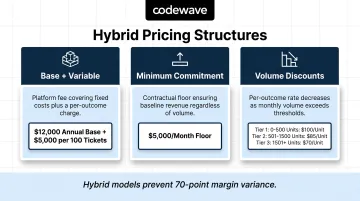
Margin protection: One customer engagement vendor experienced margin variance exceeding 70 percentage points across accounts due to variable AI costs (BCG). Hybrid models prevent this from becoming unsustainable.
Step 4 — Formalize the Contract with Precise Terms
The agreement must specify beyond the outcome definition:
- Billing cadence: Monthly in arrears based on confirmed outcomes, or weekly reconciliation?
- Attribution rules: Documented logic for edge cases (partial outcomes, multi-touch attribution, outcomes influenced by external campaigns)
- Outage handling: What happens if your system is down for 48 hours—does the clock stop on SLA commitments?
- External disruptions: Client pauses marketing campaigns for two months—how does this affect minimums?
- Dispute resolution: Process for reconciling count discrepancies (third-party audit, escalation path, binding arbitration clause)
- Termination conditions: Notice period, wind-down procedures, final outcome reconciliation process
Getting these terms right at signing is far cheaper than negotiating them mid-engagement when volume—and the stakes—are higher.
Step 5 — Align Internal Teams and Operations
Outcome-based pricing requires operational changes well beyond the sales team:
- Finance: Replace fixed MRR forecasting with scenario-based models covering low, medium, and high outcome volumes
- Sales compensation: Decide whether reps are paid on contract signature or trailing outcome delivery — and document it
- Product and engineering: Treat the outcome metric as a first-class product KPI; if revenue depends on resolution rate, that drives sprint priorities
- Legal: Build contracts with proper indemnification, liability limits for factors outside vendor control, and explicit measurement standards
When finance models fixed revenue while product optimizes a different metric, the model breaks down fast — usually within the first quarter.
Output-Based vs. Outcome-Based Pricing: Key Differences
The difference between these two models comes down to what triggers payment. Output-based pricing charges for deliverables produced—hours logged, reports generated, lines of code written, features shipped—regardless of whether those outputs create measurable business value. Outcome-based pricing charges only for the downstream business result those outputs were meant to produce.
Example pair:
- Output-based: A software agency bills $20,000 per two-week sprint, delivering 15 user stories regardless of whether conversion rates improve
- Outcome-based: The same agency bills $5,000 per percentage-point increase in conversion rate, earning nothing if the shipped features don't move the metric
When Output-Based Pricing Is Still Right
Output-based pricing remains appropriate for:
- R&D and proof-of-concept phases where outcomes are genuinely unpredictable
- Projects where the client controls the variables that determine success (a design agency can't control whether the client's sales team closes deals, so charging per mockup delivered makes sense)
- Creative services where value is subjective—branding, content creation, work where "engagement" definitions shift by stakeholder
The real question is accountability: who controls the levers that move the result? When the vendor owns execution and the outcome driver—such as application performance, automation accuracy, or conversion logic—outcome-based pricing is a fair trade. When the client controls downstream factors like sales team behavior or marketing spend, output-based billing protects both sides.
Key Benefits of Outcome-Based Pricing
Lower Barrier to Adoption and Reduced Upfront Risk for Buyers
Buyers don't need to commit large capital to promise-based contracts. Spend tracks directly to delivered value, making it easier for finance teams to approve and for internal champions to defend.
44-46% of enterprise SaaS licenses go unused, wasting an average of $17-19.8M per organization annually (Zylo 2023 and 2026). 70% of SaaS contracts were renewed in 2023 despite being underutilized. Outcome-based pricing eliminates payment for shelfware — the invoice only reflects what actually worked.
Built-In Performance Incentives for the Vendor
Because revenue rises only when the target metric rises, the vendor's engineering, product, and customer success teams are all pointed at the same goal.
Seat-based vendors actually lose revenue when their product delivers the most value — a structural flaw that outcome pricing corrects. AI agents now automate tasks that previously required 10-50 human employees per department, and 40% of IT buyers use "seat reduction" to actively decrease software spending (BCG). Companies that stick with seat-based pricing for AI products see 40% lower gross margins and 2.3x higher customer churn rates than competitors using outcome or usage-based models (HighRadius).
Intercom Fin's $0.99-per-resolution model forced the team to A/B test toward better resolution rates — revenue followed performance, not seat expansion.
Cleaner ROI Conversations and Invoice Justification
When every invoice maps to a business metric — resolved tickets, fraud-free transactions, uptime hours — procurement and finance don't need slide decks to justify renewal.
What this looks like:
- Traditional SaaS: "We paid $120,000 for 50 seats. Utilization is unclear. Value is a 40-slide business case."
- Outcome-based: "We paid $45,000 for 10,000 resolved tickets. Average ticket value saved: $5. Net ROI: $50,000."
That kind of math closes renewal conversations in a single email.
Revenue That Scales with Customer Success
Unlike flat-fee models that cap revenue even when a product drives outsized results, outcome pricing lets the vendor share in the upside as outcomes increase.
Example: A customer handling 500 support resolutions/month with Intercom Fin pays $494.50 ($49 base + 450 additional outcomes at $0.99). At 5,000 resolutions/month, that grows to $4,945.50 — directly proportional to value delivered.
For AI products that improve with usage volume, this creates a compounding revenue curve: better results drive more usage, which funds further improvement.
Stronger, Trust-Based Partnerships
Both parties need shared dashboards, agreed definitions, and mutual accountability — this transparency, baked in by design, tends to produce better long-term relationships than traditional vendor-client dynamics.
The relationship shifts from "vendor delivering to contract" to partners pursuing a shared KPI. In practice, that means joint quarterly business reviews against agreed metrics, co-owned definitions of what counts as a successful outcome, and vendors who proactively flag underperformance rather than wait for renewal to surface it.
Common Challenges and How to Navigate Them
Challenge 1 — Defining and Attributing the Right Outcome
Choosing a metric that's specific enough to measure but broad enough to capture real value is harder than it looks.
Too vague: "Improved customer experience" is unmeasurable. Too narrow: "Form submitted" may not reflect impact if 90% of submissions are spam. Right scope: "Qualified lead submitted, verified by sales, and contacted within 48 hours" captures value and filters noise.
Attribution complexity: Business results rarely have a single cause. Seasonality, marketing campaigns, competitor moves, and customer behavior all influence numbers alongside the vendor's work.
Solution:
- Explicit attribution rules in the contract: Define what percentage of credit the vendor receives when multiple factors contribute
- Auditable event-level data: Not just summary reports—drill down to individual transactions with timestamps, source, and context
- Control group baselines where feasible: Measure performance in accounts with and without the vendor's solution to isolate impact
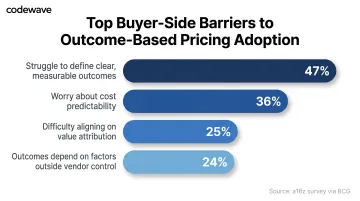
Buyer-side barriers (from a16z survey cited in BCG):
| Barrier | % of Buyers Affected |
|---|---|
| Struggle to define clear, measurable outcomes | 47% |
| Worry about cost predictability | 36% |
| Difficulty aligning on value attribution | 25% |
| Outcomes depend on factors outside vendor control | 24% |
Challenge 2 — Revenue Volatility and Forecasting Difficulty
Solving attribution is only half the equation. Even with clean metrics, vendors face a structural problem: income swings with customer performance. A seasonal dip, an implementation delay, or a client pausing campaigns can all cut outcomes — and revenue along with them.
Practical mitigation tools:
- Set minimum commitments — contractual floors that guarantee baseline revenue regardless of outcome volume (e.g., $5,000/month floor)
- Use a hybrid base+variable structure — a light base fee covers fixed costs; the variable component captures upside (Intercom's $49 base + $0.99/resolution is a live example)
- Build in caps and circuit breakers — upper limits that protect buyers from runaway costs during unexpected volume spikes
- Run scenario-based financial models — stress-test cash flow against low, medium, and high outcome projections before signing
Note: Pure outcome-based pricing with no floor is rarely sustainable. The Bessemer model explicitly targets a 2x delivery cost coverage ratio in the base fee to protect vendor margins.
Challenge 3 — Longer and More Complex Sales and Legal Cycles
Once you've stabilized the revenue model, the sales process becomes the next friction point. Outcome-based contracts require aligning on baselines, measurement methods, and edge-case handling before any work begins — pulling in legal, procurement, and finance, and stretching timelines in the process.
Mitigation:
- Start with a narrow pilot use case with a lighthouse customer willing to co-develop the model
- Document the framework once, then template it for subsequent deals
- Use standard outcome definitions where possible (resolved ticket, fraud-free transaction) rather than custom metrics for every client
- Build proof before scaling broadly: Demonstrate the model works in one account before pitching it to your entire customer base
Contract lengths are already shrinking: sub-1-year contracts grew from 4% of new deals in 2023 to 13% in 2026, while three-year deals fell from 28% to 23% (SaaStr/ICONIQ). Outcome-based models fit this shift naturally — buyers get flexibility; vendors get contracts tied to performance they can actually verify.
When to Use Outcome-Based Pricing
Condition 1 — The Outcome Is Clearly Measurable and Attributable
Outcome-based pricing works best when the business result can be tracked in near-real-time, attributed to the vendor's contribution with reasonable confidence, and expressed as a number a CFO would recognize.
Strong outcome metrics by industry:
| Industry | Outcome Metric | Example Provider |
|---|---|---|
| SaaS/CX | Resolved support tickets | Intercom Fin ($0.99/resolution) |
| Fintech/Fraud | Fraud-free transactions approved | Riskified (chargeback guarantee) |
| Fintech/KYC | Successfully verified users | iDenfy |
| Healthcare | Hospital readmission rates | CMS HRRP program |
| Legal AI | Completed demand letters | EvenUp |
| Logistics | On-time delivery rates | U.S. DoD PBL contracts |
Poor fit: Metrics where attribution is murky—"brand awareness lift," "employee satisfaction improvement," or outcomes heavily dependent on factors outside the vendor's control (client's sales team performance, macroeconomic conditions, regulatory changes).
Condition 2 — The Vendor Has Strong Delivery Confidence and Data Infrastructure
A vendor should only offer outcome-based pricing if they have:
- Enough track record to estimate outcome rates reliably (you've delivered this result for 20+ clients and know typical ranges)
- Enough data infrastructure to measure in real-time with event-level granularity
- Enough operational capacity to deliver at scale without eroding margins
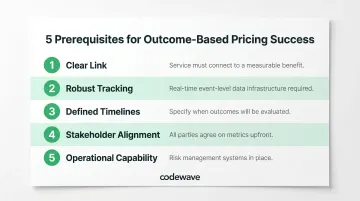
Prerequisites for success (L.E.K. Consulting):
- Clear link between service and measurable benefit
- Robust tracking systems
- Defined timelines for outcome evaluation
- Stakeholder alignment on metrics
- Operational capability and risk management systems
Example: Codewave's ImpactIndex™ model structures outcome-based engagements where clients pay for measurable results—data accessibility improvements, processing speed gains, cost reductions. Both sides define KPIs before work begins, and Codewave's technical infrastructure tracks those outcomes in real time—making it possible to tie revenue directly to results.
Condition 3 — The Buyer Has Some Skin in the Game
Pure "zero upfront risk" models often fail because clients with no investment have less motivation to cooperate, provide access, or prioritize the engagement.
Best practice: Combine an outcome-based variable fee with a small base retainer or cost-of-setup investment, ensuring both parties are committed.
Common structures that balance risk:
- Base fee covering 2x delivery costs + variable per-outcome charges
- Setup fee ($10,000-$25,000) to configure systems and integrations, then pure outcome billing after launch
- Minimum monthly commitment ($5,000 floor) regardless of outcomes
This ensures the vendor doesn't carry 100% of the risk while still preserving the performance-alignment benefits of outcome pricing.
Condition 4 — When NOT to Use It
Outcome-based pricing is a poor fit for:
- Exploratory R&D where outcomes can't be predicted (early-stage product development, innovation labs)
- Projects where the buyer controls most variables that affect results (marketing agency can't control whether client approves campaigns on time or provides accurate targeting data)
- Early-stage relationships with no baseline data (you haven't delivered this outcome before, so you can't price it reliably)
- Highly regulated industries where payment structures face legal constraints (some healthcare reimbursement models, government contracts with fixed-price requirements)
If your situation doesn't meet at least Conditions 1 and 2, a hybrid or milestone-based model will likely serve both parties better.
Frequently Asked Questions
What are outcome-based pricing models?
Outcome-based pricing is a model where payment is tied to specific, measurable business results—resolved tickets, fraud-free transactions, uptime hours—rather than product access, usage volume, or time spent. It redistributes performance risk from buyer to vendor, ensuring vendors earn revenue only when they deliver verified value.
What is an example of an outcome-based model?
Intercom's Fin AI agent charges $0.99 per successfully resolved support ticket (with a $49/month base fee including 50 resolutions). Rolls-Royce's "Power by the Hour" charges airlines per engine uptime hour, aligning payment with operational performance rather than parts sold or service hours logged.
What is the difference between output and outcome-based pricing?
Output-based pricing charges for work delivered—hours, features, reports—regardless of business impact. Outcome-based pricing charges only for the downstream business result that work produces. The distinction matters most when the vendor controls execution but the buyer controls variables that drive results, making attribution critical.
Why do customers prefer an outcome-based pricing model?
Buyers favor outcome-based pricing because it lowers financial risk and keeps vendors accountable. Three reasons it wins preference:
- Lower upfront risk: No payment for promises — only for verified results
- Finance-friendly invoices: Costs tie directly to a business metric (for example, "$0.99 per resolved ticket")
- Sustained vendor focus: Vendors stay performance-driven throughout the engagement, not just at contract signing
What are the 4 types of pricing strategies?
The four common pricing strategies are:
- Cost-based: Price = cost + margin
- Competitive/market-based: Price matches what competitors charge
- Value-based: Price reflects customer willingness to pay
- Outcome/results-based: Price tied to verified performance
Outcome-based pricing is the most advanced form of value-based pricing, requiring proven delivery before payment rather than estimated value upfront.