Introduction
Last-mile delivery accounts for 53% of total shipping costs as of 2023—up from 41% in 2018—making it the most expensive segment in modern logistics. Yet it's also the most visible to customers, where a single failed delivery can erase weeks of brand goodwill. This gap between ballooning costs and rising customer expectations is one that traditional route planning tools weren't built to close.
This article explores how AI agents—autonomous, adaptive systems that make real-time decisions—are reshaping how companies plan routes, predict demand, handle exceptions, and improve delivery outcomes at the final mile. We'll also walk through a practical deployment path—from initial pilot to measurable business results.
TLDR
- AI agents make autonomous, real-time decisions across routing, dispatch, and customer communication—unlike rule-based tools locked into fixed logic
- The biggest gains come from dynamic route optimization, predictive demand forecasting, and automated customer experience management
- Documented results include $300–$400 million in annual savings (UPS ORION) and a 20% cost reduction (DHL)—with Tesco cutting fuel consumption per order by 8%
- Successful implementation starts with data readiness and a controlled pilot—not a system-wide rollout
- Codewave designs and implements AI agent systems for logistics and transportation companies, with results tied to measurable business outcomes through the ImpactIndex™ model
Why Last-Mile Delivery Is a Problem That Demands AI
Core Operational Challenges
Last-mile delivery operators face compounding complexity that scales exponentially with volume:
- Fragmented stop density — Urban routes may have 150+ stops per day with varying distances, creating billions of possible route permutations
- Unpredictable demand spikes — Seasonal peaks, local events, and weather patterns create volume surges that outpace static planning capacity
- Failed delivery attempts — Industry-wide first-attempt failure rates range from 8-20%, with each failed delivery costing approximately $17.20-$17.78 to reattempt
- Real-time visibility expectations — 91% of consumers actively track packages, with 19% checking multiple times daily
- Escalating cost pressure — Labor constitutes 50-60% of last-mile costs, while fuel represents 10-25%—both rising faster than shipping rates
Why Traditional Tools Fail
Rule-based route planning systems optimize once at dispatch—typically between 5-7 AM—based on known variables. They cannot adapt when:
- 40 vehicles need rerouting after a sudden road closure mid-shift
- Same-day orders arrive at 11 AM and need immediate insertion into active routes
- Driver no-shows require redistributing 200+ stops across a reduced fleet
- Real-time traffic updates reveal a faster alternative route that wasn't available at dispatch
These systems execute predetermined logic. They don't perceive, decide, or learn.
Market Scale and Urgency
The global last-mile delivery market was valued at $132.71 billion in 2022 and is projected to reach $258.68 billion by 2030 at a CAGR of 8.8%. E-commerce growth, urbanization, and same-day delivery expectations are all accelerating this expansion simultaneously.
For carriers and retailers, the math is unforgiving: margins shrink as volume grows, and static planning tools don't scale. Closing that gap requires systems that can respond in real time—not just plan in advance.
What Are AI Agents—and How Are They Different from Basic Automation?
Defining AI Agents in Last-Mile Context
AI agents are autonomous software systems that continuously:
- Perceive live data inputs (GPS telematics, traffic feeds, order arrivals, customer signals, vehicle diagnostics)
- Decide independently based on current conditions and predicted outcomes
- Act by updating routes, dispatching vehicles, communicating with customers, or escalating exceptions
- Learn from outcomes to improve future performance
Contrast with rule-based automation:
| Rule-Based Tools | AI Agents |
|---|---|
| Execute fixed "if-then" logic | Adapt decisions based on real-time context |
| Optimize once at dispatch | Continuously reoptimize throughout the day |
| Cannot handle unforeseen events | Detect anomalies and respond autonomously |
| Require manual updates for new scenarios | Learn from outcomes and refine models |
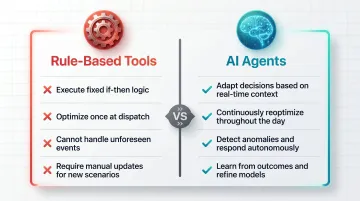
That contrast matters at the architecture level too—because real-world last-mile deployments don't rely on a single agent.
Multi-Agent Architecture for Last-Mile Delivery
Advanced deployments use specialized agents that exchange data and coordinate toward shared delivery outcomes:
- Routing agents — Recalculate optimal stop sequences across the fleet based on live traffic, time windows, and vehicle capacity
- Demand forecasting agents — Predict volume spikes 3-7 days in advance using historical patterns, seasonality, local events, and weather
- Dispatch coordination agents — Dynamically assign new orders to the best available driver based on current location, remaining capacity, and route feasibility
- Customer communication agents — Generate real-time notifications, dynamic ETAs, and handle routine inquiries without human input
Each agent operates autonomously within its domain, but all share data feeds and coordinate decisions—like a delivery center where each role communicates continuously rather than working in isolated silos.
Human-in-the-Loop Model
AI agents handle high-frequency operational decisions autonomously. That includes:
- Route updates every 2-5 minutes
- Automatic ETA recalculations
- Standard customer notifications
Strategic overrides, sensitive exceptions (customer complaints, damaged goods), and edge cases stay with human operators, who receive full context alongside AI-generated recommendations. Human expertise concentrates where it matters most: judgment calls, relationship-sensitive situations, and decisions that carry real consequence. Automation handles the rest at speed and scale.
Key Ways AI Agents Optimize Last-Mile Delivery
Intelligent Route Optimization and Real-Time Dispatch
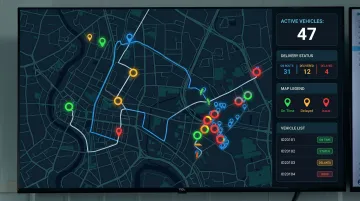
Routing AI agents ingest live traffic data, delivery time windows, vehicle capacity, driver location, and stop priorities to generate optimal routes. Unlike static morning plans, routes are recalculated continuously throughout the delivery day.
UPS ORION (On-Road Integrated Optimization and Navigation) is the most documented deployment:
- Optimizes routes for 55,000 U.S. drivers making 100+ deliveries each daily
- Reduces 6-8 miles per driver per day on average
- Saves 100 million miles and 10 million gallons of fuel annually
- Delivers $300-$400 million in annual cost savings and avoids 100,000 metric tons of CO₂ emissions
Dynamic reoptimization in action:
When a road closure, failed delivery attempt, or new urgent order arrives, the agent instantly recalculates affected routes across the entire fleet. A delivery that was scheduled as stop #47 might shift to #22, while three nearby drivers receive updated sequences, all within seconds.
Manual replanning cannot match this speed or scale. Static plans degrade by 20-30% throughout the day as real-world deviations accumulate — which is exactly the problem continuous reoptimization solves.
Predictive Analytics for Demand, ETAs, and Fleet Maintenance
Demand forecasting:
AI agents analyze historical order patterns, seasonality, local events (concerts, sports games, holidays), and weather forecasts to predict volume spikes 3-7 days in advance. This enables:
- Smarter fleet sizing (rent additional vehicles only when needed)
- Optimized driver scheduling (avoid overtime or idle capacity)
- Inventory pre-positioning at micro-fulfillment nodes (small local warehouses) closer to anticipated demand
ETA accuracy:
Instead of static 2-hour delivery windows, AI agents generate dynamic ETAs that update continuously as routes evolve. Customers receive notifications like "Your package will arrive between 2:47 PM and 3:12 PM" that adjust based on the driver's actual progress.
Why this matters: 85% of online shoppers say a poor delivery experience would prevent them from ordering again. Accurate ETAs reduce "where is my order" contact center volume and improve satisfaction without adding operational cost.
Predictive vehicle maintenance:
Telematics data fed into an AI agent can flag components approaching failure (brake wear, battery health, tire pressure) before breakdowns happen mid-route. The average cost of downtime for a commercial vehicle runs $448-$760 per day, so catching failures before they happen translates directly to avoided costs and fewer stranded drivers.
Customer Experience and Real-Time Delivery Visibility
The same predictive infrastructure that optimizes fleet operations also drives the customer-facing experience. AI agents handle:
- Automated, context-aware notifications at delivery milestones (dispatched, out for delivery, 10 minutes away, delivered)
- Real-time tracking feeds with live map updates and dynamic ETAs
- Dynamic re-slotting when delays occur, offering alternative delivery windows automatically without requiring customer service intervention
The hybrid model:
AI handles routine communication and status updates autonomously. Complex issues (wrong address, access problems, damaged packages) are escalated to human agents with full delivery context already surfaced, preserving satisfaction without adding headcount.
Smart Infrastructure: Address Validation and Load Optimization
Address validation:
AI agents cross-reference entered addresses against postal databases and historical delivery records before dispatch, automatically flagging incomplete or incorrect data and triggering customer correction workflows.
The impact is significant: 41-45% of failed first-attempt deliveries trace back to address errors. Catching bad data at checkout prevents costly reattempts before they happen.
Load optimization:
AI agents analyze package dimensions, weights, and delivery sequences to generate optimal vehicle loading configurations, ensuring the first stop's package is loaded last. This reduces mid-route rearrangement time at each stop, cutting 3-5 minutes per delivery in dense urban routes.
Measurable Business Outcomes from AI-Powered Last-Mile Operations
Cost Reduction and Efficiency
Validated operator results from named deployments:
- UPS ORION: $300–$400 million annual cost savings at full deployment
- DHL Greenplan: Approximately 20% cost reduction in last-mile operations
- Tesco: 8% fuel consumption reduction per order, 11.2 million miles saved annually
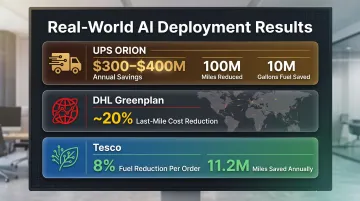
These gains come from direct savings (fuel, labor hours, vehicle utilization) and indirect savings (fewer failed deliveries, lower customer service costs, reduced overtime).
Codewave's AI deployments in transportation and logistics have delivered outcomes including 40% productivity increases and 25% cost reductions, structured through the ImpactIndex™ outcome-based model where results are validated before scaling investment.
Those efficiency gains also compound into measurable environmental impact.
Sustainability and ESG
Route optimization and stop consolidation directly reduce vehicle kilometers driven and fuel burned. UPS ORION avoids 100,000 metric tons of CO₂ annually. The Netherlands achieved 100 grams CO₂ per parcel in 2024—a 56% reduction from 230 grams in 2018.
Sustainability metrics (CO₂ per parcel) are increasingly tracked alongside operational KPIs and reported in ESG frameworks by major operators including UPS, DHL, and FedEx.
Customer Satisfaction and Retention
Delivery experience impacts loyalty:
- 57.44% of customers would not reorder if a package never arrived
- 31.9% would not buy again due to late deliveries
- 23% refuse to reorder after a failed delivery
AI-powered ETA accuracy and proactive communication reduce these failure modes, protecting customer lifetime value.
Operational Scalability
AI agents allow companies to absorb volume growth — including peak season spikes and geographic expansion — without proportional increases in dispatcher headcount or fleet size. The system scales computationally, enabling 30–40% volume increases with minimal additional fixed costs.
How to Deploy AI Agents for Last-Mile Delivery: A Practical Roadmap
Phase 1: Data Readiness Audit
Before any AI agent deployment, map all data sources:
- Transportation Management Systems (TMS)
- Warehouse Management Systems (WMS)
- ERP systems
- GPS telematics
- Customer records
- Historical delivery data
Assess each source for accuracy, completeness, freshness, and format consistency. Poor data quality is the most common reason AI routing underperforms—clean, standardized data inputs are a prerequisite, not an afterthought.
Key questions:
- Are addresses standardized and validated?
- Is GPS data updated in real-time (every 30-60 seconds)?
- Do historical records include failed delivery reasons?
- Are time windows accurately recorded?
Phase 2: Scoped Pilot with Controlled Measurement
Select a single distribution center or route cluster for initial deployment. Define KPIs upfront:
- Cost per parcel
- On-time delivery rate
- Failed delivery rate
- Fuel consumption per route
- Driver idle time
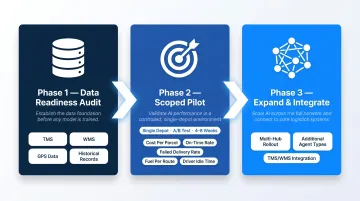
Run an A/B comparison against a control group using traditional methods. Keep the pilot tight (4-8 weeks) so results are attributable and rollback is simple if needed.
Phase 3: Expand, Integrate, and Automate
After validating pilot results, expand the agent system to additional hubs and layer in new agent types:
- Demand forecasting agents
- Customer communication agents
- Predictive maintenance agents
Integrate with customer-facing tracking tools and existing TMS/WMS platforms. The iterative model improves as agents accumulate more delivery outcome data, with accuracy typically increasing 15-25% within the first 90 days as the system learns from real-world patterns.
This is where implementation approach matters. Codewave's QuantumAgile™ methodology moves organizations from concept to validated AI agent outcomes in a matter of weeks, building custom ML models trained on client-specific delivery patterns and integrating directly with existing TMS, WMS, and carrier APIs — rather than adapting generic tools to operations they weren't built for.
Frequently Asked Questions
What is the role of AI in optimizing last-mile delivery?
AI analyzes real-time data across traffic, orders, vehicle status, and customer signals to make and continuously update routing, dispatch, and communication decisions—reducing costs, failed deliveries, and delivery times simultaneously without requiring manual intervention.
How to optimize last-mile delivery?
Core levers include dynamic route optimization, predictive demand planning, address validation, load sequencing, and real-time customer communication. AI agents coordinate all of these in parallel, producing efficiency gains that isolated point tools typically cannot match.
Can AI find the quickest route for delivery drivers?
AI routing agents continuously recalculate the fastest feasible route based on live traffic, delivery time windows, vehicle capacity, and stop sequencing. Updated routes can be pushed to drivers mid-shift when conditions change, unlike static planning tools that optimize only once at dispatch.
Can AI track my package?
AI-powered tracking combines live GPS data with predictive models to generate dynamic ETAs that update in real time, enabling customers to receive accurate delivery windows (often within 15-30 minutes) rather than static 2-4 hour estimates.
What are AI-driven innovations in last-mile delivery?
Key innovations include multi-agent route coordination, predictive maintenance, micro-fulfillment positioning, autonomous delivery vehicles and drones, computer vision for load verification, and AI-driven customer communication. Operators like Amazon, Wing, and Starship Technologies are already scaling these from pilot into commercial production.