Introduction
Supply chain leaders face a familiar frustration: intelligent tools that work brilliantly in isolation but create dangerous blind spots because they don't communicate. The result is fragmented AI intelligence that's no better than fragmented data — and often more dangerous because it creates the illusion of control.
The failure shows up the same way across organizations:
- Demand planning generates forecasts without knowing what the logistics platform sees about port delays
- Risk dashboards flag supplier problems that never reach procurement systems
- Inventory algorithms optimize stock levels based on outdated assumptions about inbound shipments
The numbers confirm the coordination gap. 89% of operations leaders report that technology investments have not fully delivered expected results, and only 27% have fully embedded an AI strategy across business units, according to PwC's 2026 survey of 767 supply chain leaders. Only 10% of brands have AI running in live supply chain workflows, despite widespread adoption of modern ERP systems.
Supply chain disruptions are no longer rare edge cases — they're constant operational realities. Multi-agent AI systems address this by connecting specialized AI agents into a collaborative network that senses, decides, and acts across functions simultaneously. What follows covers how these systems work, where they deliver measurable value, and what a realistic implementation looks like — so you can evaluate whether the approach fits your operation.
TLDR
- Multi-agent AI links specialized systems into one network, enabling supply chains to sense, decide, and act in real time
- Unlike single-agent tools, multi-agent systems share context — a logistics disruption instantly triggers recalculation across inventory, demand, and procurement
- Primary use cases: demand forecasting, route optimization, risk monitoring, warehouse automation, and supplier performance management
- Documented outcomes: up to 46% better forecast accuracy, 26–31% cost reductions, and faster disruption response
- Implementation depends on clean data, ERP/TMS/WMS integration readiness, and governance rules for autonomous decisions
What Is Multi-Agent AI for Supply Chain Optimization?
Multi-agent AI systems are coordinated networks of specialized AI agents, each built to handle a specific supply chain function: demand forecasting, inventory balancing, logistics routing, or risk monitoring. These agents connect through an orchestration layer that enables them to share data, align decisions, and act as a unified system rather than isolated tools.
This differs fundamentally from traditional automation and single-agent AI:
- Rule-based automation executes fixed if-then logic without adapting to context
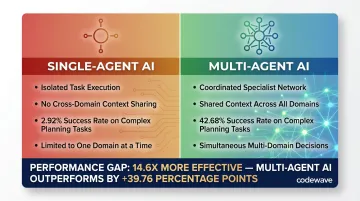
- Single AI agents solve discrete problems in isolation — a demand forecasting model generates predictions but has no visibility into carrier capacity or supplier lead times
- Multi-agent systems enable agents to understand each other's outputs, resolve competing priorities, and make decisions that account for the full operational picture
The orchestration layer is what makes this work. It sequences agent actions, manages information flow, prioritizes conflicting objectives, and keeps the system aligned to shared business goals — without requiring human intervention at every decision point.
Gartner reports a 1,445% surge in multi-agent system inquiries from Q1 2024 to Q2 2025 and predicts 40% of enterprise applications will integrate task-specific AI agents by end of 2026, up from less than 5% in 2025.
Research validates the performance advantage: a Cornell University study found multi-agent systems achieved 42.68% success rates on complex planning tasks versus just 2.92% for single-agent GPT-4 setups. Supply chain coordination — where decisions depend on information from procurement, logistics, demand, and risk simultaneously — is precisely the type of complex, interconnected problem where multi-agent architectures outperform single-agent approaches.
How Multi-Agent AI Systems Work in Supply Chains
Specialized Agents and the Orchestrator Architecture
Multi-agent systems use a layered architecture: a top-level orchestrator agent receives strategic goals or operational signals and delegates tasks to specialized agents, each expert in its own domain—logistics, procurement, inventory, risk. These agents are modular, meaning new agents can be added as supply chain complexity grows without rebuilding the entire system.
Data ingestion happens continuously at scale. Agents pull from sources across the supply chain simultaneously:
- ERP systems and TMS/WMS platforms
- IoT sensors and carrier networks
- Weather services and geopolitical feeds
- Commodity pricing indexes
This gives agents a single, coherent picture of operations that no standalone system could maintain, enabling reasoning with full context rather than siloed data from one application.
The Decision-Making and Feedback Loop
Agents follow a continuous decision cycle: they perceive incoming signals from connected systems, reason through options using machine learning and predictive models, execute actions through secure API connections, and feed outcomes back into the learning loop—so each decision improves the accuracy of the next one.
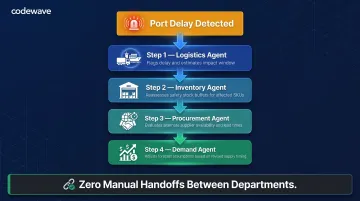
Multi-hop orchestration enables sequential agent chains. Consider this real-time chain: a port delay triggers four automated responses in sequence:
- Logistics agent flags the delay and estimates impact window
- Inventory agent reassesses safety stock buffers for affected SKUs
- Procurement agent evaluates alternate supplier availability and lead times
- Demand agent adjusts forecast assumptions based on revised supply timing
All of this happens without a single manual handoff between departments.
That speed only works safely with guardrails built in. Autonomous actions occur within defined boundaries, with humans retaining control over strategy, exceptions, and high-stakes decisions. Governance transparency is built into how agents log and explain their reasoning—so teams can audit any decision after the fact and trust the system to operate within agreed limits.
Top Use Cases of Multi-Agent AI in Supply Chain
Demand Forecasting and Inventory Optimization
Agents continuously ingest sales data, seasonal trends, external market signals, and supplier lead times to generate dynamic forecasts — adjusting replenishment triggers and safety stock levels without waiting for weekly planning cycles.
Key performance benchmarks:
- AI-driven forecasting cuts demand errors by ~46%
- Deep learning models achieve 12.3% MAPE vs. 22.7% for traditional ARIMA
Route Optimization and Logistics Management
Logistics agents monitor live traffic, weather, carrier capacity, and terminal congestion to reroute shipments mid-journey, rebalance delivery priorities, and update ETAs — shifting dispatchers from manual recalculation to exception oversight.
The results at scale are significant:
- UPS's ORION system saves 100 million miles and 10 million gallons of fuel annually
- Hybrid AI routing models reduce logistics costs by up to 32%
Supply Chain Risk Monitoring and Disruption Response
Before a disruption reaches operations, risk agents have already flagged it. These agents scan for early signals — supplier financial instability, geopolitical events, port congestion, extreme weather — and surface actionable alternatives like substitute suppliers or rerouted inventory.
Industry outlook backs the shift:
- 57% of operations leaders are comfortable letting AI agents detect anomalies and trigger corrective actions
- Gartner predicts 60% of supply chain disruptions will be resolved without human intervention by 2031
Warehouse Operations and Fulfillment Automation
Agents coordinate picking tasks, robotic path management, labor allocation, and order priority in real time — adapting to order surges or inbound delays to keep throughput consistent.
What that looks like in practice:
- AI-driven robotic picking hits 99.2% accuracy for standardized items
- Processing speed runs 3.2x faster than manual operations
- Overall warehouse productivity improves by 38.5%
Procurement and Supplier Performance Optimization
Procurement agents evaluate supplier reliability scores, pricing trends, contract terms, and risk signals to recommend optimal sourcing combinations. Teams negotiate from data rather than instinct, diversifying supply bases before disruptions force reactive decisions.
McKinsey projects 25-40% efficiency gains from AI-driven hybrid procurement workforces, with 40% of procurement functions already piloting generative AI.
Key Benefits of Multi-Agent AI for Supply Chain Optimization
Multi-agent AI delivers measurable gains across the supply chain — from faster decisions to lower operating costs. Here's where organizations see the clearest impact:
Real-Time Visibility and Faster Decisions
Multi-agent systems eliminate the lag between insight and action. Instead of waiting for humans to interpret dashboards, agents continuously monitor conditions and execute responses across the entire network.
83% of operations leaders agree AI agents and automation will accelerate the breakdown of traditional functional silos. Early adopters are already seeing results: 2-percentage-point EBITDA improvements within two years of embedding agentic AI into workflows.
Sharper Forecasts and Leaner Inventory
By synthesizing signals from multiple agents — sales data, supplier performance, market shifts, and demand patterns — these systems improve both demand and supply-side forecasting accuracy.
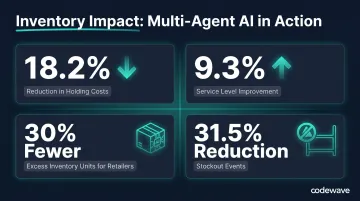
The inventory numbers back this up:
- Holding cost reductions of up to 18.2%
- Service level improvements of 9.3%
- 30% fewer excess inventory units for retailers
- 31.5% reduction in stockout events
Cost Reduction Across Logistics and Operations
Dynamic optimization across routing, inventory positioning, and carrier selection surfaces cost-saving opportunities faster than human planners can. AI delivers cost savings of 26% to 31% across supply chain and procurement, with logistics-specific reductions reaching 32% and emergency logistics costs dropping 20% through improved network design.
Proactive Risk Management
Multi-agent systems don't wait for disruptions — they detect early risk signals and model alternative responses before problems escalate. Graph neural networks achieve 92.3% anomaly detection accuracy with 4-6 day early warning lead times over traditional methods.
That kind of foresight lets supply chains absorb supplier failures, demand spikes, or geopolitical shocks with significantly less damage.
Scalability Without Proportional Headcount Growth
Agents handle coordination, analysis, and execution of high-volume repetitive decisions. Organizations can expand to new regions, product lines, or supplier tiers without hiring at the same pace. As global supply chain complexity grows, that efficiency gap becomes a real competitive advantage.
What to Look for When Implementing Multi-Agent AI
Data readiness and systems integration: Multi-agent AI is only as effective as the data it can access. Organizations need clean, consistently structured data across ERP, TMS, WMS, and IoT systems, with API connectivity that allows agents to both read and write across platforms.
Only 51% of companies establish a clean, structured data foundation before scaling digital initiatives, and 87% report that poor data quality impacted their ability to achieve value. Organizations with siloed or inconsistent data don't need to rebuild from scratch — incremental integration strategies and data lakes can bridge gaps progressively.
Governance design and human oversight framework: Before deploying autonomous agents, define clear operational boundaries. Gartner recommends starting with low-risk decisions given current technological maturity and data availability constraints. Governance isn't an afterthought — it's what makes expanding agent autonomy responsible over time.
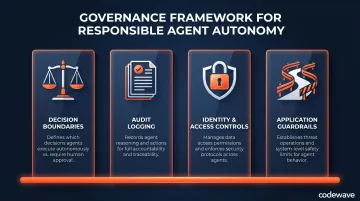
A solid governance framework covers:
- Which decisions agents can execute independently vs. which require human approval
- How agent reasoning is logged for audit and accountability
- Identity management and data access controls
- Threat operations and application-level guardrails (Forrester's AEGIS framework addresses all four)
Choosing an implementation partner built for outcomes: Multi-agent AI deployments built on generic templates often fail to align with an organization's specific decision layers, compliance requirements, and data structures. Codewave applies its QuantumAgile™ framework to move from validated use cases to live agent deployment rapidly, and its ImpactIndex™ model ensures clients pay for measurable outcomes rather than implementation effort alone.
Codewave has worked with 400+ businesses across Retail, Transportation, Healthcare, and Energy — sectors where multi-agent systems must fit tightly around existing workflows and compliance requirements, not the other way around.
Frequently Asked Questions
What is the difference between single-agent and multi-agent AI in supply chains?
Single agents handle isolated tasks in their own context—one forecasts demand, another optimizes routes. Multi-agent systems connect specialized agents through an orchestration layer so they share data, resolve tradeoffs together, and produce decisions that account for the full supply chain.
How does multi-agent AI handle real-time supply chain disruptions?
Agents continuously monitor signals for disruption indicators. Upon detection, they trigger a sequential or parallel chain of agent responses—rerouting shipments, sourcing from alternate suppliers, rebalancing inventory—without requiring manual handoffs between departments.
What data infrastructure is needed to deploy multi-agent AI for supply chain?
Organizations need accessible, structured data from ERP, TMS, WMS, and IoT systems, with API connectivity enabling agents to read and write across platforms. You don't need perfect data maturity to begin—targeted integration layers and API bridges can connect systems progressively as the deployment matures.
Can multi-agent AI systems integrate with existing ERP, TMS, and WMS platforms?
Yes. Multi-agent systems connect to existing platforms through APIs rather than replacing them. They add intelligence and coordination on top of systems organizations already have in place, so existing platform investments stay intact and operational.
How long does it typically take to implement a multi-agent AI system in a supply chain?
Timelines vary based on data maturity and integration complexity. Focused pilots targeting specific use cases are often achievable in weeks, while full enterprise rollouts are phased over several months to validate performance and expand scope based on measured results.
Which industries benefit most from multi-agent AI supply chain optimization?
Manufacturing, retail, healthcare, energy, and consumer goods companies see the strongest returns. Any organization managing multiple suppliers, distribution nodes, and variable demand can use coordinated agent intelligence to respond faster than manual planning allows.