Introduction
Manufacturing operations are under pressure from every direction. Three numbers frame the problem:
- A labor shortfall will leave 2.1 million U.S. manufacturing jobs unfilled by 2030, costing the economy an estimated $1 trillion
- Unplanned downtime drains $50 billion annually across industries
- Legacy systems hamstring 66% of enterprises competing in volatile supply chains
Traditional automation—rule-based RPA, fixed-interval maintenance schedules, scripted production lines—has hit its ceiling. It can't adapt when a supplier shipment arrives late, can't learn from last month's quality failures, and can't reroute production when a critical machine overheats.
AI agents represent the next evolution: autonomous systems that perceive operational data, analyze patterns using machine learning, make decisions, and act without constant human oversight.
TLDR
- AI agents make real-time, adaptive decisions across manufacturing workflows—unlike rule-based automation, they learn and adjust as conditions change
- Proven applications: predictive maintenance cuts downtime 35-45%, quality control reduces defects up to 66%, and supply chain optimization drives 73% better inventory turnover
- Manufacturing leaders report measurable ROI, but only 2% have AI fully embedded—the scaling gap is real
- Successful deployments start with data readiness, target high-impact use cases first, and scale in deliberate phases
What Are AI Agents in Manufacturing—and How Do They Differ from Traditional Automation?
AI agents in manufacturing are autonomous software systems that continuously perceive operational data from sensors, machines, and enterprise systems. They analyze that data using machine learning models, make decisions based on defined goals, and execute actions—without waiting for human approval at every step.
In practice, that means agents can:
- Adjust production schedules in response to a rush order
- Trigger maintenance before equipment fails
- Correct quality parameters mid-run based on sensor readings
Traditional automation follows predetermined scripts. An RPA bot moves data between ERP and MES on schedule. A conveyor runs at a fixed speed. Planned maintenance happens every 500 hours regardless of actual equipment condition. When conditions change—a rush order arrives, a sensor reading spikes, a supplier misses delivery—traditional systems freeze or fail. They have no mechanism to respond to conditions they weren't explicitly programmed for.
AI agents operate differently. They evaluate real-time conditions, compare them against historical patterns, predict outcomes, and adjust behavior autonomously. When a motor's vibration signature shifts, the agent doesn't wait for the next scheduled inspection—it generates a work order, checks parts inventory, and reschedules production to minimize disruption.
Two Categories of AI Agents in Manufacturing
Virtual AI agents automate decisions across digital systems—ERP, MES, QMS, WMS, and supply chain platforms. They handle scheduling, inventory management, quality documentation, and compliance reporting without physical interaction.
Embodied AI agents operate in the physical environment—robots with computer vision inspecting welds, autonomous mobile robots moving materials, cobots adjusting assembly parameters based on real-time feedback.
Most process automation use cases involve virtual agents working across disconnected manufacturing systems, connecting systems that historically operated in isolation and blocked end-to-end optimization.
Agentic Process Automation in Practice
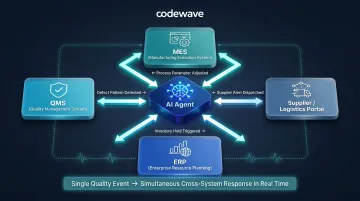
Agentic process automation (APA) describes how AI agents orchestrate workflows across previously isolated systems. Instead of quality data sitting in QMS while production schedules live in MES and procurement operates in ERP, agents create continuous data flows. When a quality agent detects a defect pattern, it can trigger upstream process adjustments in MES and downstream inventory holds in ERP simultaneously—coordinating actions that would traditionally require multiple departments, manual handoffs, and days of back-and-forth to resolve.
Key Process Areas Where AI Agents Are Automating Manufacturing
AI agents aren't one-size-fits-all solutions. They deliver measurable value when deployed against specific, high-friction workflows where delays, errors, or manual intervention create bottlenecks. Five core process areas show the strongest returns.
Predictive Maintenance and Equipment Health Monitoring
AI agents continuously monitor equipment sensor data—vibration, temperature, pressure, acoustic signatures—to detect anomaly patterns that precede failures. Unlike planned maintenance that services machines every fixed interval regardless of actual condition, predictive maintenance agents analyze real-time performance against historical failure data to forecast breakdowns before they occur.
When an agent detects early warning signs, it automatically schedules maintenance, generates work orders, coordinates parts procurement, and adjusts production schedules to minimize disruption. Unplanned downtime costs industries $50 billion annually, with Siemens estimating $1.4 trillion in annual losses among the world's top 500 companies. Automotive manufacturers lose approximately $2.3 million per hour of downtime—double the 2019 rate.
Predictive maintenance AI agents deliver:
- 35-45% downtime reduction
- 70-75% breakdown reduction
- 20-25% production increase
- 5-10% maintenance cost reduction
A global pharmaceutical company deploying predictive maintenance AI increased OEE by 10 percentage points, halved unplanned downtime, and is on track to double production volume in under three years.
Quality Control and Defect Detection
AI agents equipped with computer vision and deep learning inspect 100% of products at production speed, detecting surface defects, dimensional deviations, assembly errors, and material inconsistencies that human inspectors or sample-based methods miss.
When defects are detected, agents trace root causes, adjust upstream process parameters automatically, and generate auditable quality records—closing the loop without human intervention.
The Cost of Poor Quality (COPQ) represents 15-25% of manufacturer revenue. Vision-based AI agents reduce this burden dramatically:
- Beko: 66% defect rate reduction using decision-tree models for clinching processes; 12.5% material cost savings through smart ML control in sheet metal operations
- Midea Group: 53% reduction in poor quality across 457 production sub-scenarios using AI-driven inspection
- Siemens Erlangen: Significant first-pass yield increase and 90% reduction in automation costs through ML-optimized testing
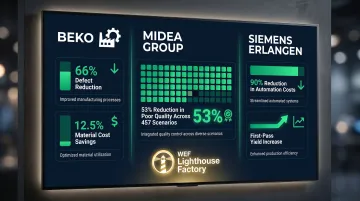
All three results came from Lighthouse factories validated by the World Economic Forum.
Supply Chain and Inventory Optimization
AI agents analyze order patterns, supplier performance, lead times, and external disruptions—weather, geopolitical events, demand shifts—to adjust inventory levels, trigger reorders, and reroute shipments. Integration with ERP and warehouse management systems provides visibility across the full procurement-to-delivery chain, supporting compliance traceability requirements like the EU Digital Product Passport, which goes live July 19, 2026, with battery compliance mandatory February 2027.
AI-driven supply chain agents deliver:
- Mengniu Dairy: 73% increase in inventory turnover and 8% operational efficiency gain through AI-automated supplier scheduling
- Midea Group: 29% logistics path optimization improvement
- 10% reduction in stockouts and 5% improvement in on-time deliveries (industry benchmark)
Production Scheduling and Planning
AI agents evaluate real-time production status, order priorities, material availability, machine conditions, and workforce capacity simultaneously—generating and continuously updating schedules that reflect actual conditions rather than planned assumptions. When disruptions occur—late materials, machine downtime, rush orders—agents autonomously adjust schedules, resequence jobs, and rebalance workloads.
Traditional scheduling takes days and becomes obsolete the moment conditions change. AI agents update schedules in minutes:
- Qingdao Hisense Hitachi: 22% reduction in production cycle times and 66% shorter changeover times using AI-driven scheduling
- Siemens Opcenter APS: Scheduling time reduced from 2-5 days to 10 minutes
- AstraZeneca: Manufacturing lead times reduced from weeks to hours using AI-powered process digital twins
Gartner predicts 40% of enterprise applications will integrate task-specific AI agents by end of 2026, with scheduling agents among the top priorities.
Compliance Documentation and Reporting
AI agents automate generation, formatting, and storage of quality records, maintenance logs, change management documentation, and regulatory reports—capturing data directly from production systems to eliminate manual data entry errors.
Pharmaceutical companies spend 15-25% of total revenue on quality and compliance. A single FDA warning letter can cost a facility its entire reputation. A typical mid-sized contract manufacturer manages approximately 500 SOPs; manual regulatory guidance assessment takes weeks, while AI produces a prioritized change list within minutes.
The same principle applies beyond pharma.
High-volume change management workflows—such as mold change documentation in beverage manufacturing—illustrate the impact. Instead of approval cycles stretching weeks across multiple departments, AI agents capture change data automatically, route documents to appropriate reviewers, track approval status, and archive records for audit trails—reducing cycles from weeks to days.
AstraZeneca achieved:
- 70% reduction in time to create regulatory documents
- 50% reduction in development lead times
- 75% reduction in API usage in experiments
How AI Agents Work in a Manufacturing Environment
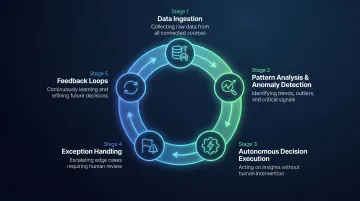
Understanding the operating cycle helps demystify what feels like autonomous intelligence. Manufacturing AI agents follow a continuous loop:
1. Data ingestion: Agents pull data continuously from IoT sensors (temperature, vibration, pressure), MES (production status, cycle times), ERP (inventory, orders), SCADA (machine states), QMS (inspection results), and environmental systems (humidity, air quality). This is streaming data analyzed in real time, not batch processing on a delay.
2. Pattern analysis and anomaly detection: Machine learning models compare current conditions against historical baselines, identifying deviations that signal problems. A predictive maintenance agent recognizes vibration signatures that preceded past motor failures. A quality agent spots subtle color variations invisible to human inspectors but correlated with downstream defects.
3. Autonomous decision execution: When analysis triggers a threshold, the agent acts. It adjusts production schedules, triggers maintenance work orders, initiates corrective process parameter changes, or flags non-conforming products for quarantine—all without waiting for human approval.
4. Exception handling: Agents escalate edge cases they can't resolve autonomously. When confidence scores fall below thresholds or situations fall outside training data, the agent notifies human operators, presents options, and learns from their decisions.
5. Feedback loops: Agents refine models over time. When a predicted maintenance event doesn't occur, the agent adjusts its failure threshold. When a quality adjustment eliminates defects, the agent reinforces that parameter relationship. Over months of operation, this compounds: agents become more precise in your specific environment than any general-purpose rule set could achieve.
Integration and Orchestration
Effective AI agents connect with existing enterprise systems rather than replace them. Each agent typically spans multiple platforms simultaneously:
- Inventory optimization: Pulls from ERP (order data), WMS (stock levels), and supplier portals (lead times), then updates transportation management systems with shipping status
- Quality control: Reads from vision systems and MES (process parameters), cross-references QMS (inspection records), and pushes corrective actions and compliance documentation back to both
- Predictive maintenance: Ingests SCADA machine states and IoT sensor streams, then triggers work orders in ERP and updates maintenance schedules in MES
This orchestration requires APIs, middleware, and edge computing, but manufacturers don't need to replace existing systems first. Modern integration approaches layer agents onto current tech stacks incrementally. A 15-year-old ERP and legacy SCADA system can coexist with AI agents through properly designed middleware.
Business Impact: What Manufacturers Are Actually Gaining
Industry data cuts through the hype: here's what manufacturers actually achieve when AI agents move from pilot to production.
Adoption is accelerating, but the gap is real: 87% of manufacturers have initiated a GenAI pilot; 24% have adopted in at least one facility. Yet only 2% have AI fully embedded across operations, and 66% remain in exploration or targeted-implementation stages.
Investment intent tells a different story. 93% of manufacturing COOs plan to increase AI spending, with nearly one-third committing 5%+ of COGS — a clear signal that the experimentation phase is ending.
Efficiency and Throughput Gains
AI agents optimize scheduling and resource allocation to increase output without capital expenditure. They enable dynamic responses to demand changes that static scheduling can't match.
Manufacturers deploying AI agents report:
- 20-25% production increases through predictive maintenance optimization
- 22-66% reductions in cycle times and changeover times
- Schedule optimization reducing planning time from days to minutes
Where AI-specific KPIs exist, nearly 66% of companies meet or exceed targets — a rate that holds across sectors and deployment scales.
Quality and Compliance Impact
Moving from sample-based inspection (checking 5% of products) to 100% AI-driven inspection not only reduces defects and warranty claims—it generates auditable quality data supporting regulatory compliance and continuous improvement. Vision-based agents inspect every unit at production speed, catching defects human inspectors miss due to fatigue or speed constraints.
Quality improvements include:
- 53-66% defect rate reductions in consumer electronics and appliances
- 12-18% material cost savings and cycle time improvements
- Significant first-pass yield increases
The compliance benefit extends beyond defect reduction. AI agents automatically generate the structured, verifiable digital information required for regulations like the EU Digital Product Passport, transforming compliance from a burden into an automated byproduct of production.
Workforce Impact
AI agents automate repetitive data entry, inspection, and reporting — freeing operators and engineers for higher-value problem-solving, process improvement, and oversight. The net effect is augmentation, not replacement.
77% of employers plan to upskill workers for AI, and 72% will use AI for knowledge capture and transfer. When experienced technicians retire, their diagnostic expertise gets captured in agent training data and decision models — transferred to the next generation rather than lost.
Early adopters are already seeing this play out:
- A global pharmaceutical site filled ~12 new digital/analytics roles, mostly through internal mobility rather than external hiring
- Beko invested 3,160 training hours over six months on AI principles, treating workforce development as a prerequisite to technology adoption
Real-World Benchmarks
Codewave clients deploying AI-driven process automation and data intelligence solutions report:
- 40% increase in productivity
- 25% reduction in costs
- 90% fewer data errors
- 50% faster invoice processing

These aren't projections — they're production results from implementations already running at scale.
How to Deploy AI Agents into Manufacturing Processes
Successful deployment starts with strategy, not technology. The manufacturers scaling AI effectively follow a disciplined approach prioritizing business outcomes over technical complexity.
Start with Use Case Prioritization
Identify the highest-impact, lowest-complexity process problem first—not the flashiest technology. Predictive maintenance, quality inspection, and documentation automation are strong starting points because they have clear data sources, well-defined success metrics, and measurable ROI.
Use case evaluation criteria:
- Data availability: Does the process generate consistent, accessible data from sensors or systems?
- Process frequency: Does the problem occur often enough to justify automation investment?
- Cost of current failure: What does downtime, rework, or manual effort cost today?
- Stakeholder alignment: Will operators and engineers support the solution?
A predictive maintenance use case with rich sensor data, frequent equipment failures costing $10,000+ per incident, and frustrated maintenance teams ready for change beats an ambitious supply chain optimization project with sparse data, unclear ROI, and resistant stakeholders.
Assess Data Readiness
AI agents require clean, consistent, accessible data. Many manufacturers discover during assessment that sensor coverage has gaps, systems don't communicate, or data quality makes reliable predictions impossible.
Audit data sources before committing to a use case:
- Sensor coverage: Do you have continuous monitoring where it matters, or just periodic snapshots?
- System connectivity: Can you extract data from MES, ERP, SCADA, and QMS without manual exports?
- Data quality: Are timestamps accurate? Are readings calibrated? Do you have labeled historical failure data?
This assessment often reveals foundational infrastructure investments needed before agents can function effectively. Addressing data gaps isn't a failure. It's a necessary step that prevents wasted investment in AI models trained on poor-quality data.
Phase Rollout Carefully
Start with a focused pilot: one agent, one process, one facility. Measure results rigorously. Gather user feedback. Then scale proven solutions before adding complexity.
Phased deployment reduces risk and builds organizational confidence:
- Pilot phase (3-6 months): Deploy one agent in a controlled environment, establish baseline metrics, validate accuracy, and refine integration
- Scaling phase (6-12 months): Expand proven agent to additional lines/facilities, train operators, document procedures, and measure consistency
- Optimization phase (12-18 months): Add complementary agents, integrate workflows, capture continuous improvement opportunities
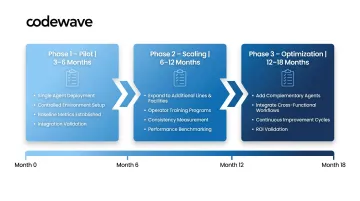
Set realistic expectations: full value realization typically takes 12-18 months, not weeks. Industry data suggests only around 2% of manufacturers reach full AI embedment — largely those who skipped validation steps. The 24% who achieve successful facility-level adoption tend to share one trait: they phased carefully and proved value before scaling.
Work with the Right Implementation Partner
Even a well-structured phased rollout carries real complexity — integrating legacy systems, cleaning sensor data, and building models that hold up on the shop floor. A specialized implementation partner compresses that learning curve and protects the investment.
Codewave's QuantumAgile™ approach moves from validated use case to shipped solution in days, simulating multiple futures and shipping what works. The ImpactIndex™ model aligns incentives by billing for measurable outcomes rather than effort, ensuring implementation delivers real business value. The result: clients are charged for outcomes delivered, not time logged.
Codewave has worked with 400+ businesses across 15+ industries, with a 70-80% client retention rate and documented results including 40% productivity gains and 90% reductions in data errors — the kind of outcomes that distinguish pilot projects from production-scale deployments.
Frequently Asked Questions
How can AI agents be used in manufacturing?
AI agents automate predictive maintenance, quality control, supply chain coordination, production scheduling, and compliance documentation. They operate autonomously across ERP, MES, QMS, and SCADA systems, making real-time decisions that adapt to changing conditions with minimal human input.
What types of AI agents are used in manufacturing?
Two primary types exist: virtual AI agents (software-based, automating digital workflows across enterprise systems) and embodied AI agents (physical systems like robotic pickers and vision-equipped cobots). Most process automation use cases involve virtual agents orchestrating decisions across disconnected manufacturing platforms.
Which AI agents are best for manufacturing?
The right agent depends on your most pressing operational challenge. Predictive maintenance agents suit equipment-intensive operations with high downtime costs; quality control agents fit precision or high-volume production; supply chain agents address complex multi-supplier inventory challenges. Start with the area where downtime or error costs are highest.
How do you deploy AI agents into production?
Start by identifying a high-impact use case and assessing data readiness, then integrate via APIs or middleware and run a focused pilot before scaling. Phased deployment builds organizational confidence; full value realization typically takes 12-18 months.
How do AI agents differ from traditional RPA in manufacturing?
RPA follows fixed, predefined rules and breaks when conditions change. AI agents use machine learning to adapt, make judgment calls, and improve over time. That adaptability is what makes them suitable for dynamic manufacturing environments where variability is constant.
What are the biggest challenges when implementing AI agents in manufacturing?
Data quality, legacy system integration, and change management consistently block progress — 46% of COOs cite IT/OT data limitations and 50% cite culture shift as key hurdles. Addressing data readiness early and involving operations teams in design significantly improve outcomes.