Introduction
Businesses are facing growing operational pressure from every direction. Customer expectations are climbing, margins are tightening, and traditional automation tools—built for simpler workflows—hit a hard ceiling when volumes spike or processes cross departments.
The problem isn't automation itself. Most implementations still rely on single-agent or rule-based systems that fail predictably: when exceptions multiply, context shifts, or hand-offs between systems break down.
Gartner reports a 1,445% surge in multi-agent systems client inquiries from Q1 2024 to Q2 2025—a signal that enterprises have identified the gap and are moving fast to close it. What follows breaks down how multi-agent AI architecture delivers measurable operational advantages, and why the structure behind your automation determines whether it scales or stalls.
TL;DR
- Multi-agent AI systems coordinate specialized AI agents to automate cross-functional business workflows that single-agent systems can't handle
- They execute tasks in parallel, recover from individual failures, and scale without proportional cost increases
- Businesses across finance, healthcare, retail, and logistics are realizing faster processing times, fewer errors, and lower operational costs
- Well-implemented systems have delivered outcomes like 40% productivity gains, 50% faster processing, and 90% reductions in data errors across industries
What Is a Multi-Agent AI System?
A multi-agent AI system (MAS) is a network of autonomous AI agents, each assigned a specific role, that communicate and coordinate to complete tasks too complex for a single agent to handle effectively. Rather than one generalist agent attempting to manage every step of a workflow sequentially, MAS distributes responsibilities across specialized agents: one classifies incoming requests, another retrieves data, a third drafts responses, and a fourth logs outcomes.
This architecture is applied where workflows involve multiple steps, tools, or decision points: customer support pipelines, finance operations, supply chain coordination, and revenue operations. According to Gartner, MAS "orchestrate specialized agents, each focused on a specific task, to automate more complex problems" by "breaking workflows into manageable steps. Each step is handled by the best-suited agent."
The goal is end-to-end process automation where agents handle the coordination and decision-making that would otherwise require human intervention or manual handoffs. A practical example: a 7-agent MAS architecture for sepsis management spans Data Collection, Diagnostic, Risk Stratification, Treatment Recommendation, Resource Management, Monitoring/Alert, and Documentation agents. Each performs a specialized function while communicating with the others to deliver comprehensive patient care.
When deployed correctly, these systems reduce bottlenecks, eliminate manual handoffs, and let businesses scale operations without proportional increases in cost or headcount.
Key Advantages of Multi-Agent AI Systems for Business Automation
The advantages discussed below map directly to metrics businesses already track: processing speed, error rates, cost per task, system uptime, and workforce productivity. Each maps to a concrete operational improvement you can measure.
Advantage 1: Task Specialization and Parallel Execution
In a multi-agent system, each agent is trained and optimized for a specific domain rather than attempting to handle everything. One agent classifies incoming data, another retrieves historical context, a third drafts a resolution, and a fourth logs the outcome.
How this works in practice:
When a customer support request arrives, a router agent classifies it by type and urgency. Simultaneously, a retrieval agent pulls the customer's history and account details. A resolution agent drafts a response based on the classification and context, while a feedback agent logs the interaction for future learning. These steps happen in coordinated parallel execution rather than a linear queue.
What the data shows:
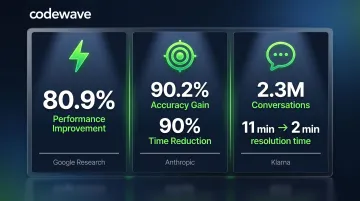
Parallel execution reduces completion time: Google Research measured an 80.9% performance improvement with centralized multi-agent coordination on parallelizable tasks compared to single-agent systems. Tasks that would take hours sequentially complete in minutes when agents work simultaneously.
Domain-specialized agents are more accurate: Agents trained for narrow tasks make fewer mistakes than generalists switching between contexts. Anthropic's multi-agent research system outperformed single-agent approaches by 90.2% on internal evaluations, with parallelization reducing research time by up to 90%.
Speed and accuracy together reduce costs: Faster resolution with fewer errors means less rework, lower escalation rates, and reduced need for human intervention. Klarna's AI assistant handled 2.3 million conversations in its first month, equivalent to 700 full-time agents, while reducing average resolution time from 11 minutes to under 2 minutes.
KPIs impacted:
- Task completion time
- Error rates
- First-contact resolution rate
- Agent throughput
- Escalation frequency
When this advantage matters most:
High-volume, multi-step workflows where bottlenecks compound—invoice processing, customer support queues, onboarding pipelines—and in industries like fintech, retail, and healthcare where both speed and accuracy are business-critical.
Important caveat: Multi-agent systems don't improve all workflows. Google Research found that multi-agent architectures degraded performance by 39-70% on sequential reasoning tasks where steps must occur in strict order. The architecture must match the workflow structure.
Advantage 2: Scalable Automation Without Proportional Cost Growth
Traditional automation scales linearly—more volume requires more rules, more tools, or more people. Multi-agent systems scale differently by routing simple tasks to lightweight, cost-efficient agents and complex tasks to more capable ones. This tiered approach means the average cost per task drops as volume increases.
The operational impact:
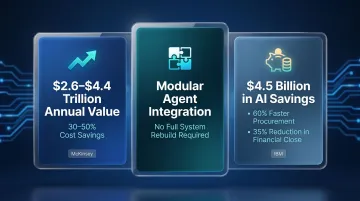
Volume spikes don't require proportional cost increases: Businesses absorb seasonal demand or rapid growth without adding headcount or infrastructure at the same rate. McKinsey projects that AI agents could add $2.6 to $4.4 trillion in annual value across business use cases, with fully reimagined processes delivering 30-50% cost savings.
Adding capabilities doesn't require rebuilding the system: Integrating a new fraud detection agent or compliance review agent happens by adding a new node, not redesigning the entire workflow. This modularity reduces implementation cost and accelerates deployment payback.
Cost advantages compound over time: IBM is on track for $4.5 billion in AI/automation savings by end of 2025, including procurement processing approximately 60% faster and 35% reduction in financial close activities.
KPIs impacted:
- Cost per task or transaction
- Headcount required per output unit
- Time-to-deploy new automation capabilities
- Operational cost as percentage of revenue
When this advantage matters most:
Fast-growing businesses, enterprises managing seasonal demand spikes, and organizations in high-transaction industries—fintech, insurance, e-commerce, logistics—where scaling automation cost-effectively is a strategic priority.
Advantage 3: Fault Tolerance and Operational Continuity
In a multi-agent architecture, agents operate independently. If one agent fails, encounters an error, or is overloaded, the system can reroute, retry, or fall back to an alternative agent without the entire workflow collapsing.
How this plays out in real operations:
Circuit breakers detect repeated failures and redirect tasks to functioning agents. Retry logic with exponential backoff handles transient errors without overwhelming the system. Dead-letter queues capture failed tasks for review rather than silently dropping them. The system degrades gracefully instead of breaking catastrophically.
Why continuity is worth designing for:
Single points of failure are eliminated: Business processes remain operational even during partial system issues. Gartner estimates the average cost of IT downtime at $5,600 per minute (over $300,000 per hour)—fault-tolerant systems prevent these losses.
Fault-tolerant systems reduce manual intervention: Anthropic uses checkpoints and retry logic rather than full restarts for long-running agents, reducing the operational burden on IT teams who would otherwise manually catch and correct errors.
Auditability and continuity meet compliance standards: For regulated industries, built-in logging, lineage tracking, and fallback mechanisms satisfy compliance requirements without additional tooling.
Critical architectural consideration: Google Research found that unsupervised (independent) multi-agent systems amplified errors by 17.2x, while centralized orchestration contained amplification to 4.4x. Production deployments require a centralized orchestrator to maintain fault tolerance.
KPIs impacted:
- System uptime
- SLA compliance rate
- Mean time to recovery (MTTR)
- Manual intervention frequency
- Audit trail completeness
When this advantage matters most:
Mission-critical workflows in healthcare, finance, insurance, and logistics where process continuity is non-negotiable and downtime carries regulatory, financial, or reputational consequences.
What Happens When Multi-Agent AI Is Missing or Ignored
When businesses attempt to scale automation with single-agent or rule-based systems instead of multi-agent architectures, they encounter predictable failure patterns. These aren't edge cases. They're what happens when automation architecture can't keep up with operational reality.
- A single agent hits context limits or misclassifies tasks once workflow complexity exceeds its training scope — what works at 100 tasks per day breaks at 1,000.
- Errors in step one propagate unchecked through downstream processes. EY reports 30-50% of initial RPA projects fail outright, and Deloitte finds only 3% of organizations successfully scale RPA.
- Operations teams end up manually intervening when automations break — negating the productivity gains automation was supposed to deliver. McKinsey finds nearly 8 in 10 companies using generative AI report no significant bottom-line impact, with 90% of vertical AI use cases stuck in pilot mode.
- Higher volume creates more exceptions, not fewer. Without specialized agents handling edge cases, costs scale linearly — and at that point, the economics of automation stop making sense.
- Adding new capabilities requires rebuilding workflows from scratch. McKinsey reports less than 10% of organizations are scaling AI agents within any single business function — a ceiling that blocks broader digital transformation progress.
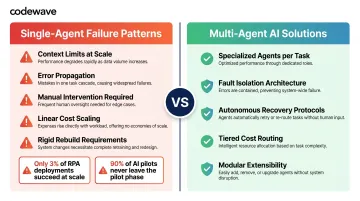
The pattern is consistent: single-agent systems create diminishing returns as complexity grows. Multi-agent architectures exist precisely to break that ceiling.
How to Get the Most Value from Multi-Agent AI Systems
Multi-agent AI delivers compounding returns when deployed with clear ownership of outcomes, not just tasks. Every agent should map to a measurable business result—reduced processing time, lower error rate, faster resolution—not just a process step.
Three operating principles drive value realization:
Start with focused, high-impact use cases. Choose workflows where data is clean, the process is well-understood, and success metrics are clear. Prove value before expanding scope.
Review agent performance against defined KPIs. Track task completion time, error rates, throughput, and cost per transaction. Identify which agents are underperforming and why.
Act on insights rather than just logging them. If an agent consistently misclassifies a task type, refine its training data or adjust routing logic. If bottlenecks appear, redistribute workload or add specialized agents.
The implementation partner matters too. Businesses working with development partners that use outcome-based models tend to see faster time-to-value and better ROI alignment. Codewave's ImpactIndex™, for instance, ties delivery to measurable results rather than hours billed—a model that has contributed to outcomes like 25% cost reduction and 40% productivity increases for clients across healthcare, fintech, and retail. That accountability structure is what separates implementations that scale from those that stall after the pilot.
Conclusion
Multi-agent AI systems deliver value through three reinforcing strengths:
- Specialized agents execute tasks faster and with greater accuracy than generalist models
- Scalable architecture grows output without proportional cost increases
- Fault-tolerance keeps operations running when individual components fail
Together, these produce measurable improvements in cost, quality, and speed — the metrics that ultimately determine competitive position.
These advantages grow over time when agents are monitored, refined, and expanded thoughtfully. Multi-agent automation is an ongoing operational practice, not a one-time deployment. Businesses that build multi-agent AI into their core operations — rather than running isolated pilots — are the ones that accumulate efficiency gains quarter over quarter and widen the gap on competitors still relying on manual workflows.
Frequently Asked Questions
Frequently Asked Questions
What is a multi-agent AI system in simple terms?
A multi-agent AI system is a network of individual AI agents, each with a specific role, that communicate and coordinate to complete complex tasks together. Each agent handles what it's designed for; together, they accomplish work no single model could manage efficiently.
How are multi-agent AI systems different from traditional automation or RPA?
RPA and traditional automation follow fixed rules and break when inputs vary. Multi-agent systems use AI to reason, adapt, and coordinate dynamically—handling exceptions and complex decisions that rule-based tools cannot.
Which industries benefit most from multi-agent AI systems?
Industries with high-volume, multi-step workflows see the strongest results: fintech, healthcare, insurance, logistics, retail, and e-commerce. These systems deliver particular value where accuracy, speed, and regulatory compliance are all required simultaneously.
What are the biggest challenges in implementing multi-agent AI systems?
The core hurdles are legacy system integration, data quality, and architectural design expertise. McKinsey found that 80% of companies cite data limitations as their top roadblock to scaling agentic AI—making a strong implementation partner critical from day one.
How long does it take to implement a multi-agent AI system?
Timelines depend on scope. A focused use case with clean data can show results in 4–8 weeks; enterprise-wide deployments typically run 3–6 months. Start with one high-impact workflow, prove the value, then scale.
Can small and mid-sized businesses benefit from multi-agent AI systems, or are they only for large enterprises?
SMBs benefit too. Companies with repetitive, multi-step workflows in sales, support, or finance can realize meaningful gains without enterprise-scale budgets. The key is starting with one focused use case rather than trying to automate everything at once.