Introduction
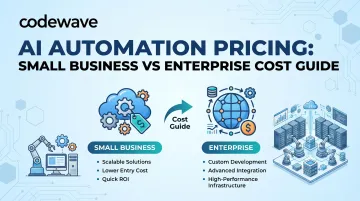
AI automation pricing ranges from $29/month no-code tools to multi-million-dollar enterprise deployments. Cost varies dramatically based on business size, scope, integration complexity, and whether you choose off-the-shelf tools or custom-built solutions.
Picking the wrong tier is one of the most common — and expensive — mistakes companies make.
Research shows 85% of organizations misestimate AI costs by more than 10%, with nearly 25% missing the mark by 50% or more. This isn't just about choosing the wrong subscription plan — it reflects a fundamental misunderstanding of what AI automation actually costs when you account for implementation labor, data preparation, training, and ongoing maintenance.
This guide breaks down pricing ranges by business size, what drives costs up or down, what a full cost picture actually looks like, and how to build a realistic budget, whether you're a 10-person operation or a 1,000-person enterprise.
TL;DR
- AI automation costs range from roughly $500–$35,000/year for small businesses to $500,000–$5M+ annually for enterprise deployments
- The biggest cost drivers are implementation scope, integration complexity, customization, and ongoing operations — not just the monthly subscription fee
- Small businesses should expect fast ROI on task automation; enterprises should plan for longer timelines tied to governance, compliance, and multi-system rollouts
- Hidden costs like data preparation, staff training, and maintenance routinely add 2–3x the sticker price in year one
- Spend to match your actual workflow complexity — buying more than you need wastes budget just as surely as buying too little
How Much Does AI Automation Cost? Pricing by Business Size
AI automation does not have a fixed price — costs depend on business size, deployment model, number of systems involved, and whether you are using prebuilt tools or custom solutions. Get the tier wrong and you'll face underbudgeting, mismatched tooling, and surprise integration costs down the line.
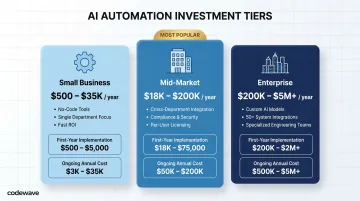
Small Business Automation ($500–$35,000/year)
This range covers no-code/low-code platforms like Zapier (starting at $19.99/month for professional plans) and Make.com (starting at $9/month for 10,000 operations), along with AI assistants at $20–$30/user/month and lightweight API usage. One-time implementation from a freelancer or small firm typically runs $1,500–$8,000 for 1–3 workflows.
Best for:
- Businesses with 10–100 employees
- Repetitive single-department tasks (email triage, lead routing, appointment scheduling, FAQ chatbots)
- Teams that want results in 30–90 days without heavy technical infrastructure
- Budget-conscious operations where monthly subscriptions and setup fees can't exceed low five figures annually
Small business tools prioritize speed and simplicity. You're paying for pre-built connectors, template-based workflows, and self-service configuration. The trade-off is limited customization and potential vendor lock-in.
Mid-Market Automation ($18,000–$200,000/year)
This tier covers governed, cross-department workflow automation with tools like Microsoft Power Automate (premium plans at $15/user/month) or Salesforce Flow. Includes audit trails, compliance documentation, and integration with HR, finance, and CRM systems.
Mid-market platforms charge differently:
- Per-user licensing: Predictable budgeting as headcount grows
- Bot-based pricing: Power Automate charges $150/month for unattended RPA bots
- Tenant-wide add-ons: Process mining capabilities can run $5,000/month
Best for:
- Companies with 100–1,000 employees where processes span multiple teams
- Environments where manual handoffs create delays
- Organizations needing predictable per-user pricing for budgeting
- Industries requiring security compliance and audit documentation
According to The Consultancy World, total first-year implementation costs for mid-market businesses typically run around $80,000 USD, with ongoing annual costs near $16,500 USD.
Enterprise AI Automation ($200,000–$5M+/year)
Enterprise deployments include real-time system integration across 50+ core business tools, custom AI model development, infrastructure platforms (MuleSoft, Databricks, Apache Kafka), and specialized engineering talent that can represent 60–80% of total costs.
Platform pricing at this tier:
- UiPath enterprise plans: Contact vendor (typically starting around $25,000+ annually)
- Custom AI model development: $50,000–$500,000+ depending on complexity
- Integration engineering talent: $80,000–$100,000 per engineer annually
Best for:
- Organizations with 1,000+ employees
- Operations needing sub-second data synchronization
- Companies building proprietary predictive models on proprietary data
- Businesses where competitive advantages depend on automation capabilities
- ROI measured in competitive positioning, not just hours saved
According to The Consultancy World, first-year enterprise implementation costs typically reach approximately $650,000 USD, with annual ongoing costs running $135,000+ USD.
Key Factors That Affect AI Automation Pricing
Pricing is shaped by a combination of technical, operational, and business requirements. Knowing which factors drive costs helps you avoid over-specifying — paying for enterprise capabilities you don't need — or under-investing in tools that create technical debt down the line.
Scope and Number of Workflows
Narrow, single-department pilots (like automating inbound email triage) cost a fraction of multi-system rollouts. Each additional workflow adds implementation time, testing cycles, and integration complexity — and this compounds costs exponentially, not linearly.
Why costs don't scale linearly:
- First workflow: Setup infrastructure, authentication, error handling
- Second workflow: May share infrastructure but requires new testing scenarios
- Third workflow: Interactions with first two create combinatorial complexity
- Fourth+ workflows: Integration points grow exponentially
A business automating three separate workflows might pay 4–5x what a single workflow costs, not 3x.
System Integration Complexity
Connecting AI tools to legacy ERP, CRM, or accounting systems is the single biggest cost amplifier. Simple integrations with modern cloud apps are low-cost, while legacy system APIs, custom middleware, and real-time data pipelines require engineers with deep knowledge of legacy protocols and custom middleware.
Integration complexity pricing tiers:
- Level 1 (Simple API): $10,000–$40,000 (modern cloud apps with standard REST APIs)
- Level 2 (Multi-System): $40,000–$150,000 (orchestrating 3–5 platforms)
- Level 3 (Custom Bespoke): $150,000–$750,000 (legacy systems requiring custom middleware)
- Level 4 (Enterprise Platform): $750,000–$5,000,000+ (real-time data synchronization across 50+ tools)
Legacy system integration requires engineers earning $80,000–$100,000+ annually. A single complex integration can easily consume 6–12 months of engineering time.
Build vs. Buy Decision
Off-the-shelf tools lower upfront costs but limit customization and can create vendor lock-in. Custom builds require more design and testing investment but deliver workflow-specific logic that pre-packaged products can't replicate.
When off-the-shelf makes sense:
- Standard workflows with minimal customization needs
- Rapid deployment requirements (30–90 days)
- Budget constraints under $25,000
- Workflows that won't change significantly
When custom builds become necessary:
- Proprietary workflows providing competitive advantage
- Complex business logic that templates can't handle
- Integration requirements beyond standard API connectors
- Long-term cost of per-task pricing exceeds custom build amortization
A 50-person business running a $29/month tool matched precisely to its workflow will outperform a six-figure enterprise deployment aimed at the wrong problem. Fit matters more than sophistication.
Data Readiness and Preparation
Many businesses discover their data is not "automation-ready." Industry research shows up to 80% of AI project effort goes into data gathering, cleaning, labeling, and organizing.
Data preparation represents 20–30% of total AI implementation cost:
- Small businesses: $500–$5,000 for basic data structuring
- Mid-market: $5,000–$25,000 for multi-system data consolidation
- Enterprise: $25,000–$150,000+ for complex data governance and quality programs
External data labeling costs $15–$45 per hour when specialized expertise is required.
Compliance and Governance Requirements
Regulated industries (healthcare, fintech, insurance) must budget for access controls, audit logging, legal review, and documentation.
Compliance costs by framework:
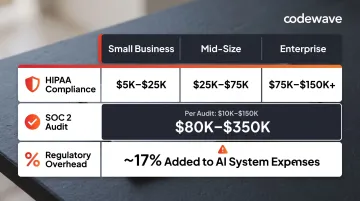
- HIPAA compliance: $5,000–$25,000 (small practices), $25,000–$75,000 (mid-size), $75,000–$150,000+ (large enterprises)
- SOC 2 audit: $10,000–$150,000 per audit; total compliance $80,000–$350,000
- Regulatory overhead: Approximately 17% added to AI system expenses
In healthcare and fintech projects, compliance work routinely adds 15–20% to total implementation scope before a single workflow goes live. Treat it as a fixed cost multiplier, not an afterthought.
Full Cost Breakdown: One-Time vs Recurring Expenses
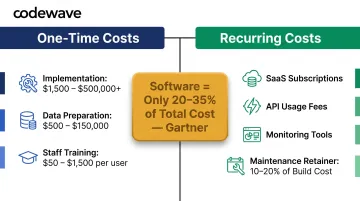
The sticker price of AI automation — whether a monthly SaaS subscription or an implementation quote — represents only a fraction of total cost. Gartner research indicates software costs typically represent only 20–35% of total AI implementation expenses, meaning hidden costs account for 65–80% of true first-year expenses.
Initial Implementation (One-Time)
Covers design, development, workflow configuration, and testing. This is the largest single line item in most AI projects.
Cost ranges:
- Small business pilots: $1,500–$8,000
- Mid-market multi-system builds: $10,000–$50,000
- Enterprise custom solutions: $50,000–$500,000+
Implementation covers:
- Business process analysis
- Technical architecture design
- Integration development
- Testing and quality assurance
- Initial deployment
Data Preparation and Security Setup (One-Time)
Includes data cleanup, structuring for automation readiness, access controls, and legal/compliance review.
- SMBs: $500–$5,000 for basic data structuring
- Regulated industries: $5,000–$25,000+ including compliance documentation
- Enterprise: $25,000–$150,000 for complex governance frameworks
Staff Training and Change Management (One-Time to Short-Term Recurring)
Employees need onboarding to new automated workflows. Calculate cost in hours lost to training multiplied by average loaded hourly rates.
- Online training modules: $50–$150 per user
- Instructor-led workshops: $500–$1,500 per day
- Change management consultant: $150–$350 per hour
For a 50-person team spending 8 hours each in training at an average loaded rate of $75/hour, training costs alone reach $30,000. Teams that skip proper onboarding consistently underuse automation features — and the productivity gains you budgeted for don't materialize.
Ongoing Operations (Recurring)
Once one-time costs are absorbed, recurring expenses determine your long-term cost baseline. These include SaaS subscriptions, API usage fees, monitoring tools, and optional maintenance retainers.
Recurring cost components:
- SaaS subscriptions: $50–$500/month for SMBs, scaling to per-user enterprise licensing
- API usage fees: Billed per token/request volume (can range from $50–$5,000+/month depending on volume)
- Monitoring tools: $30–$200/month
- Maintenance retainers: Typically 10–20% of build cost annually
Annual maintenance runs 15–20% of initial implementation cost. Scoping API usage and user counts accurately before signing contracts is where most budget overruns are prevented — not after launch.
Small Business vs Enterprise AI Automation: What's the Real Difference?
The price gap between small business and enterprise AI automation is not just about scale — it reflects fundamentally different economic models, success metrics, and operational requirements. Choosing the wrong model for your size is the most common source of overspend.
Success Metrics:
- Small business: Hours saved per week, cost per automated task, payback in months
- Enterprise: Process reliability, competitive advantage, regulatory compliance, strategic positioning
Integration Depth:
- Small business: Single-department tools connecting 2–5 cloud apps via standard APIs
- Enterprise: 50+ system orchestration requiring real-time data synchronization and custom middleware
Governance Needs:
- Small business: Basic reporting and simple audit trails
- Enterprise: Centralized audit logging, role-based access controls, compliance documentation for regulated environments
Talent Requirements:
- Small business: No-code self-service or freelance implementation support
- Enterprise: Specialized engineering teams earning $80,000–$150,000+ annually
These structural differences drive the pricing models — and understanding them is what separates a smart deployment from an expensive mistake.
Economic Comparison:
Small business tools charge per task or per operation (Zapier: $19.99/month for 750 tasks; Make.com: $9/month for 10,000 operations). You pay for what you automate, making cost predictable and ROI easy to calculate.
Enterprise platforms charge per user or per compute cycle (Power Automate: $15/user/month; UiPath: $420+/month per automation developer). You're paying for governance infrastructure, not just task execution.
A 50-person business using a $29/month task automation tool can outperform a mismatched enterprise deployment costing $200,000/year — but only when the tool matches the actual workflow complexity. Scale mismatch, in either direction, is where budgets break.
How to Estimate the Right AI Automation Budget
The right budget is not the lowest or the highest — it is the one that matches your workflow complexity, integration requirements, and expected ROI timeline.
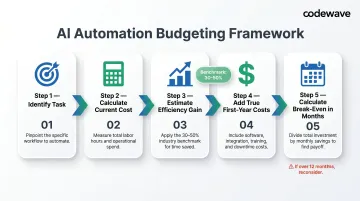
5-Step Budgeting Framework:
- Identify the specific task or process you want to automate with clear boundaries
- Calculate current cost in hours × loaded hourly rate (include benefits, overhead)
- Estimate realistic AI efficiency gain — 30–50% time savings is a conservative benchmark, not 10x
- Add all true first-year costs — setup + training + subscriptions + data preparation + contingency
- Calculate break-even in months — if over 12 months, reconsider scope
Phased Budgeting:
Once you have your break-even number, consider whether to commit fully or start smaller. The smartest approach for both SMBs and enterprises is a focused pilot on one high-frequency, measurable process. Research shows organizations implementing intelligent automation in phases see average cost reduction of 32% over 3 years, with some achieving over 70% in targeted areas. Phased deployment also limits risk — data quality gaps and hidden process issues tend to surface during a pilot, not after a full rollout.
Outcome-Based Budgeting:
Phased pilots work even better when paired with an outcome-based pricing model. Codewave's ImpactIndex™ model shifts the contract from hours logged or features licensed to measurable business results. Documented outcomes include 25% cost reduction, 40% productivity increase, and 50% faster invoice processing — making it straightforward to set a budget ceiling tied to the value you actually expect to gain.
Contingency Buffer:
Whatever model you choose, build in a buffer. PMI recommends 15–25% contingency for IT service projects, with a minimum of 10% even for well-understood projects. AI projects routinely surface data quality issues and process gaps that weren't visible upfront — and a contingency reserve keeps those discoveries from stalling the project entirely.
What Most Businesses Get Wrong About AI Automation Costs
Focusing Only on Subscription Price
The monthly fee is typically just 20–40% of true first-year cost. Gartner research confirms software costs represent only 20–35% of total AI implementation expenses. A $99/month tool becomes a $2,500+ first-year investment when you account for:
- Implementation labor ($1,500–$8,000)
- Data preparation ($500–$5,000)
- Staff training ($30–$150 per user)
- Ongoing monitoring and maintenance (10–20% annually)
Over-Specifying or Under-Investing
Copying enterprise playbooks for small-scale operations wastes money. Choosing SMB tools for complex multi-system environments builds compounding integration problems you'll pay to fix later. The right tool is the one sized to your actual workflow complexity, not what competitors use or vendors pitch.
Skipping ROI Measurement
Tool selection only matters if you can prove the tool is working. If you cannot quantify what an AI tool has saved or earned after 90 days, you have no basis to justify the investment — or expand it.
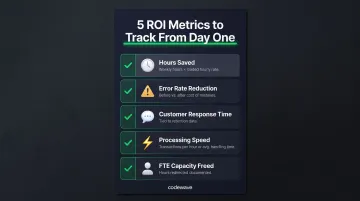
Critical metrics to track from day one:
- Track hours saved per week and multiply by your loaded hourly rate for a dollar figure
- Measure error rates before and after to calculate the cost of mistakes eliminated
- Monitor customer response time and tie improvements to retention data
- Record processing speed — transactions per hour or average handling time
- Count FTE capacity freed up and document what those hours are redirected toward
Less than 40% of organizations report measurable productivity gains from AI. Tracking these metrics from day one is what separates organizations that can prove ROI from those that cancel contracts and start over.
Frequently Asked Questions
How much does AI automation cost?
Small businesses typically spend $500–$35,000/year while enterprise deployments run $200,000–$5M+ annually, depending on workflow complexity, integration requirements, and whether custom development is involved. The subscription fee represents only 20–40% of true first-year costs when implementation, training, and maintenance are included.
What is the difference between small business and enterprise AI automation pricing?
Small business tools charge per task or operation for departmental efficiency; enterprise platforms charge per user or compute cycle for cross-system orchestration, compliance, and real-time data infrastructure. Enterprise deployments also require specialized engineering talent costing $80,000–$150,000+ annually.
What hidden costs should I expect when implementing AI automation?
Data preparation, staff training, workflow disruption, and ongoing monitoring represent 60–80% of true first-year expenses beyond the subscription price. Compliance and governance requirements in regulated industries can add 17% or more on top of that.
How long does it take to see ROI from AI automation?
Focused small business pilots targeting high-frequency tasks typically break even in 3–9 months. Enterprise deployments with complex integrations may take 12–24 months before measurable ROI is realized, with average payback periods around 22 months for intelligent automation projects.
Do small businesses need a developer to implement AI automation?
No-code and low-code tools handle common use cases — email triage, chatbots, scheduling — without developer help. Developer expertise becomes necessary when integrating legacy systems, enforcing fine-grained data permissions, or building custom workflows that templates cannot support.
When should a small business switch from no-code tools to a custom enterprise-grade solution?
Switch when processes span multiple departments requiring audit trails, when API costs at scale exceed flat per-user licensing, or when workflow complexity outpaces what template-based tools can handle without creating technical debt. This typically happens between 100–500 employees as governance and integration requirements increase.