Introduction
The enterprise agentic AI market has reached $2.58 billion in 2024 and is projected to reach $24.50 billion by 2030, according to Grand View Research. Gartner forecasts that 33% of enterprise software will include agentic AI by 2028, up from less than 1% in 2024 — a pace that gives enterprise leaders very little time to plan strategically.
That speed creates a real budgeting problem. Development costs range from $20,000 for a simple rule-based agent to over $500,000 for autonomous multi-agent systems — and many enterprises underestimate total investment, pick the wrong agent type, or miss ongoing operational expenses that add 30–50% to year-one costs.
This article breaks down pricing tiers, cost components, the factors that drive price differences, and how to build a realistic budget covering the full implementation lifecycle.
TL;DR
- Enterprise AI agent costs range from $20,000 (simple rule-based) to $500,000+ (complex multi-agent systems)
- Agent complexity, integration depth, model selection, and compliance requirements drive the biggest price differences
- Ongoing costs—cloud infrastructure, retraining, API usage—add 30–50% to initial build costs annually
- Regulated industries (healthcare, fintech) budget 20–40% more than average due to compliance and audit requirements
- Well-scoped agents targeting high-volume workflows achieve ROI within 6–12 months
How Much Does It Cost to Build an Enterprise AI Agent?
Enterprise AI agent pricing isn't a fixed number. It depends on agent type, the systems it connects to, the data it processes, and the level of autonomy required. Misreading this often leads to underbudgeting or over-specifying features that don't deliver business value.
Two budgeting mistakes derail most enterprise AI projects before they start:
- Assuming all agents cost the same regardless of complexity
- Focusing only on build costs while ignoring what you'll spend in the first year on LLM tokens, cloud compute, model retraining, and compliance audits
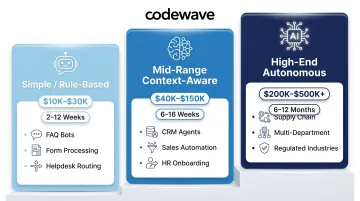
The three tiers below reflect real-world project scopes — from narrow pilot deployments to full autonomous systems.
Simple / Rule-Based Agents
Cost Range: $10,000–$30,000
What's Included:
- Requirements definition and workflow mapping
- Basic rule logic with no memory or planning
- Minimal training data
- Simple conversational interface
- Limited integrations (1–2 systems)
- Deployment timeline: 2–4 weeks for low-code platforms, 8–12 weeks for custom builds
Best For:
- FAQ automation
- Structured form processing
- Basic customer support routing
- Internal helpdesk bots
- Teams piloting AI for the first time with a narrow, well-defined use case
Mid-Range / Context-Aware and Goal-Based Agents
Cost Range: $40,000–$150,000
What's Included:
- LLM integration (GPT-4, Claude, or open-source alternatives like Llama)
- RAG (Retrieval-Augmented Generation) pipelines for company-specific knowledge
- Multi-system integrations (CRM, ERP, payment platforms, databases)
- Multi-step workflows with context tracking
- Admin dashboards with monitoring and analytics
- Deployment timeline: 6–16 weeks
Best For:
- Customer support agents with access to order/CRM data
- Sales automation (lead qualification, opportunity tracking)
- Internal knowledge retrieval from documents and databases
- HR onboarding agents
- Most mid-market enterprise deployments land here — broad enough to drive real ROI, scoped tightly enough to ship within a quarter
High-End / Autonomous and Multi-Agent Systems
Cost Range: $200,000–$500,000+
What's Included:
- Multiple coordinated agents with orchestration layers
- Custom model fine-tuning or domain-specific models
- Extensive compliance frameworks (SOC 2, HIPAA, GDPR)
- Deep legacy system integration with custom middleware
- Long-term monitoring infrastructure
- Security and risk management protocols
- Full IP ownership and control
- Deployment timeline: 6–12 months
Best For:
- Supply chain optimization with autonomous decision-making
- Multi-department workflow automation
- Autonomous decision-support in finance or legal
- Enterprise deployments in highly regulated industries
- Organizations scaling AI across multiple functions simultaneously
Key Factors That Drive Enterprise AI Agent Development Costs
Enterprise AI agent pricing is shaped by technical decisions, operational requirements, and business context. Understanding these levers helps teams budget with precision rather than guessing.
Agent Type and Complexity
Agent type is the single largest cost driver. A simple reflex agent that responds to predefined triggers requires far less engineering than a learning agent that adapts based on outcomes or a multi-agent system where multiple specialized agents collaborate.
Example: A rule-based helpdesk bot that routes tickets based on keywords costs $15,000–$25,000. A goal-based sales agent that qualifies leads, accesses CRM data, schedules meetings, and adapts its approach based on conversion rates costs $60,000–$100,000. An autonomous supply chain agent that coordinates with procurement, inventory, and logistics systems while optimizing for cost and delivery time can exceed $300,000.
Integration Depth and Legacy Systems
Every additional system integration—CRM, ERP, payment platform, legacy database—adds authentication, data mapping, error handling, and testing effort. Legacy systems are particularly expensive because 70% of Fortune 500 companies still operate software over 20 years old, according to McKinsey. These systems typically lack modern APIs and require custom middleware.
Cost per integration:
- Standard API connection (1–2 systems): $1,800–$4,300
- Complex/legacy integration (3+ systems): $4,000–$8,500+
- Enterprise-grade integration layer: $20,000–$50,000
Legacy integration is the most common hidden cost driver. Enterprises spend 60–80% of IT budgets maintaining legacy infrastructure, and integrating AI agents with these systems often doubles initial timeline estimates.
AI Model Selection and Token Usage
Choosing between proprietary API-based LLMs (GPT-4, Claude) and open-source models (Llama, Mistral) dramatically affects both upfront and ongoing costs.
Approximate API pricing (verify current rates with providers):
- GPT-4o (OpenAI): ~$2.50/million input tokens, ~$10.00/million output tokens
- Claude 3.5 Sonnet (Anthropic): ~$3.00/million input tokens, ~$15.00/million output tokens
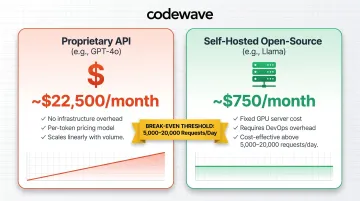
- Self-hosted Llama 3.1 8B: ~$750/month cloud GPU at 10,000 requests/day
At enterprise scale, token consumption costs compound quickly. A support agent handling 10,000 conversations/day can cost roughly $22,500/month using a proprietary API versus approximately $750/month for a self-hosted open-source model. The break-even point for self-hosting typically occurs between 5,000 and 20,000 requests/day or past 100 million tokens/month.
Data Readiness and RAG Pipeline Requirements
Clean, structured internal data lowers cost. Messy, unstructured data spread across disconnected systems adds substantial preprocessing work. RAG pipelines—which give agents access to company-specific knowledge by retrieving relevant documents before generating responses—are often non-negotiable for enterprise deployments, but they add meaningful architecture and infrastructure costs.
Data quality compounds the challenge. Most enterprise datasets carry duplicates, missing values, and inconsistent formatting. Addressing these during discovery costs far less than mid-development fixes. According to the Standish Group, correcting requirements errors in production costs 10x to 100x more than catching them during planning.
Security, Compliance, and Industry-Specific Requirements
Regulated industries face significant compliance overhead. HIPAA, GDPR, SOC 2, and CCPA requirements add encryption, audit trails, access controls, and penetration testing.
Compliance costs:
- SOC 2 audit: $10,000–$35,000
- Security and risk management: $25,000–$75,000 annually
- Monitoring and compliance infrastructure: $50,000–$100,000 annually
Healthcare data breaches cost an average of $9.77 million; financial industry breaches cost $6.08 million, according to IBM's 2024 Cost of a Data Breach Report. At those breach costs, even a $75,000 annual compliance investment is straightforward to justify.
AI Agent Development Cost Breakdown: Phase by Phase
Total cost accumulates across every development phase and continues post-launch. Enterprises that budget only for development often face surprises in the first operational year.
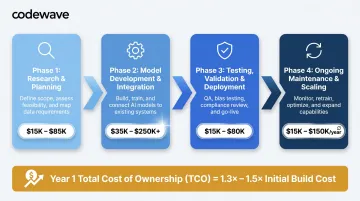
Phase 1 — Research, Planning, and Data Preparation
Cost Range: $15,000–$85,000
This phase covers:
- Requirements definition and use-case scoping
- Architecture design and technology selection
- Data auditing and readiness assessment
- AI consulting and stakeholder alignment
Skipping a rigorous discovery phase is one of the most expensive mistakes enterprise teams make—it leads to costly rework and scope creep.
The numbers are sobering: according to the Standish Group CHAOS Report, only 16.2% of software projects finish on time, on budget, and with all features. 52.7% run late or over budget, and 31.1% are cancelled outright.
A 4–6 week discovery phase directly addresses this. It forces alignment on use-case selection, data readiness, and success metrics — the exact failure factors Gartner flags as top reasons GenAI projects stall.
Phase 2 — Model Development, Integration, and Orchestration
Cost Range: $35,000–$250,000+
The largest cost component:
- Fine-tuning a foundation model (benchmarks, validation): $10,000–$50,000
- Training a custom model from scratch: $50,000–$200,000+
- Integration and workflow orchestration (API connectors, data pipelines): $20,000–$50,000
- Enterprise-grade integration layer for legacy systems: $20,000–$50,000
Integration complexity—especially with legacy systems—is the #1 variable that causes budget overruns in this phase. 48% of organizations cite complexity as the top modernization challenge, rising to 58% in early stages, per Konveyor research.
Phase 3 — Testing, Validation, Deployment, and Monitoring
Cost Range: $15,000–$80,000
AI agent testing requires multi-layered approaches unlike traditional software QA:
- Unit tests and integration tests
- Trajectory evaluation (did the agent achieve the goal?)
- Hallucination detection
- Security and adversarial testing
- Human-in-the-loop review
Cutting testing time to save money is a false economy. Skipping these layers is precisely why Gartner found that at least 50% of GenAI projects are abandoned after proof of concept — poor quality, inadequate risk controls, and unclear business value are the leading causes.
Phase 4 — Maintenance, Retraining, and Scaling (Ongoing Annual Costs)
Cost Range: $15,000–$150,000/year
Post-launch costs include:
- Cloud hosting and compute: $5,000–$30,000/month
- Model retraining as business data evolves: 15–20% of initial build cost annually
- LLM API token usage (scales with interaction volume)
- Monitoring tools and dashboards
- Compliance updates and security audits
Annual maintenance adds 15–30% of initial build cost per year. Industry benchmarks consistently show true total cost reaching 2x the initial vendor build quote over 12–18 months once data preparation, cloud compute, and model drift maintenance are factored in.
What Most Enterprises Get Wrong When Budgeting for AI Agents
Treating the Build Cost as the Total Cost
Many enterprise teams budget only for development and are caught off guard by ongoing LLM API token costs, cloud infrastructure, model retraining cycles, and security audits—which can add 30–50% to year-one spend. For a $150,000 mid-range agent build, realistic Year 1 total ownership costs range from $195,000–$270,000 when accounting for all operational expenses.
Plan budgets around total cost of ownership (TCO) across 2–3 years. The initial invoice is rarely the largest line item.
Skipping a Phased Approach in Favor of Full Autonomy from Day One
Attempting to build a complex multi-agent system without first validating a focused MVP is one of the most common causes of enterprise AI project failure and budget overrun. Gartner reports 50%+ of GenAI projects are abandoned after POC.
Starting with one high-impact, well-scoped workflow—then expanding only after proven ROI—keeps projects alive and on budget. The teams that skip this step are disproportionately represented in that 50% abandonment figure.
Under-Specifying Compliance and Integration Requirements Early
Enterprises in regulated industries often discover compliance overhead only after architecture decisions are locked in. By that point, rework is expensive and timelines have already slipped. Common requirements that surface too late include:
- HIPAA, SOC 2, or FedRAMP controls that affect data storage and model access design
- Legacy API limitations that require custom middleware not scoped in original estimates
- Audit logging and explainability requirements that demand architectural changes
- Data residency restrictions that rule out initially selected cloud regions
Surface all of these in discovery. Uncovering a compliance gap in week two costs a fraction of what it costs in week fourteen.
How to Estimate the Right Budget for an Enterprise AI Agent
The right budget for an enterprise AI agent is not the lowest price you can negotiate—it's the investment that achieves a measurable business outcome at acceptable risk. Frame cost estimation around use case, not just technology specs.
Key questions to answer before budgeting:
- What is the specific business problem being automated?
- What systems must the agent connect to, and how modern are they?
- What industry compliance requirements apply?
- What is the expected interaction volume (which determines ongoing token and infrastructure costs)?
- Is this a pilot or a production-scale deployment?
Outcome-based partnerships give enterprises better leverage over AI investment. Vendors who tie their fees to measurable results, not just deliverables, keep incentives pointed at performance rather than hours logged.
Codewave's ImpactIndex™ model works this way: every engagement is measured against concrete business outcomes, not code shipped. This distinction matters when comparing vendors, because hourly rates and project scopes tell you very little about what you'll actually get.
Once you've aligned on a vendor model, translate it into dollars with these benchmarks:
Practical rule of thumb:
- Multiply initial build cost by 1.3–1.5x to estimate year-one TCO
- Multiply by 2.0–2.5x for a realistic three-year investment view
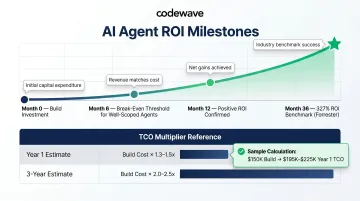
Well-scoped enterprise AI agents targeting high-volume repetitive workflows typically achieve ROI within 6–12 months. Forrester TEI research found 327% ROI over three years with payback in as few as 6 months for enterprise AI platforms.
Conclusion
The cost of building an enterprise AI agent varies widely—from $20,000 for a simple rule-based agent to $500,000+ for complex autonomous systems—and depends on agent type, integration depth, compliance requirements, and ongoing operational needs.
Enterprises that get the most from these investments typically follow a consistent pattern:
- Define measurable outcomes before scoping the build
- Budget for the full lifecycle, not just initial development
- Account for compliance, integration, and maintenance costs early
- Choose a development partner accountable to results, not just deliverables
Optimizing only for the lowest upfront cost rarely delivers the strongest return. Codewave's ImpactIndex™ model, for instance, ties engagements to measurable business outcomes — so the incentive is performance, not just project completion. That alignment between investment and result is what separates AI deployments that scale from those that stall.
Frequently Asked Questions
How much does it cost to build an AI agent?
Enterprise AI agent costs range from $10,000–$30,000 for simple rule-based agents to $500,000+ for multi-agent autonomous systems. Most mid-market enterprise deployments fall in the $40,000–$150,000 range depending on complexity, integrations, and compliance requirements.
How much do people charge for AI agents?
Development agencies charge $15,000–$500,000+ for custom builds; SaaS platforms run $20–$500/user/month; consulting firms bill $100–$450/hr. The right model depends on whether you need a configured product or a custom-built solution tied to your specific workflows.
Is it free to build an AI agent?
Basic no-code or low-code agents using platforms like Zapier or Voiceflow can be built for minimal upfront cost, but enterprise-grade AI agents—with integrations, security, compliance, and scalability—require meaningful investment. "Free" options rarely hold up under enterprise load, audit requirements, or the need for custom integrations.
How do enterprise marketing teams work with AI agents?
Enterprise marketing teams deploy AI agents for lead qualification, content repurposing, and campaign performance analysis—typically integrated with CRM and analytics platforms. Marketing-specific agents generally cost $40,000–$120,000, depending on personalization depth and the number of data integrations required.
Which AI agent is worth paying for?
The most valuable AI agents target high-volume, well-defined workflows where automation reduces measurable cost or accelerates measurable revenue—such as customer support, invoice processing, lead qualification, or internal knowledge retrieval. If a $60,000 agent eliminates $200,000 in annual manual labor, it pays for itself in under four months—that's the metric that matters.
What ongoing costs should enterprises budget for after launching an AI agent?
Key ongoing costs include LLM API token usage (scales with interaction volume), cloud infrastructure (compute and storage), model retraining (quarterly minimum to maintain accuracy), security and compliance audits, and maintenance/feature updates. These typically add 30–50% to build costs in year one.