Introduction
The global agriculture sector faces an unprecedented challenge: producing 50% more food, feed, and fiber by 2050 compared to 2012 levels while managing the reality of less arable land, constrained freshwater resources, and growing climate volatility. According to the FAO's 2025 State of the World's Land and Water Resources report, this massive production increase must also draw on 25% more freshwater—a resource already stretched thin across farming regions worldwide.
Climate change compounds the urgency. Stanford's Climate Impact Lab projects that global crop yields will be 8% lower by 2050 regardless of emission scenarios, with losses potentially reaching 24% by 2100 under high-emission pathways. Every additional degree Celsius of warming reduces food production capacity by approximately 120 calories per person per day.
Traditional farming—characterized by uniform input application, reactive pest management, and intuition-based timing—cannot close this production gap. AI-driven precision agriculture shifts the foundation from reactive guesswork to proactive, data-informed decisions: deploying the right input, in the right amount, at the right place to maximize efficiency and minimize waste.
This article explores how AI enables smarter farming decisions at every stage, from soil health monitoring to harvest forecasting, and what agribusinesses need to know to implement these technologies successfully.
TLDR:
- AI processes soil, weather, crop imagery, and historical data to generate actionable field-specific recommendations
- Precision irrigation and targeted pest detection reduce water use by up to 30% and herbicide application by 77%
- Machine learning yield forecasting achieves 93-96% accuracy, improving revenue planning and supply chain coordination
- Global AI in agriculture market projected to reach $8.5-9.5 billion by 2030, up from $1.9 billion in 2023
- Implementation requires clean data infrastructure first—poor data quality is the primary bottleneck
What Is AI-Driven Precision Agriculture, and Why Does It Matter Now?
Precision agriculture uses spatial and temporal data—from satellites, soil sensors, drones, and GPS-enabled machinery—to make field-level management decisions that respond to localized crop conditions, soil characteristics, and environmental factors. Instead of applying the same fertilizer rate across an entire 500-acre field, variable-rate technology adjusts nitrogen application zone by zone based on soil nutrient levels, elevation, and historical yield data.
This contrasts sharply with conventional farming, which treats fields as uniform blocks. Traditional methods apply inputs based on average field conditions or calendar schedules, leading to over-application in some zones (wasted cost, environmental runoff) and under-application in others (reduced yield potential).
Previous-generation precision agriculture tools generated massive amounts of data—yield maps, soil test results, NDVI imagery—but lacked the analytical capacity to synthesize this information at scale. Farmers collected terabytes of field data but still relied on manual interpretation to decide what actions to take.
AI adds the computational layer that processes multiple variables simultaneously: soil composition, weather forecasts, crop growth stage, historical pest pressure, and market prices. The output is specific, actionable guidance—for example:
- Apply 120 lbs/acre nitrogen to Zone 3 based on current soil nutrient readings
- Delay spraying in Zone 7 due to forecast rain in the next 48 hours
- Prioritize irrigation in the southeast quadrant where soil moisture has dropped below threshold
Investment patterns confirm that adoption is accelerating. The global AI in agriculture market was valued at $1.91 billion in 2023 and is projected to reach $8.5–9.5 billion by 2030—a compound annual growth rate of approximately 25.5%, according to Grand View Research and BCC Research. North America leads with 35.9% market share, while Asia-Pacific is the fastest-growing region.
The value proposition is built around resource optimization: using less water, fertilizer, and pesticide while maintaining or improving yields. This ties directly to operational cost reduction and environmental sustainability—both top priorities for modern agribusinesses facing margin pressure and regulatory scrutiny.
How AI Powers Smarter Farming Decisions: Core Applications
AI is directly influencing the operational decisions farmers and agribusinesses make every day—from planting density to irrigation schedules to harvest timing. The following use cases illustrate where AI delivers the most measurable impact.
Soil Health Monitoring and Variable-Rate Input Management
AI-powered sensors, drones, and hyperspectral imaging analyze soil composition, moisture levels, pH, and nutrient concentrations at spatial resolutions far exceeding traditional grid sampling. Machine learning models translate this high-resolution data into variable-rate prescription maps that instruct applicators exactly how much fertilizer, lime, or amendment to apply in each management zone.
Instead of blanket applications that over-fertilize some zones and under-fertilize others, AI enables targeted nutrient delivery that matches crop demand precisely. USDA Agricultural Research Service research found that precision guidance systems reduce over-application of fertilizer, seed, and herbicide by 20%.
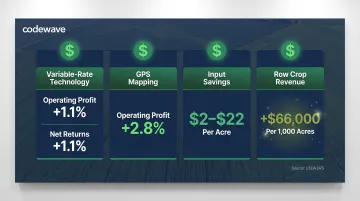
The financial case is equally direct. A USDA Economic Research Service study found:
- Variable-rate technology raised corn farm operating profit by 1.1% and net returns by 1.1%
- GPS mapping raised operating profit by 2.8%
- Precision adopters saved $2–$22 per acre depending on technology combination
- Every 1,000 acres of row crops generates an additional $66,000 in annual revenue (Association of Equipment Manufacturers)
Predictive Pest and Disease Detection
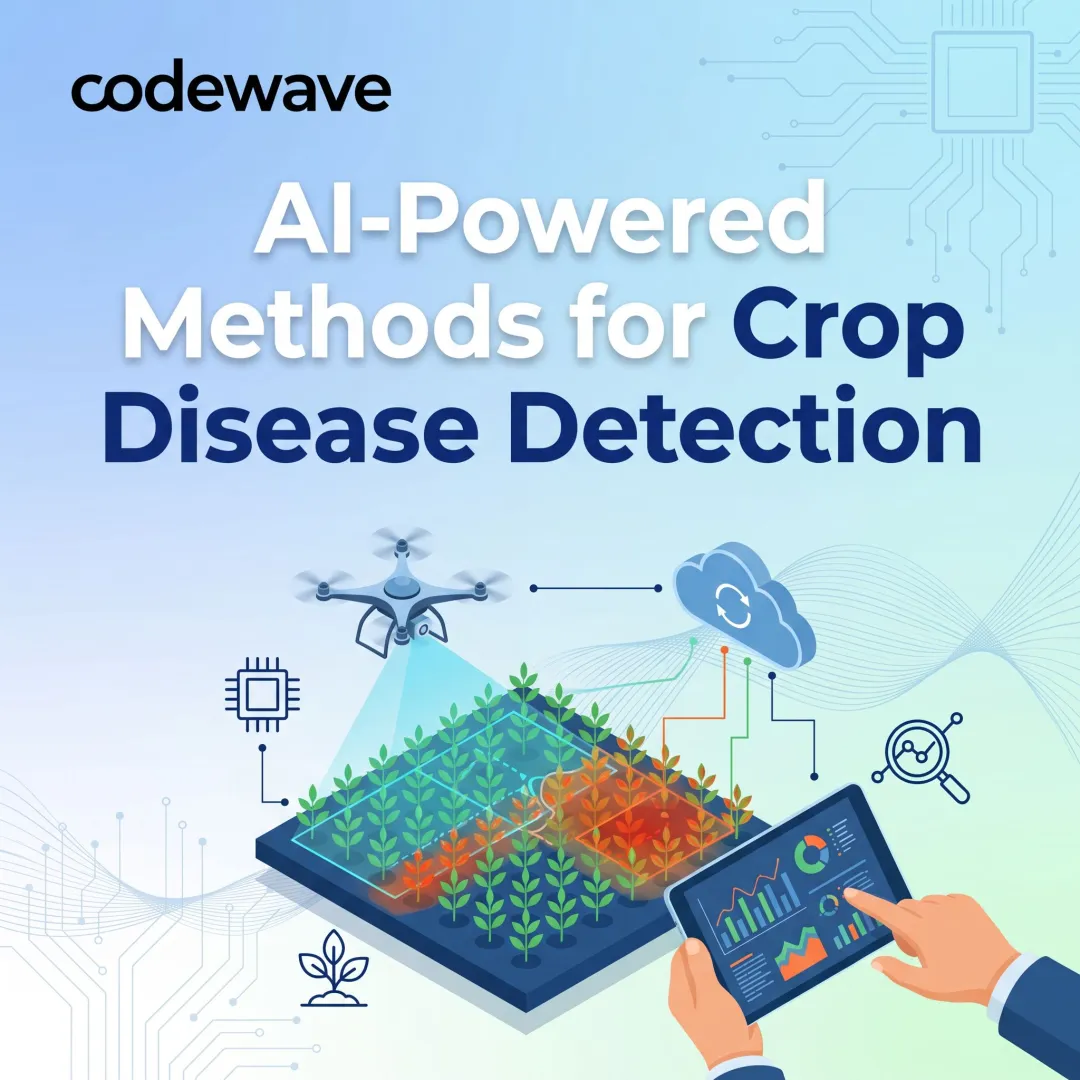
AI analyzes satellite imagery, historical outbreak patterns, weather data, and crop stress indicators to predict pest infestations or fungal disease conditions before visible symptoms appear. Computer vision models trained on millions of crop images identify disease signatures from smartphone photos uploaded by farmers in the field.
Early intervention with targeted treatment—rather than reactive broad-spectrum spraying—cuts chemical costs and protects yields. Two platforms show what this looks like at scale:
Plantix (PEAT GmbH) uses deep learning for smartphone-based disease identification with 90%+ accuracy. It serves ~10 million annual users, tracks 500 crop diseases, and adds 50,000 images daily. In one documented case, farmer Tushar Kamble received a corrected diagnosis identifying nutrient deficiency rather than disease, avoiding an unnecessary pesticide application entirely.
FAO's Nuru app, built with Pennsylvania State University, identifies fall armyworm on maize across sub-Saharan Africa. It runs offline on standard Android phones and feeds data into FAO's Fall Armyworm Monitoring and Early Warning System (FAMEWS) for real-time infestation mapping.
The stakes are significant: FAO estimates that pests and diseases destroy up to 40% of global crop production annually, costing the global economy over $220 billion.
Precision Irrigation and Water Management
Reinforcement learning algorithms and sensor fusion generate dynamic irrigation schedules based on actual crop water demand. These systems combine soil moisture sensors, weather forecasts, evapotranspiration models (which measure water lost through plant transpiration and soil evaporation), and crop growth stage data—replacing fixed calendars and manual observation.
Water is applied when and where crops need it. That precision eliminates two costly failure modes: over-irrigation, which wastes water and promotes disease, and under-irrigation, which stresses plants and cuts yields.
Field research published in ScienceDirect documented a 30% reduction in water usage with IoT-based smart irrigation systems, while maintaining optimal soil moisture levels between 35–45%. Agriculture already accounts for 70% of freshwater withdrawals worldwide (FAO)—at that scale, a 30% reduction is a substantial conservation outcome.
Yield Forecasting and Crop Planning
Machine learning models—particularly recurrent neural networks (RNNs), long short-term memory (LSTM) networks, and gradient boosting machines—process historical yield data, weather patterns, soil health metrics, and planting density to produce pre-harvest forecasts accurate enough to inform marketing, procurement, and distribution decisions.
Yield prediction is not just an agronomic tool — it's a financial planning tool. Accurate pre-harvest forecasts reduce revenue uncertainty, support supply chain coordination, and help agribusinesses lock in favorable commodity prices before harvest.
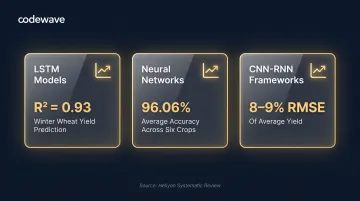
A systematic review published in Heliyon put the model performance in concrete terms:
- LSTM models achieved R² of 0.93 for winter wheat yield prediction
- Neural networks averaged 96.06% prediction accuracy across six crops
- CNN-RNN frameworks reduced root mean square error to 8–9% of average yield, outperforming traditional linear regression
That accuracy gives agribusinesses a credible basis for buyer commitments and mid-season input adjustments.
Autonomous Equipment and Weed Control
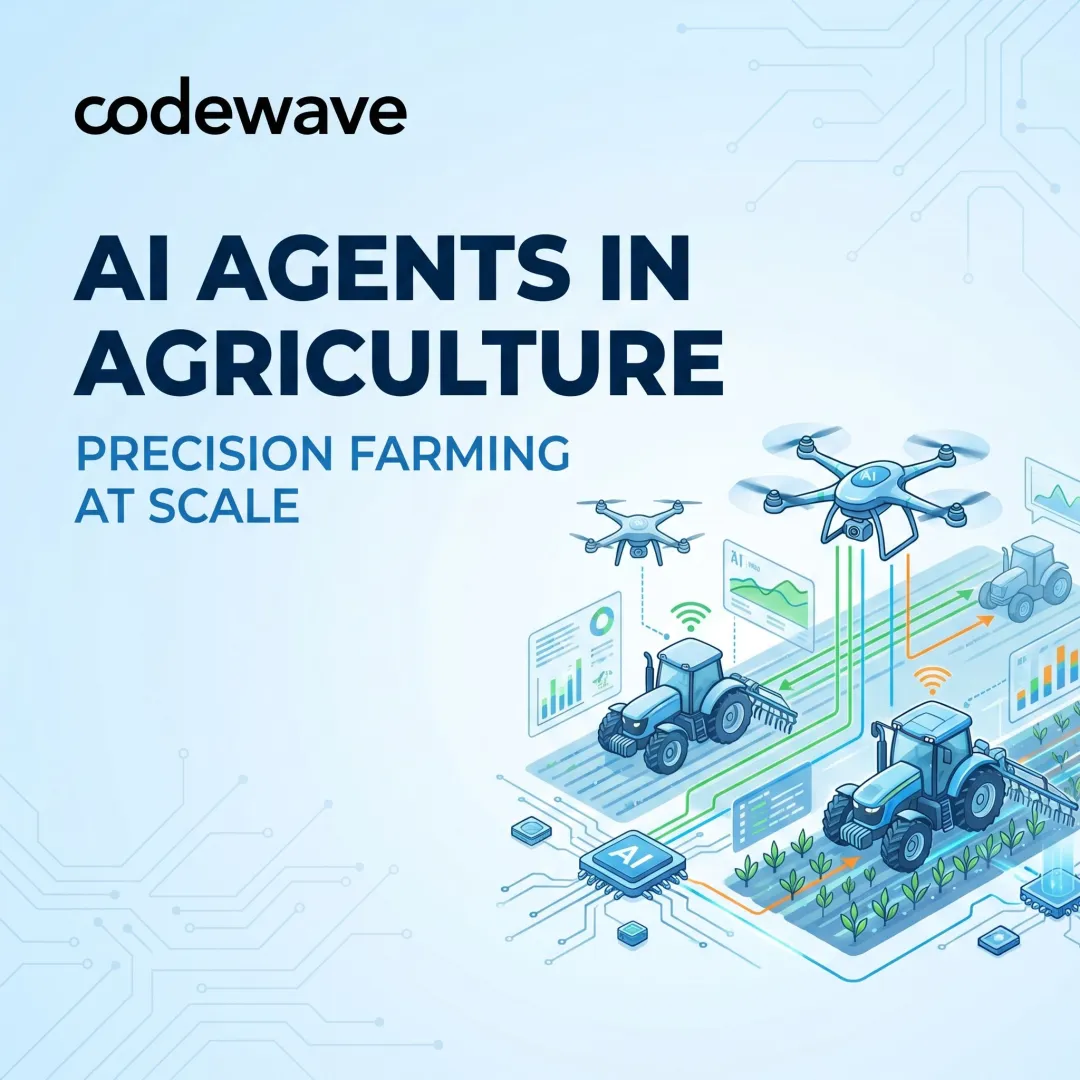
Autonomous tractors, AI-guided harvesters, and precision weed control robots represent AI moving decisions from the operator's cab to the algorithm—reducing labor costs, improving timing precision, and minimizing herbicide use.
John Deere's See & Spray Select system uses computer vision and machine learning to deliver targeted herbicide application, achieving 77% average herbicide savings based on a study of 75,000 acres. Cameras scan the field in real-time, activating nozzles only when weeds are identified.
Carbon Robotics' LaserWeeder uses computer vision and deep learning to identify and laser-destroy more than 100,000 weeds per hour without chemicals. Documented results for specialty row crops showed hand weeding costs dropped from $900/acre to $282/acre, with net savings of $350/acre and annual savings of $822,500 for a single machine covering 2,350 acres.
From Raw Data to Real Decisions: The AI Pipeline in Agriculture
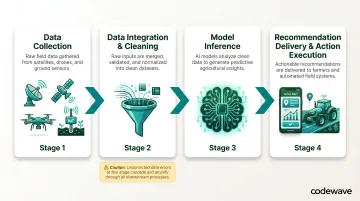
Understanding the end-to-end data flow is essential for agribusinesses evaluating AI adoption. The pipeline follows this sequence:
Data collection → Data integration and cleaning → Model inference → Recommendation delivery → Action execution
Each stage builds on the last — and a breakdown at any point degrades the quality of every recommendation downstream.
Data collection — Satellites capture multispectral imagery of crop health. IoT soil sensors log moisture, temperature, and nutrients every 15 minutes. Drones with hyperspectral cameras surface stress zones invisible to the naked eye. GPS-equipped machinery records application rates and coverage in real time.
Data integration and cleaning — Raw data from varied sources — sensor manufacturers, machinery brands, weather APIs — requires normalization into consistent formats, accurate timestamping, and spatial alignment. A field boundary mismatch of just 5 meters can route fertilizer prescriptions to the wrong zone.
Model inference — ML models trained on historical patterns detect anomalies and predict outcomes. A pest model, for example, might flag that current temperature, humidity, and crop stage match conditions that preceded aphid outbreaks within 7-10 days.
Recommendation delivery — Insights reach farmers as specific actions via mobile apps, dashboards, or automated triggers: "Increase irrigation runtime by 20% in Zone 4" or "Schedule fungicide application in northern fields within 48 hours."
When the Cloud Is Too Slow
Some decisions can't wait for a round-trip to a server. When an autonomous sprayer must identify a weed and trigger a nozzle in milliseconds, cloud latency fails. AI models deployed at the edge — on local devices with limited compute — handle these real-time calls. That requires deliberate architecture choices that go well beyond raw model accuracy.
Why Explainability Is Non-Negotiable
Farmers act on recommendations they understand. Techniques like SHAP values translate opaque model outputs into plain language: "This zone is flagged for nitrogen deficiency because spectral readings fall 30% below baseline for this crop stage." That transparency converts AI output from a black box into a decision-support tool agronomists actually trust.
Building the Infrastructure That Makes It Work
Codewave has built data pipelines for clients across agriculture and adjacent industries using TensorFlow, Snowflake, and Apache Kafka. Those implementations have produced 3X faster data processing and 90% fewer data errors — concrete gains that show up in field-level recommendations, not just dashboard metrics.
Measurable Impact: What AI Delivers for Agribusinesses
The business case for AI in agriculture comes down to three numbers: higher yields, lower input costs, and faster ROI. For agribusiness decision-makers, the data from real-world adoption is increasingly hard to ignore.
Yield and Productivity Gains
USDA Economic Research Service data shows precision agriculture adopters achieve operating profits $66 per acre higher than non-adopters, with labor hours per bushel running 35% lower among GPS mapping users. These gains trace back to optimized input management, earlier stress detection, and better planting decisions — areas where AI delivers the most consistent lift.
A survey cited by University of Illinois Extension found that 88% of crop producers stated precision agriculture technologies had a positive impact on their farm's financial profitability, with 29% identifying variable-rate fertilizer application as the technology most likely to increase yields and reduce input costs.
Cost and Resource Efficiency
Yield gains matter, but cost savings tend to show up on the balance sheet faster. Input cost reduction is where many agribusinesses see their first concrete return from AI adoption:
Herbicide savings:
- John Deere See & Spray Select: 77% average herbicide savings