While traditional AI has supported agriculture for years through yield prediction models and logistics optimization, generative AI introduces fundamentally new capabilities. Rather than simply analyzing existing data, GenAI creates new outputs: personalized crop advisories written in local languages, compliance reports generated in seconds, and context-specific recommendations that translate complex data into plain-language action steps. This shift from analysis to actionable guidance represents a pivotal moment for an industry where 80% of smallholder farmers lack basic insurance access and extension agent ratios reach 1:5,000 in some regions.
This article explores how generative AI differs from traditional agricultural AI, examines the highest-impact use cases transforming both farm operations and enterprise functions, addresses the real implementation challenges organizations face, and provides practical guidance for getting started.
TLDR
- GenAI creates actionable outputs—advisories, compliance documents, personalized recommendations—that traditional analytical AI cannot generate
- The generative AI in agriculture market was valued at $226.2 million in 2024 and is projected to reach $2,158.9 million by 2033 at a 28.7% CAGR
- On-farm applications include intelligent crop advisory chatbots, automated reporting systems, and predictive maintenance tools that reduce manual workload
- Enterprise applications accelerate R&D cycles, personalize farmer marketing, and optimize volatile supply chains
- Key adoption barriers—data fragmentation, rural connectivity gaps, and hallucination risks—demand human-in-the-loop validation before deployment
Why Agriculture Is the Perfect Proving Ground for Generative AI
Few industries generate data at agriculture's scale and variety. Satellite imagery, localized weather logs, soil sensor readings from distributed IoT networks, and decades of handwritten agronomic notes all flow into farm management systems daily.
Yet most of it goes unused. Traditional analytical tools can't reconcile these diverse, unstructured inputs—leaving terabytes of potentially valuable information sitting in silos with no clear path to action.
GenAI closes this gap by processing varied data types simultaneously and translating raw information into natural-language insights. A farmer no longer needs to interpret complex dashboards showing satellite indices, soil moisture percentages, and weather probability models—GenAI synthesizes these inputs and generates a simple recommendation: "Delay irrigation for 48 hours; forecasted rain will provide adequate moisture."
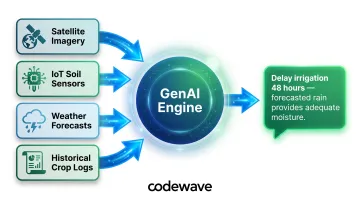
The market opportunity reflects this transformational potential:
- McKinsey estimates AI (analytical + generative) can unlock $250 billion in economic value across agriculture—$100 billion on-the-acre and $150 billion at the enterprise level
- The GenAI-specific agriculture market is growing at 28.7% CAGR, significantly outpacing general agricultural technology adoption
- FAO projects food production must increase 70% by 2050 to feed 9.1 billion people, while agricultural labor hours have declined 80% since 1948
The industry also operates with extended R&D cycles—bringing a new crop protection product to market requires $301 million and 12.3 years—making any technology that compresses development timelines exceptionally valuable. The access problem compounds this further. Millions of smallholder farmers need personalized agronomic guidance but face extension agent ratios of 1:3,000 or worse in many regions. GenAI-powered virtual advisers can reach these farmers directly, at marginal cost, without waiting for an agent to show up.
What Generative AI Does That Traditional AI Cannot
Understanding the distinction between traditional AI and generative AI clarifies why GenAI represents a fundamental shift in how agricultural decisions get made and communicated.
Traditional (analytical) AI excels at classification, prediction, and optimization using structured data. It identifies patterns in historical datasets and applies those patterns to new situations. Agricultural applications include:
- Analyzing satellite imagery to detect early crop stress
- Predicting yield based on historical weather and soil data
- Classifying pest infestations from trap images
- Forecasting supply chain disruptions based on logistics patterns
Generative AI produces new content—text, recommendations, code, summaries—by processing large, varied, and often unstructured datasets. In agriculture, this means moving beyond "this field will yield 8.2 tons per hectare" to "here is a three-step irrigation plan for this field, written in your local language, with specific product recommendations available from your regional distributor."
Side-by-Side Examples:
| Scenario | Traditional AI | Generative AI |
|---|---|---|
| Crop health monitoring | Detects nitrogen deficiency in satellite imagery and flags affected zones | Generates a farmer-facing WhatsApp message: "North field shows nitrogen stress. Apply 25 kg urea per acre within 3 days. Local supplier Agromart has stock." |
| Supply chain disruption | Forecasts 40% probability of fertilizer shipment delay based on port congestion patterns | Drafts alternative procurement scenarios with three supplier options, negotiation talking points, and updated delivery timelines |
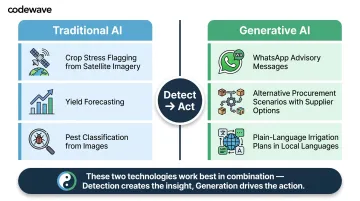
The two technologies deliver maximum value when combined in a "detect and act" loop: analytical AI provides the precision data foundation, and GenAI translates findings into communication, automation, and decision support. For agribusinesses, the practical question is how to integrate both layers without building two separate systems — which is where implementation approach matters as much as technology choice.
How Generative AI Is Transforming On-Farm Operations
Intelligent Crop Advisory and Personalized Decision Support
GenAI-powered virtual agronomy advisers combine multiple data sources—IoT sensor readings, satellite imagery, weather forecasts, historical crop performance—to generate personalized, farm-specific recommendations. Rather than presenting farmers with complex dashboards requiring interpretation, these systems answer direct questions in natural language: "Should I irrigate today?" or "Which fungicide should I apply to my wheat block?"
CropIn's Sage platform reaches 7 million+ farmers across 30 million acres in 100+ countries, delivering actionable advisories—pest-risk alerts, harvest-window predictions, irrigation recommendations—in local languages through mobile-first interfaces. The platform covers 400 crops and 10,000+ crop varieties, showing how GenAI can deliver expert-level guidance to farmers who would never see an agronomist in person.
GenAI delivers advisories via WhatsApp, SMS, or voice in local languages, removing dependency on scarce in-person agronomist visits. In regions where extension agent-to-farmer ratios reach 1:3,000 or higher, virtual advisers bring precision agriculture within reach for smallholder farmers who previously lacked access to expert guidance.
Microsoft's Krishi Mitra app, currently piloting with 300,000 farmers, projects expansion to 10 million users across 9 key crops in 5 Global South countries. This matters at a systemic level: 80% of smallholder farmers have no insurance, and the world's 450 million smallholders face a $200 billion financing gap. GenAI advisory tools don't just improve yields—they generate the data trail needed for credit access and risk assessment.
Automating Farm Reporting, Alerts, and Routine Management
The same data streams that power crop advisories also create a documentation burden. Farm managers spend significant time compiling field notes, expense records, compliance logs, and weekly reports—pulling from disconnected systems and manually reconciling inconsistencies. GenAI agents automate this by connecting to ERP systems, field management software, and IoT sensors to generate complete reports in seconds.
Beyond reporting, GenAI agents turn passive anomaly detection into active communication. Rather than logging an issue and waiting for someone to notice, they generate actionable messages and route them to the right person immediately:
- Soil moisture drops below threshold → Message to farm manager with irrigation recommendation
- Pest pressure pattern detected → Alert to agronomist with affected zones and treatment options
- Machinery error code logged → Notification to equipment dealer with diagnostic summary
This shift from passive data logging to active communication ensures critical information reaches decision-makers immediately, reducing response time and preventing small issues from escalating into yield-impacting problems.
Predictive Maintenance and Precision Input Optimization
Equipment downtime during critical windows—planting, spraying, harvest—carries enormous cost. Unplanned breakdowns cost U.S. farmers approximately $3,348 per season per farmer due to restrictive repair policies and parts availability challenges. GenAI, integrated with equipment telematics, synthesizes maintenance logs and sensor readings to generate predictive maintenance schedules in plain language, notify dealers automatically, and reduce costly unplanned downtime.
Input costs tell a similar story. GenAI translates nutrient deficiency data from satellite imagery or soil samples into field-level fertilizer and irrigation recommendations—replacing blanket application rates with targeted ones. Variable rate technology guided by GenAI can achieve fertilizer savings up to 20% in data-rich zones. Precision irrigation frameworks go further, improving water productivity by 2% while cutting energy consumption by 37% per unit of production.
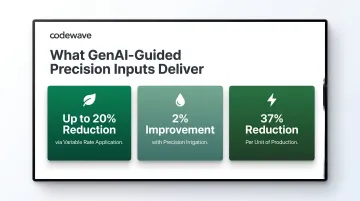
For farm operators, these two levers—keeping equipment running and applying inputs precisely—target the cost categories where margin is most often lost.
Enterprise Transformation: GenAI Across the Agricultural Value Chain
Accelerating R&D, Seed Discovery, and Regulatory Compliance
Input companies—seed developers, crop protection manufacturers, biologicals producers—face extended R&D cycles that delay product commercialization and slow product launches. GenAI is compressing these timelines sharply.
Bayer's AI-powered precision breeding is a leading example: a single breeding cycle compressed from 5–6 years to roughly 4 months. GenAI models screen genomic datasets, scan patents and scientific literature in natural language, and propose candidate sequences for testing — shrinking the discovery phase from years to months.
The downstream numbers are equally striking:
- Seed production field productivity up over 30%
- FieldView digital platform now managing 220+ million acres across 20+ countries
- Genetic gain rate targeted to double by 2030
Regulatory acceleration represents another high-value application. Bringing a new crop protection active ingredient to market costs $301 million over 12.3 years, with registration costs alone averaging $42 million. GenAI cuts into that burden by automating trial data collection, generating registration documents, and tracking shifting regulatory requirements across markets — reducing both the time and cost of commercialization.
Syngenta's collaboration with InstaDeep on the AgroNT large language model follows the same logic — integrating natural language processing into proprietary R&D pipelines to accelerate seed trait research. The same capability that speeds up breeding and regulatory work is now reshaping how agribusinesses sell to and serve farmers.
Personalized Marketing, Sales Enablement, and Customer Experience
Agribusinesses serving large farmer bases—input distributors, agronomy services, rural fintech providers—use GenAI to personalize marketing at scale:
- Generating farmer-specific content based on crop history, geography, and purchase behavior
- Creating product education agents on WhatsApp/SMS that answer technical questions
- Providing AI-powered sales copilots that generate tailored pitches for field sales representatives
Fintech and insurance applications address critical access gaps. GenAI automates loan application processing by synthesizing farm performance data and satellite imagery into credit risk profiles, reducing manual underwriting time and expanding access to capital. SatSure offers a "Farm Credit Score"—a proprietary risk score derived from multi-season crop data, climatic risks, and proximity factors—embedded directly into lending workflows.
For insurance, GenAI can auto-trigger claims based on weather data or drone-confirmed crop damage, reducing paperwork burden on farmers and administrative costs for institutions. In markets where 80% of smallholder farmers have no coverage at all, that friction reduction is the difference between uptake and exclusion.
Supply Chain Resilience and Operational Intelligence
Agricultural supply chains face extreme volatility from weather events, trade disruptions, and demand swings. Globally, 13.2% of food is lost in the supply chain after harvest and before retail, with an additional 19% wasted at household and retail levels.
GenAI monitors real-time signals across supply networks and generates disruption scenarios with updated procurement or logistics recommendations—without requiring weeks of analyst time. Cargill won the 2026 BIG Artificial Intelligence Excellence Award for integrating AI across its value chain from on-farm decision tools to supply chain optimization.
That same operational intelligence extends inward to ESG reporting and workforce management — two areas where large agroholdings struggle with consistency at scale. ESG and workforce applications now include:
- Auto-generating sustainability reports from multi-farm performance data
- Synthesizing dashboards that surface compliance gaps across dispersed operations
- Delivering onboarding and training to field workforces through conversational AI tools
The result is tighter regulatory compliance and a more consistent workforce — without adding headcount to manage either.
The Real Challenges of Adopting GenAI in Agriculture
Data Readiness Gap
GenAI models are only as effective as the data they're trained on. Agricultural data, unfortunately, remains largely unprepared for AI deployment.
The Council for Agricultural Science and Technology describes it as "fragmented, distributed, heterogeneous, and incompatible," with no universal interoperability framework—unlike healthcare or finance, which have established data standards.
Farms and agribusinesses have collected decades of information, but most of it sits in disconnected systems—IoT platforms that don't talk to ERP software, field management applications isolated from satellite data feeds, and advisory documents trapped as PDFs that AI can't reason over.
Organizations must invest in data integration before expecting meaningful GenAI output. This includes:
- Mapping data lineage across disconnected systems
- Defining authoritative data sources for key metrics
- Building validation pipelines that flag inconsistencies
- Creating unified data warehouses that connect IoT, ERP, and field management platforms
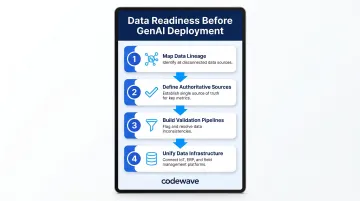
This groundwork is where most implementations stall. Codewave has helped agribusinesses navigate this stage across 400+ engagements—using tools like TensorFlow, Kafka, and Snowflake to assess data readiness and validate quality through rapid prototyping before committing to full-scale deployment.
Connectivity and Trust Barriers in Rural Contexts
ITU reports 85% of urban populations are online versus only 58% in rural areas, with 2.2 billion people globally still offline. Many farming regions lack reliable internet infrastructure, making cloud-dependent AI tools impractical.
Successful implementations require low-bandwidth design choices:
- SMS and WhatsApp delivery rather than data-heavy mobile apps
- Offline-capable applications that sync when connectivity is available
- Voice-based interfaces for farmers with limited literacy
- Local language support that goes beyond simple translation to context-appropriate phrasing
Trust is the other major hurdle. Farmers may be skeptical of AI-generated advice that conflicts with their experience or local knowledge. Effective change management involves trusted agronomists validating AI recommendations before broad rollout, pilot programs that demonstrate value on small scales first, and transparent communication about how recommendations are generated.
Risk Management and Governance
GenAI hallucinations—confident but incorrect outputs—carry real stakes in agriculture. A wrong spray recommendation can damage yields, an incorrect irrigation schedule can stress crops, and miscalculated fertilizer rates can harm ecosystems.
Stanford research shows LLM hallucination rates of 58-88% on legal queries, and agriculture's complexity compounds this risk. General-purpose AI models "fall apart" when applied to specific soil types, previous crop interactions, and local product availability—agriculture's variability breaks horizontal LLM approaches.
Three mitigation strategies reduce these risks in practice:
- Human-in-the-loop validation: agronomists review AI recommendations before delivery to farmers
- Domain-specific training: Bayer's E.L.Y. system was trained exclusively on proprietary agronomic datasets rather than open-source data, outperforming general LLMs on agricultural queries
- Clear accuracy thresholds: define acceptable confidence levels before deployment
- Embed ethical AI governance frameworks with risk assessment and bias detection built in from day one
Organizations implementing GenAI in agriculture must weigh the cost of inaction—leaving millions without advisory access—against the risk of imperfect recommendations. The answer lies in deployment with defined guardrails: domain-specific training, human review checkpoints, and governance frameworks embedded from the start, not bolted on after launch.
Frequently Asked Questions
What is the difference between AI and generative AI in agriculture?
Traditional AI classifies and predicts using structured data—think yield forecasting or pest detection from images. Generative AI goes further, producing new outputs like written advisories, compliance documents, and personalized recommendations. The two work best together: analytical AI detects patterns, GenAI translates them into actionable guidance.
What are the most impactful use cases of generative AI in farming today?
The highest-impact applications today are virtual agronomy advisers, automated farm reporting, predictive equipment maintenance alerts, and multilingual advisory delivery via WhatsApp or SMS. Each addresses a distinct operational bottleneck where manual processes previously slowed decision-making.
How does generative AI help reduce input costs in agriculture?
GenAI translates precision data (soil samples, satellite imagery, weather forecasts) into specific, field-level input recommendations—reducing over-application of fertilizers, pesticides, and water. Variable rate fertilizer application can achieve up to 20% savings, while precision irrigation can improve water productivity by 2% while reducing energy consumption by 37%.
Can generative AI work for smallholder or resource-limited farmers?
GenAI advisory tools designed for low-bandwidth delivery (WhatsApp, SMS, voice) and local language support bring expert agronomic guidance to smallholder farmers at low cost. Platforms like CropIn already reach 7 million+ farmers across 30 million acres—removing the dependency on infrequent in-person agronomist visits.
What are the biggest challenges agribusinesses face when implementing generative AI?
Three barriers dominate: fragmented data pipelines that need integration before deployment, rural connectivity constraints that require low-bandwidth design, and the need for human validation to catch erroneous outputs before they cause crop or financial damage.
How long does it take to implement a generative AI solution for agricultural operations?
Focused use cases—automated reporting agents, WhatsApp advisory bots—can be prototyped and piloted in weeks. Enterprise-wide implementations integrating multiple data sources typically take several months, with phased rollouts recommended to validate data quality and adoption before full-scale deployment.
Ready to explore how generative AI can transform your agricultural operations? Codewave has partnered with 400+ businesses to build AI and data solutions that drive measurable outcomes. Schedule a consultation to assess your data readiness and identify the highest-value GenAI use cases for your operation.