Introduction
A commercial aircraft engine generates as much as 20 terabytes of data per engine per hour of flight, while an Airbus A350 produces approximately 2.5 terabytes daily. This data explosion—spanning real-time sensor feeds, MRO logs, passenger behavior analytics, and ATC communications—creates both a competitive advantage and an operational challenge for airlines, MROs, and airports worldwide.
The challenge? More than 80% of MRO organizations cite data limitations as the most significant barrier to digital adoption. Legacy systems remain siloed, maintenance technicians spend 60% of their day on manual research rather than wrench time, and supply chain challenges cost airlines more than $11 billion in 2025 alone.
Specialized AI and data consulting firms translate this raw operational data into predictive maintenance alerts, route optimization models, safety compliance dashboards, and personalized passenger experiences that impact margins.
Finding the right partner requires more than technical depth in data pipelines and ML models — it demands fluency in FAA and EASA compliance, too. This guide ranks the top aviation AI and data consulting firms for 2026, covering what each does best and how to evaluate fit for your operation.
TL;DR
- Aviation AI consultants connect siloed legacy data into real-time intelligence that drives operational decisions
- High-ROI use cases: predictive maintenance, fuel analytics, crew scheduling, revenue management, and baggage optimization
- Top firms pair deep aviation domain knowledge with hands-on AI engineering and regulatory literacy
- Top services in 2026: Codewave, Accenture, IBM Consulting, SITA, Capgemini Engineering, and Palantir Technologies
- Selection criteria: proven aviation delivery, legacy integration experience, regulatory know-how, and measurable ROI
Overview of AI and Data Consulting in the Aviation Industry
Aviation AI and data consulting encompasses three core disciplines: strategic advisory (AI roadmapping, data governance frameworks), technical delivery (building data lakes, ML pipelines, real-time dashboards), and operational integration (connecting insights into dispatch systems, ERP, MRO platforms). The work isn't software licensing — it's embedding intelligence directly into flight operations, maintenance cycles, and ground handling workflows.
The AI in Aviation Market is valued at $8.63 billion in 2025 and projected to reach $171.53 billion by 2033, growing at a 45.33% CAGR. Predictive maintenance alone holds 28.45% market share, yet only 6% of MRO organizations have successfully integrated digital and analytics at scale throughout their operations.
The financial exposure makes the investment case concrete:
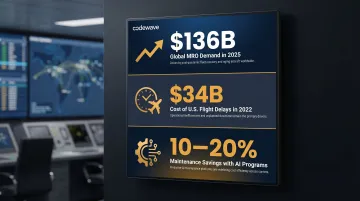
- Global MRO demand hit $136 billion in 2025, with U.S. airline maintenance costs up 15% over five years
- Flight delays cost the U.S. economy $34 billion in 2022 alone
- Organizations running AI-powered maintenance programs report 10-20% reductions in maintenance spending and 10%+ gains in engineering productivity
Given how specialized aviation data environments are — ACARS feeds, AMOS platforms, ATA chapter coding, SPEC 2000 standards — the section below ranks the top firms evaluated for aviation-specific capability, delivery maturity, and proven operational outcomes.
Top Aviation AI and Data Consulting Services in 2026
Each firm below was evaluated on criteria that reflect what aviation deployments actually demand. Selection was based on aviation domain expertise, technical depth in AI and data engineering, ability to integrate with aviation-native systems (ACARS, AMOS, SITA platforms, OEM data feeds), evidence of production deployments, and the ability to deliver measurable operational or financial outcomes — not just proofs of concept.
Codewave
Award-winning AI and data consulting firm with cross-industry delivery experience including transportation, offering end-to-end data solutions spanning data engineering, predictive analytics, and intelligent automation. Built on a stack that includes TensorFlow, Apache Kafka, Snowflake, and Power BI, Codewave delivers production-grade systems designed for complex operational environments.
What sets Codewave apart:
- ImpactIndex™ ties fees to measurable outcomes, not hours — clients pay for results that move the needle
- QuantumAgile™ compresses idea-to-validated-outcome timelines from months to days
- ZeroDX™ removes middlemen entirely, so aviation clients work directly with the engineers building their systems
The firm reports 95%+ data accuracy, 3X faster processing, and approximately 3 weeks saved per month in manual data work across client engagements.
In regulated industries requiring compliance rigor comparable to FAA/EASA standards — healthcare (HIPAA), fintech (PCI-DSS, SOC 2) — Codewave has achieved a 94% decrease in flagged violations and 100% adherence to regional data residency requirements.
Their transportation and logistics work spans real-time fleet management optimization, predictive maintenance platforms, and IoT telemetry processing. These capabilities translate directly to aviation ground operations and MRO analytics.
| Core Aviation Offerings | Data pipeline engineering, predictive analytics, operational dashboards, AI model development, intelligent process automation for MRO and ground ops |
|---|---|
| Key Aviation Use Cases | Predictive maintenance modeling, fuel consumption analytics, ground turnaround optimization, operational reporting automation |
| Engagement Model | Outcome-based (ImpactIndex™); project and retainer options; direct collaboration model (ZeroDX™) |
Accenture
Global consulting firm with a dedicated Aerospace & Defense practice, supporting airlines, MROs, and airport operators with AI strategy, digital twin programs, data platform modernization, and intelligent automation at enterprise scale.
Accenture differentiates through proprietary AI platforms, deep partnerships with cloud providers (AWS, Azure, Google Cloud), and a proven track record deploying AI in highly regulated aviation environments. The firm partnered with Air France-KLM to migrate 350 applications to the cloud, transforming aircraft maintenance operations using AI and generative AI for real-time resource scalability and faster time-to-market.
Their aviation thought leadership includes published frameworks for digital twins, predictive analysis, and operational simulations — demonstrating both strategic vision and technical execution capability.
| Core Aviation Offerings | AI strategy, digital twin development, predictive MRO, airline revenue management analytics, cloud data platform migration |
|---|---|
| Key Aviation Use Cases | Predictive maintenance, operational disruption management, crew and fleet optimization, ancillary revenue analytics |
| Engagement Model | End-to-end transformation; multi-year program; enterprise-scale delivery |
IBM Consulting
Leverages IBM Watsonx and IBM Maximo (asset management AI) to deliver aviation-specific AI consulting across MRO optimization, safety analytics, and operational intelligence. IBM brings a long-standing presence in airline and aerospace IT infrastructure that few technology firms can match.
IBM differentiates through deep integration capability with legacy aviation systems, aviation-hardened governance and compliance frameworks, and established partnerships with major OEMs and airline IT ecosystems (SITA, SAP, Salesforce). This enables aviation clients to add intelligence to existing infrastructure without full replacement.
Riyadh Air partnered with IBM to integrate Watsonx and deploy agentic AI across their enterprise, targeting over 100 destinations by 2030. IBM Maximo supports major airports including Amsterdam Schiphol, Riyadh Airports Company, and Palermo Airport with AI-enabled remote asset monitoring and automated visual inspection.
| Core Aviation Offerings | Watsonx AI consulting, MRO asset intelligence (Maximo), safety and compliance analytics, operational data integration |
|---|---|
| Key Aviation Use Cases | Aircraft component lifecycle prediction, maintenance cost reduction, regulatory reporting automation, ground crew productivity analytics |
| Engagement Model | Platform-led consulting; hybrid licensing + implementation model; global delivery |
SITA
Aviation-native IT and data services company serving over 1,000 airports and most of the world's airlines, providing specialized data consulting, analytics platforms, and AI solutions built entirely around aviation operational data.
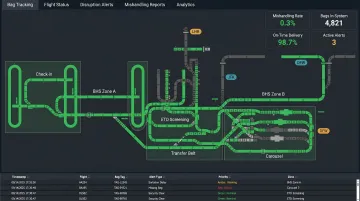
SITA is unique on this list as the only pure-play aviation technology and consulting organization. The firm owns aviation data networks (AirportHub, ACRIS standards) and delivers real-time passenger and baggage intelligence. WorldTracer is used by over 2,800 airports and 500 airlines — the de facto standard for baggage management.
SITA's Bag Manager deployment across 44 airports in India cut mishandling rates by 20%, contributing to a global 63% reduction in mishandled baggage since 2007. The firm recently launched Bag Radar, a cloud-based predictive baggage analytics solution offering early warning of disruptions.
This aviation-specific data product approach — not adapted general-purpose tools — makes SITA the go-to partner for airports and airlines seeking proven, aviation-native analytics.
| Core Aviation Offerings | Airport analytics, passenger flow intelligence, baggage analytics, airline data management, biometric identity consulting |
|---|---|
| Key Aviation Use Cases | Terminal capacity optimization, on-time performance analytics, baggage mishandling reduction, passenger experience personalization |
| Engagement Model | Aviation-native SaaS + consulting hybrid; subscription and advisory models; global airport and airline client base |
Capgemini Engineering
Engineering and digital transformation consultancy with a dedicated Aerospace, Defense & Space division, providing AI-driven engineering services including digital twin development, predictive maintenance systems, simulation modeling, and safety-critical software for OEMs and MROs.
Known for deep engineering domain expertise that bridges software and physical aviation systems, Capgemini differentiates through Model-Based Systems Engineering (MBSE) capabilities, FAA/EASA-aligned development practices, and experience deploying AI systems in safety-critical environments including avionics and engine health monitoring.
Capgemini designed an end-to-end predictive asset maintenance solution for a European aircraft component manufacturer using edge compute and Intel IoT Gateways, minimizing production downtime and enabling real-time detection of equipment failures. MTU Aero Engines AG implemented MBSE with Capgemini to accelerate engineering workflows.
| Core Aviation Offerings | Digital twin consulting, AI-enhanced MRO, avionics software, predictive engine health monitoring, aerospace simulation |
|---|---|
| Key Aviation Use Cases | Engine performance degradation prediction, flight test data analytics, aircraft structural health monitoring, MRO planning optimization |
| Engagement Model | Program-based engineering delivery; co-development models with OEMs; safety-certified development standards |
Palantir Technologies
Data analytics and AI platform company that powers Airbus Skywise, one of aviation's largest open data platforms, providing aviation AI consulting built around its Foundry and AIP platforms for fleet intelligence, operational analytics, and MRO data integration.
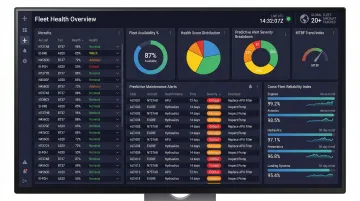
Palantir differentiates as the only firm on this list that serves as both the platform provider and implementation consultant for aviation data ecosystems. Skywise connects 10,500+ aircraft (49% of the Airbus fleet) with 25,000+ unique monthly users managing petabytes of data. The platform increased A350 delivery rates by 33% through integrated production data analytics.
Allegiant Air reported: "We are saving no less than one aircraft out of service per day, largely based on predictive alerting." Palantir's strategic partnership with FTAI Aviation deploys AIP across global CFM56 and V2500 engine maintenance to improve scheduling, inventory optimization, and automated workflows.
Foundry has become a de facto data operating system for large fleet operators, enabling cross-fleet analytics at a scale no bespoke consulting engagement can replicate.
| Core Aviation Offerings | Fleet data platform (Skywise/Foundry), AI-driven MRO analytics, operational decision intelligence, AIP aviation deployment |
|---|---|
| Key Aviation Use Cases | Fleet reliability analytics, AOG (Aircraft on Ground) prevention, maintenance interval optimization, fuel and emissions intelligence |
| Engagement Model | Platform licensing + implementation consulting; ecosystem-based delivery through Airbus Skywise; enterprise contracts |
How We Chose the Best Aviation AI and Data Consulting Partners
A common mistake aviation buyers make is selecting general-purpose AI consulting firms without verifying aviation-specific domain depth. This leads to long onboarding cycles, poor integration with ACARS/AMOS/MRO platforms, and AI models trained on generic industrial data rather than aviation operational data.
Our evaluation criteria prioritized:
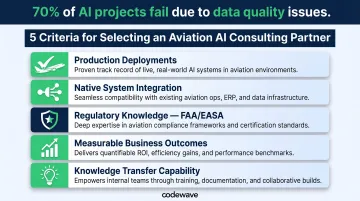
- Verified production deployments in aviation — not analogous industry references or proof-of-concept claims
- Native integration with ACARS, AMOS, ATA chapters, SPEC 2000, and OEM data feeds
- AI systems running in live operations, with documented go-live timelines
- Working familiarity with FAA, EASA, and DO-178C regulatory frameworks
- Measurable business outcomes — AOG rate reduction, on-time performance improvement, MRO cost savings tied to operational KPIs
Pricing model transparency, scalability of engagement, and knowledge transfer capability were also weighted. The best consulting partner builds your internal capability rather than locking you into long-term dependency.
Industry research consistently shows that 70% of AI projects fail due to data quality and integration issues, and digital transformation success rates sit at just 4–11% in industries comparable to MRO. In aviation, where operational stakes are high and systems are deeply interconnected, a partner without proven domain delivery is a material risk — not just a suboptimal choice.
Conclusion
The right aviation AI and data consulting partner must demonstrate aviation data fluency, integration experience with live systems, and an engagement model that ties fees to your operational outcomes — not hours delivered.
We recommend testing shortlisted firms with a scoped discovery engagement before committing to full-program delivery. Evaluate whether the firm can show production evidence from aviation (not just analogous industries) at a scale comparable to your own operation.
For aviation operators, MROs, and airports that need measurable outcomes — not consulting hours — Codewave's ImpactIndex™ model ties every engagement to results. Clients have seen:
- 90% fewer data errors across operational pipelines
- 3X faster data processing
- 40% less time spent on reporting
You pay for outcomes that improve how your operation runs, not for deliverables that sit in a drawer.
Frequently Asked Questions
What is the future of AI in aviation industry?
AI in aviation is expanding rapidly into predictive maintenance, autonomous ground operations, real-time flight optimization, and passenger personalization. The FAA maintains a formal AI-Machine Learning technical discipline and published an AI Safety Assurance roadmap, while EASA released its AI Concept Paper Issue 2 in March 2024. Regulatory frameworks are evolving to keep pace with AI deployment across safety-critical systems.
What does an aviation AI and data consulting firm do?
Aviation AI and data consulting firms help airlines, MROs, and airports design data strategies, build AI models for predictive maintenance, route optimization, and revenue analytics, integrate outputs with operational systems, and govern data in line with aviation safety and compliance standards. They bridge the gap between raw operational data and actionable intelligence that drives decisions.
What are the top AI use cases in commercial aviation today?
The highest-ROI use cases include predictive MRO and maintenance (reducing AOG events), fuel consumption analytics, crew and fleet scheduling optimization, passenger revenue management, and real-time operational disruption management. American Airlines saved 870,000 gallons of jet fuel annually at Dallas/Fort Worth using AI-powered gating.
How is aviation AI consulting different from general AI consulting?
Aviation AI consulting requires deep familiarity with aviation-native data systems (ACARS, AMOS, OEM data streams), safety-critical regulatory environments (FAA, EASA, DO-178C), and domain-specific structures like ATA chapter coding and SPEC 2000. Without that background, generalist consultants typically produce failed integrations and models that don't reflect operational realities.
How long does an aviation AI and data implementation typically take?
Timelines vary based on scope, data readiness, and regulatory complexity: a predictive maintenance POC typically takes 6-12 weeks, a production-grade fleet analytics platform runs 4-9 months, and enterprise-wide transformation programs for large carriers can span 12-24 months.
What should I look for when evaluating aviation AI consulting firms?
Prioritize three must-check criteria: evidence of production deployments in aviation (not just analogous sectors), integration experience with the specific systems you operate (MRO, ERP, flight ops platforms), and an engagement model that ties delivery to measurable aviation KPIs rather than advisory hours alone. Ask for named references and quantified operational outcomes before signing.