The gap between pilot and production is where internal teams hit a wall. Data governance is incomplete, integration with legacy ERP systems stalls, and compliance frameworks lag behind deployment speed. External AI consulting firms bridge this divide—bringing the technical depth, regulatory expertise, and implementation maturity that most organizations lack at scale.
TL;DR
- AI consulting bridges the gap from strategy to deployment through data readiness, model development, MLOps, and ERP/CRM integration
- Top 2026 firms are evaluated on technical depth, proven delivery track records, industry compliance experience, and integration capability
- Coverage ranges from specialized boutiques like Codewave and RTS Labs to global powerhouses like Accenture, IBM, McKinsey, and Deloitte
- Your choice hinges on AI maturity, regulatory environment, and whether you need strategic guidance, engineering execution, or a mix of both
What Is AI Consulting for Enterprises?
Enterprise AI consulting goes far beyond strategy presentations. It covers a broad set of disciplines, each aimed at delivering measurable outcomes:
- Data readiness assessments and AI roadmapping
- Custom model development and system integration with existing tech stacks
- MLOps infrastructure implementation
- Organizational change management and governance frameworks
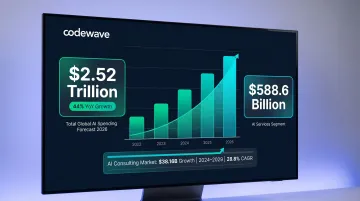
The commercial scale of this space reflects its strategic importance. Global AI spending is forecast to reach $2.52 trillion in 2026, up 44% year-over-year, with AI services representing $588.6 billion of that total. The AI consulting market is projected to grow by $38.16 billion from 2024 to 2029 at a 28.8% compound annual growth rate.
That spending exists because most enterprises can't close the gap internally. Most lack AI talent at scale, and even those with data science teams get stuck converting proof-of-concept projects into production systems.
The governance picture is equally stark. Only 18% of organizations have an enterprise-wide council with authority over responsible AI governance, while 44% have experienced at least one negative consequence from generative AI use. Moving from a fragile pilot to a governed, production-grade system is where external consulting partners earn their place.
Top AI Consulting Firms for Enterprise Solutions in 2026
Each firm on this list was selected for enterprise delivery record, technical depth across the full AI stack, industry experience, and proven ability to produce measurable outcomes—not just strategy decks.
Codewave
Codewave is an award-winning AI and data consulting firm that has worked with 400+ businesses across 15+ industries including healthcare, fintech, retail, insurance, and energy. The company specializes in transforming business data into competitive advantage through AI-powered analytics and outcome-based delivery models.
Three proprietary frameworks define how Codewave works. ImpactIndex™ ties client payments to measurable results rather than hours billed. QuantumAgile™ simulates multiple product futures in parallel, shipping what proves value—moving ideas to validated outcomes in days, not weeks. ZeroDX™ removes middle management layers entirely, so clients work directly with the engineers building their solutions.
Documented results across engagements include:
- 25% reduction in operating costs
- 40% improvement in productivity
- 3X faster data processing
- 95%+ data accuracy
| Detail | Summary |
|---|---|
| Key Features | Outcome-based model (ImpactIndex™), QuantumAgile™ rapid delivery, ZeroDX™ direct collaboration, AI + analytics stack (TensorFlow, PyTorch, Apache Kafka, Databricks, Power BI), 95%+ data accuracy |
| Pricing | Outcome-based engagement; pricing tied to measurable results—contact for custom enterprise scope |
| Best For | Enterprises in healthcare, fintech, retail, energy, and insurance seeking measurable AI ROI with direct team collaboration and no bureaucratic middlemen |

Accenture
Accenture is one of the world's largest professional services firms with a dedicated Data & AI division. The company announced a $3 billion investment over three years to double AI talent to 80,000 professionals through hiring, acquisitions, and training. Accenture offers end-to-end AI transformation from strategy and generative AI to workforce readiness and responsible AI governance.
What separates Accenture at the enterprise level is its cloud ecosystem depth—major partnerships with AWS, Google Cloud, and Microsoft Azure—combined with formal responsible AI governance frameworks that address risk from day one. A recent engagement with Best Buy illustrates the execution side: Accenture and Google deployed generative AI to power virtual assistants and agent-support tools that improved both efficiency and personalization at scale.
| Detail | Summary |
|---|---|
| Key Features | Generative AI strategy, AI implementation, advanced analytics, responsible AI frameworks, enterprise cloud integration |
| Pricing | Premium enterprise tier; typically $250,000+ minimum engagement |
| Best For | Large, established enterprises seeking comprehensive multi-year AI transformation across multiple business functions |
IBM Consulting
IBM Consulting brings its proprietary IBM Consulting Advantage platform to enterprise AI engagements—a library of purpose-built AI assets and role-based generative AI assistants designed for regulated industries including banking, healthcare, and the public sector. Early pilots cited up to 50% productivity improvements in application design, development, and testing.
IBM's core strength is compliance-by-design AI. WatsonX handles building and operating enterprise AI platforms with governance and security built into the architecture from the start—not bolted on after deployment. That approach proved out with American Airlines, where IBM supported cloud migration and shipped a self-service dynamic rebooking app in 4.5 months.
| Detail | Summary |
|---|---|
| Key Features | WatsonX platform, AI governance and compliance, hybrid cloud modernization, generative AI, responsible AI frameworks |
| Pricing | High enterprise tier; typically $250,000+ minimum engagement |
| Best For | Heavily regulated enterprises in banking, healthcare, and public sector needing compliant-by-design AI with deep governance frameworks |
McKinsey QuantumBlack
QuantumBlack is McKinsey's dedicated AI arm, combining management consulting heritage with deep expertise in generative AI, advanced analytics, and intelligent automation. The practice serves global enterprises across competitive and regulated industries.
QuantumBlack builds AI strategy around business performance levers first—technology is the means, not the goal. That discipline shows in the work: deep reinforcement learning agents with high-fidelity simulators helped Emirates Team New Zealand defend the America's Cup by accelerating design cycles and informing critical racing decisions. The firm also partners with Google Cloud for real-time AI applications, blending strategic depth with hands-on technical execution.
| Detail | Summary |
|---|---|
| Key Features | Generative AI, advanced analytics, intelligent automation, data science, AI strategy roadmapping |
| Pricing | Upon request; premium pricing aligned with McKinsey engagement models |
| Best For | Established global enterprises seeking AI strategy tightly integrated with business performance and competitive positioning |
Deloitte
Deloitte operates AI consulting at global scale, covering analytics, intelligent automation, generative AI, and machine learning across industries. The firm's proprietary Age of With™ framework treats human-machine collaboration as the foundation of AI success—pairing strategic insight with delivery speed rather than choosing one over the other.
Standout capabilities include a global delivery network, proprietary IP factories that accelerate deployment timelines, and active collaborations with NVIDIA for enterprise-scale AI. Recent work with Rakuten Securities demonstrates range: Deloitte built an AI avatar to enhance the firm's digital customer experience, combining emerging technology with a measurable business application.
| Detail | Summary |
|---|---|
| Key Features | Analytics-led AI strategy, generative AI, intelligent automation, machine learning, managed data analytics |
| Pricing | Upon request; enterprise-tier pricing |
| Best For | Organizations looking to embed analytics, automation, and generative AI into core business operations at scale |

LeewayHertz
LeewayHertz focuses on custom AI engineering—LLM fine-tuning, NLP, computer vision, and AI-powered automation built to specific client requirements across healthcare, fintech, manufacturing, and retail.
The firm's industrial work illustrates its technical depth. For NSG Group, a global glass and glazing manufacturer, LeewayHertz built computer vision systems for anomaly detection and label verification on the production line. Pricing sits well below global consultancy levels, with typical project ranges from $50,000 to $200,000—making advanced custom AI engineering accessible to mid-market budgets.
| Detail | Summary |
|---|---|
| Key Features | Custom AI development, LLM fine-tuning, NLP, computer vision, AI automation, digital product engineering |
| Pricing | Typical project range $50,000–$200,000 |
| Best For | Mid-to-large enterprises needing deeply engineered, custom AI applications with strong UX and rapid development cycles |
RTS Labs
RTS Labs is a technical AI and analytics consultancy that combines AI strategy, data engineering, cloud architecture, and MLOps into a single delivery model. The firm specializes in helping mid-market and enterprise organizations in finance, insurance, logistics, and healthcare move from AI pilots to governed production systems.
RTS Labs covers the full delivery chain—data engineering through AI through integration through MLOps—without handing off between teams. That end-to-end ownership shortens timelines and reduces the coordination failures common when large consultancies compartmentalize delivery. Published case work in financial services includes conversational AI implementations and fraud detection systems, demonstrating practical production experience in regulated verticals.
| Detail | Summary |
|---|---|
| Key Features | AI strategy, data engineering, generative AI and RAG pipelines, MLOps, enterprise system integration (ERP, CRM, cloud), governance frameworks |
| Pricing | Project-based; mid-six to low-seven figures for full enterprise engagements |
| Best For | Mid-market and enterprise organizations needing production-grade AI with strong data foundations and governed deployment |
How We Chose the Best AI Consulting Firms
Many enterprises choose AI partners based on brand name or lowest price—overlooking factors like production delivery maturity, data governance experience, and integration capability with legacy systems. These are the real predictors of AI project success. A recent MIT Media Lab report found that 95% of corporate generative AI initiatives fail to deliver ROI, with engagements involving external partners succeeding 67% of the time versus just 33% for internal-only efforts.
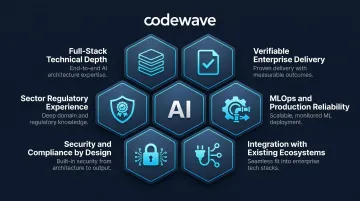
We compiled this list using six criteria tied to business outcomes:
- Full-stack technical depth — covers data engineering, model development, MLOps, and system integration, not just strategy consulting
- Verifiable enterprise delivery — documented case studies with measurable production results; firms without specifics are a red flag
- Sector-specific regulatory experience — proven track record with HIPAA, financial services rules, or other compliance requirements relevant to your industry
- MLOps and production reliability — monitoring pipelines, retraining workflows, and governance frameworks built in from the start; 70% of AI high performers still report data-related difficulties, making operational maturity non-negotiable
- Security and compliance by design — privacy and risk controls embedded from day one, not bolted on later; 44% of organizations have reported at least one negative consequence from gen AI use due to inadequate risk management
- Integration with existing ecosystems — ability to connect AI models to SAP, Salesforce, Microsoft Dynamics, AWS, Azure, or GCP so results feed into workflows your teams already use
Matching Firm Type to Organizational Need
Enterprises with complex regulated environments may need governance-first firms like IBM Consulting, which brings decades of compliance expertise and purpose-built frameworks. Those seeking outcome-based delivery with direct collaboration may be better served by boutique specialists like Codewave, where the ZeroDX™ model eliminates middle management and accelerates decision-making. Organizations needing custom AI engineering at mid-market budgets should evaluate firms like LeewayHertz or RTS Labs, which deliver technical depth without the overhead of global consultancies.
Conclusion
The right AI consulting partner isn't the most recognized name — it's the firm whose delivery model, industry expertise, and engagement style fit your organization's AI maturity and actual business objectives.
Whether a firm succeeds or fails in your environment depends on its ability to navigate your regulatory constraints, integrate with existing systems, and produce verifiable outcomes.
Before signing any AI consulting engagement, evaluate against these criteria:
- Scalability: Can their solution grow with your data volume and user load?
- Governance frameworks: Do they have documented AI ethics, compliance, and audit processes?
- Integration track record: Have they deployed into environments like yours — not just greenfield builds?
- ROI transparency: Can they show production results, not pilot metrics?
Also press them on accountability: what happens when targets aren't met?
Codewave's ImpactIndex™ model structures every engagement around client-defined outcomes rather than hours billed — a practical fit for enterprises in healthcare, fintech, retail, and energy that need results they can actually measure.
Frequently Asked Questions
What does an AI consulting firm actually do for enterprises?
AI consulting firms cover strategy, data readiness, model development, system integration, MLOps, governance, and change management. The emphasis has shifted to production-grade AI that connects with existing ERP, CRM, and cloud infrastructure—delivering measurable outcomes, not just working prototypes.
How much does enterprise AI consulting typically cost?
Costs vary widely by scope and firm type. Boutique specialists may start projects at $50,000–$100,000, while global consultancies typically require $250,000+ minimums for comprehensive engagements. Outcome-based firms tie pricing to measurable results rather than billable hours, which directly aligns incentives with business impact.
How long does an AI consulting engagement take?
Readiness assessments run 4–8 weeks; proof-of-concept builds take 2–4 months. Full enterprise deployments with integration and governance typically require 6–12+ months. McKinsey's 2024 State of AI report notes most gen AI prototypes reach production in 1–4 months, though that timeline extends significantly for customized, enterprise-scale rollouts.
What are the red flags when choosing an AI consulting company?
Key warning signs include no clear ROI framework or success metrics, inability to show production-grade case studies (only demos or pilots), overemphasis on technology features over business outcomes, and avoidance of governance, compliance, and security discussions. Also watch for firms that promise unrealistic timelines or claim expertise across every industry without demonstrated depth in any.
Which industries benefit most from enterprise AI consulting?
Healthcare, financial services, insurance, retail, manufacturing, logistics, and energy see the highest impact. These sectors use AI for fraud detection, predictive maintenance, supply chain optimization, and personalized customer experiences—all areas where domain expertise and regulatory knowledge are non-negotiable.
What is the difference between AI consulting and AI development services?
AI consulting focuses on strategy, roadmapping, readiness assessment, and organizational change management—answering "what should we build and why?" AI development is the hands-on engineering of models, data pipelines, and system integrations—answering "how do we build it?" The strongest firms deliver both under one engagement model, so strategy feeds directly into engineering without handoff gaps or lost context between teams.