Introduction
Enterprise generative AI has evolved from boardroom experiment to business imperative in less than three years. Companies spent $37 billion on generative AI in 2025—a 3.2x increase from 2024's $11.5 billion—and the technology now captures 6% of the entire global software market. For enterprise leaders, the question is no longer whether to adopt GenAI. It's which tools to deploy and how to integrate them without exposing the business to hallucination risk, compliance violations, or costly failed rollouts.
What separates enterprise-grade GenAI from consumer tools like ChatGPT? Four factors that consumer platforms simply don't offer:
- Proprietary data access — grounds AI outputs in your actual business context
- Security and compliance controls — protects sensitive information across regulated environments
- Domain-specific training — delivers accurate outputs for specialized workflows
- Deep system integration — connects with existing enterprise infrastructure
Using consumer AI in production environments without these guardrails creates real operational and compliance risk.
This article helps enterprise decision-makers cut through vendor noise and identify the right GenAI tools based on use case fit, infrastructure compatibility, and proven business outcomes. We'll evaluate the top platforms across horizontal productivity, coding, knowledge management, and CRM use cases—and provide selection criteria that reduce the 88% failure rate documented for enterprise AI projects.
TL;DR
- Enterprise GenAI tools prioritize security, compliance, and deep integration — not just conversational capability
- The GenAI market hit $37 billion in 2025, with application-layer tools capturing over 50% of total spend
- 76% of enterprises now buy rather than build AI solutions, making vendor selection mission-critical
- Tool fit depends on use case — ChatGPT Enterprise and Copilot lead for productivity, Claude for coding, Glean for search, and Agentforce for CRM
- Hallucination rates range from 22% to 94% across leading models — poor tool selection is a measurable production risk
Generative AI in the Enterprise: Why 2026 Is a Defining Year
Enterprise generative AI is no longer a pilot program — it's a procurement decision with a price tag in the billions.
Unlike consumer AI trained on public web data, enterprise GenAI integrates with internal knowledge bases, respects access controls, and maintains audit trails. The shift from generic models to domain-specific systems trained on company data represents the fundamental difference between experimentation and live enterprise deployment.
Enterprise GenAI spending grew 21x in two years: from $1.7 billion in 2023 to $37 billion in 2025. The application layer—copilots, agents, and vertical solutions—now captures $19 billion, representing more than half of all enterprise AI investment. Horizontal AI tools like Microsoft Copilot and ChatGPT Enterprise account for $8.4 billion of that spend, while departmental AI (coding, legal, finance) adds another $7.3 billion.
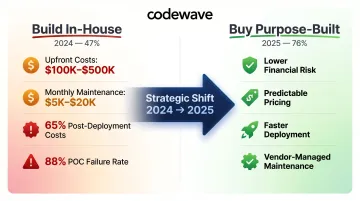
That spending surge reflects a strategic reversal in how enterprises approach AI. In 2024, 47% built AI solutions in-house. By 2025, 76% now purchase rather than build, according to the Menlo Ventures' State of GenAI report. The economics explain why: building enterprise AI runs $100,000–$500,000 upfront, with $5,000–$20,000 in monthly maintenance. Sixty-five percent of total costs hit after deployment. When 88% of POCs never reach production, buying purpose-built tools becomes the lower-risk path.
The tools that follow are evaluated on the criteria that matter most to enterprise buyers: security posture, integration depth, domain performance, and demonstrated ROI.
Top Generative AI Tools for Enterprise in 2026
These tools were selected based on enterprise readiness: security and compliance controls, integration with existing infrastructure, domain-specific performance, deployment scalability, and documented outcomes with enterprise clients. Each platform addresses different use cases—choosing the right one requires matching capability to workflow rather than defaulting to brand recognition.
ChatGPT Enterprise (OpenAI)
ChatGPT Enterprise is OpenAI's business-grade offering built for organizations that need GPT-4 models with enterprise security, SOC 2 compliance, and a guarantee that customer data never trains OpenAI's models. It supports use cases across content creation, data analysis, coding, internal search, and workflow automation—making it the broadest-purpose GenAI tool for teams that don't need industry-specific functionality.
Key differentiator: Unlimited, high-speed GPT-4o access with a 128K context window lets teams process documents up to 300 pages in a single session. The custom GPT builder enables departments to create workflow-specific assistants without coding—legal teams build contract review bots, HR creates onboarding assistants, finance builds analysis tools.
OpenAI reports enterprise users save 40-60 minutes daily, with data scientists and engineers reporting 60-80 minute gains. Custom GPTs now account for 20% of enterprise workflows, and 75% of users report performing tasks they previously couldn't.
| Attribute | Details |
|---|---|
| Best For | Horizontal productivity across marketing, legal, HR, finance, and general knowledge work |
| Key Features | GPT-4o access, custom GPT builder, 128K context window, admin dashboard, API access, enterprise SSO |
| Pricing | Custom quote based on seats and usage; ChatGPT Team starts at $25-30/user/month for reference |
Caveat: 25% of enterprises paying for ChatGPT Enterprise have not connected it to company data, leaving significant value unrealized.
Microsoft Copilot (Microsoft 365)
Microsoft Copilot embeds GPT-4 models across the M365 ecosystem—Word, Excel, PowerPoint, Teams, Outlook, and OneNote—to assist with drafting, summarizing, analyzing, and automating work within existing Microsoft workflows. For organizations already standardized on M365, Copilot offers the lowest-friction path to GenAI adoption because it requires no new tools or training on separate interfaces.
Why enterprises choose it: Native integration with Microsoft Graph gives Copilot access to an organization's emails, meetings, files, chats, and calendar data. When a user asks Copilot to "summarize the latest product feedback," it pulls from emails, Teams discussions, and SharePoint documents automatically—no manual search required.
Microsoft's internal study found users were 29% faster at searching, writing, and summarizing, with 70% reporting higher productivity. A UK Government study documented 26 minutes saved daily per employee.
| Attribute | Details |
|---|---|
| Best For | Enterprises deeply embedded in the Microsoft 365 ecosystem seeking AI-augmented productivity |
| Key Features | Native M365 integration, Copilot Studio for custom agent building, Microsoft Graph data access, Teams summarization, email drafting |
| Pricing | $30/user/month (requires M365 E3, E5, Business Standard, or Business Premium subscription) |
Caveat: Despite adoption by 70% of Fortune 500 companies, 50% of tech leaders remain unsure whether the $30/month cost justifies ROI—measurement remains a challenge.
Claude for Work (Anthropic)
Claude for Work is Anthropic's enterprise AI assistant, and it leads the market in coding and document analysis for regulated industries. Its constitutional AI training methodology prioritizes safety, accuracy, and nuanced instruction-following—making it the preferred choice for legal, compliance, finance, and software development teams that require high-fidelity outputs and explainable reasoning.
The technical edge: Anthropic holds 54% of the enterprise coding market and 40% overall enterprise AI market share—up from 12% in 2023. Around 80% of Anthropic's revenue comes from enterprise customers, reflecting deep adoption in professional services and regulated sectors.
Claude's 200K token context window handles entire codebases or 500+ page documents in a single session. Its artifacts feature enables persistent session management for iterative legal drafting, contract review, or financial analysis workflows.
| Attribute | Details |
|---|---|
| Best For | Legal, compliance, finance teams; software development organizations needing top-tier code generation |
| Key Features | 200K context window, constitutional AI training, multi-language code generation, vision analysis, artifacts for document workflows |
| Pricing | Claude Team: $25-30/user/month (minimum 5 users); Claude Enterprise requires custom quote |
Notable clients include Pfizer, Bridgewater Associates, GitLab, and Accenture (multi-year partnership).
Google Gemini for Workspace
Google Gemini integrates multimodal AI (text, image, audio) across Google Workspace—Gmail, Docs, Sheets, Meet, and Drive—giving enterprises AI assistance within tools their teams already use daily. Its deep integration with Google Search and real-time data access makes it particularly strong for research-heavy and content-heavy workflows in organizations running Google Cloud infrastructure.
Key differentiator: Gemini's search grounding provides real-time information with citations, reducing hallucination risk for fact-based queries. NotebookLM Enterprise—included in Workspace plans—summarizes PDFs, Docs, and Slides with enterprise security controls and higher usage limits.
Agent Designer enables non-technical users to build custom agents without coding, while Gemini Code Assist supports software development with multi-file code changes and bug fixes.
| Attribute | Details |
|---|---|
| Best For | Organizations running on Google Workspace and GCP infrastructure |
| Key Features | Multimodal capabilities (text, image, audio), native Google Workspace integration, real-time search grounding, NotebookLM integration, Agent Designer |
| Pricing | Gemini Business: $21/user/month; Gemini Enterprise Standard: $30/user/month; Gemini Enterprise Plus: $50/user/month |
Case study: Virgin Voyages created an AI marketing agent that reduced campaign creation time by 40% and drove a 28% year-over-year sales increase in July 2025.
GitHub Copilot
GitHub Copilot is the leading AI coding assistant for enterprise software development teams, built on OpenAI's Codex models and deeply integrated into IDEs including VS Code, JetBrains, and Neovim. It accelerates development through real-time code completion, pull request summarization, multi-file editing, and chat-based debugging—reducing repetitive coding work and increasing development velocity.
Why engineering teams adopt it: 50% of developers now use AI tools daily, rising to 65% in top-quartile organizations. GitHub's research found developers using Copilot were 55% faster at completing tasks, with teams reporting 15%+ velocity gains. Copilot Enterprise extends this to repository-level context—AI assistance grounded in an organization's entire codebase, not just the current file.
| Attribute | Details |
|---|---|
| Best For | Engineering and product teams looking to accelerate development velocity and reduce debugging time |
| Key Features | Real-time code suggestions, multi-language support, PR summarization, IDE integrations (VS Code, JetBrains, Neovim), chat in editor, repository-level context |
| Pricing | Copilot Business: $19/user/month; Copilot Enterprise: $39/user/month |
At the Business tier, it covers most team needs. The Enterprise tier pays back quickly in organizations where engineering hours are the primary cost constraint.
Glean
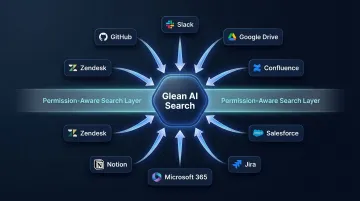
Glean is an enterprise AI search and knowledge management platform that indexes across 100+ business applications—Slack, Google Drive, Confluence, Salesforce, Jira, Microsoft 365, and more—to give employees a unified, AI-powered search experience across all company knowledge. It solves the knowledge fragmentation problem that plagues distributed enterprises where information lives in siloed systems.
The operational advantage: Real-time indexing ensures search results reflect current information. Permission-aware search respects existing document-level access controls, so users only see what they're authorized to view—no separate permission management required.
Glean's built-in AI agent builder lets teams create specialized agents that automate knowledge retrieval and workflow tasks. The platform now powers 100 million+ agent actions annually and reached $100 million ARR within three years of launch.
| Attribute | Details |
|---|---|
| Best For | Enterprises with large, distributed knowledge bases spread across multiple SaaS applications |
| Key Features | 100+ native connectors, permission-aware search, real-time indexing, AI agent builder, NLP-driven query understanding, Slack/Teams integration |
| Pricing | Custom quote (contact Glean sales) |
Customers include LinkedIn, TIME, Booking.com, Dell, Palo Alto Networks, Snowflake, and Workday. Glean raised $150 million at a $7.2 billion valuation in February 2026, reflecting strong enterprise demand for knowledge management solutions.
Salesforce Agentforce
Salesforce Agentforce is an AI agent platform built natively into the Salesforce ecosystem, enabling enterprises to deploy autonomous AI agents for sales, customer service, and marketing workflows. Unlike traditional CRM automation that follows rigid rules, Agentforce agents make contextual decisions, escalate intelligently to humans when needed, and learn from interactions over time.
Key differentiator: Agentforce's "human-in-the-loop" model balances AI autonomy with intelligent escalation—suitable for regulated industries where full automation isn't appropriate. Integration with Salesforce Data Cloud provides a rich customer data layer for AI-driven interactions grounded in real transaction history, support tickets, and engagement data.
Agent creation grew 119% in H1 2025, with customer service conversations led by agents growing 22x during the same period.
| Attribute | Details |
|---|---|
| Best For | Enterprises with complex sales pipelines, customer support operations, and marketing funnels on Salesforce |
| Key Features | Autonomous AI agents, 24/7 customer support, Salesforce Data Cloud integration, agent builder, real-time recommendations, voice capabilities |
| Pricing | Flex Credits: $500 per 100k credits (~$0.10/action); Per Conversation: $2/conversation; Agentforce Add-on: $125-150/user/month |
Case study: 1-800Accountant reports Agentforce resolves up to 60% of incoming requests autonomously, while Engine reduced average handle time by 15%.
How We Chose the Best Generative AI Tools for Enterprise
The most common mistake enterprises make is selecting GenAI tools based on brand recognition or impressive demos rather than fit-for-purpose criteria. The right tool depends on specific use case requirements, existing infrastructure, data governance needs, and team readiness. When 88% of AI POCs fail to reach production, selection criteria matter as much as the tool itself.
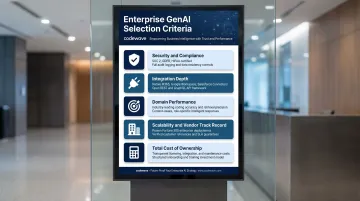
Our evaluation criteria:
- Enterprise security and compliance posture — SOC 2 Type II certification, GDPR compliance, HIPAA-readiness for healthcare, role-based access controls, audit logging, and data residency guarantees
- Depth of integration with existing tech stack — Native connectors to Microsoft 365, Google Workspace, Salesforce, Slack, and enterprise systems; API access for custom integrations
- Domain-specific performance vs. general purpose — Coding tools evaluated on code quality and debugging accuracy; knowledge tools tested on retrieval precision; CRM tools measured on contextual response accuracy
- Scalability and vendor track record — Proven deployment at Fortune 500 scale; customer references in similar industries; transparent pricing models
- Total cost of ownership — Licensing costs plus integration, training, and ongoing maintenance; pricing predictability
For industries like Healthcare, Fintech, Insurance, and Energy that handle sensitive data, security posture and regulatory compliance should be weighted above feature novelty. A capable tool with weak data controls creates greater risk than a less sophisticated tool with enterprise-grade security.
59.9% of AI/ML transactions are currently blocked by enterprises due to security concerns — compliance is a hard requirement, not a checkbox.
An experienced implementation partner can reduce deployment risk by customizing tools to your specific workflows, establishing governance frameworks, and connecting AI systems to proprietary data environments. The enterprises seeing consistent returns are those that approach GenAI as an integrated capability — one that is scoped, governed, and built into existing systems from day one.
Conclusion
The GenAI tools landscape in 2026 is mature enough for strategic enterprise adoption, but the right platform depends on aligning capability with specific business objectives — not defaulting to the most publicized vendor. A quick recap:
- ChatGPT Enterprise and Microsoft Copilot deliver horizontal productivity gains across departments
- Claude dominates coding and document-intensive workflows
- Glean solves knowledge fragmentation across siloed systems
- Salesforce Agentforce automates CRM processes with contextual intelligence
Evaluate beyond the demo. Test for data security, integration depth with your existing stack, adoption friction, and vendor support quality before committing to an enterprise contract. Hallucination rates range from 22% to 94% across top models, and AI incident reports rose to 362 in 2025—up from 233 in 2024. The risk of poor tool selection isn't theoretical.
Those risks are manageable with the right implementation approach. Enterprises that want to move from tool selection to measurable business outcomes benefit from working with a partner experienced in deploying AI across complex environments. Codewave works with organizations across healthcare, fintech, retail, and more to go from validated GenAI use case to production quickly — using their QuantumAgile™ process to test multiple deployment paths and ship what actually performs. Contact Codewave to map a GenAI implementation path for your industry.
Frequently Asked Questions
What is enterprise generative AI?
Enterprise generative AI refers to AI systems that generate content, automate workflows, and surface insights from an organization's proprietary data—not public internet information. Unlike consumer tools, enterprise versions add security controls, compliance features, access management, and domain customization built on company-specific knowledge.
Which generative AI tools are best for enterprise?
The best tools depend on use case. OpenAI's ChatGPT Enterprise and Microsoft Copilot lead for horizontal productivity; Anthropic's Claude leads for coding and document analysis; Glean excels at knowledge management; Salesforce Agentforce is strongest for CRM and customer-facing workflows. Match the tool to your workflow requirements and existing infrastructure.
What is enterprise AI development?
Enterprise AI development involves building, customizing, or integrating AI models into an organization's workflows using proprietary data. It includes fine-tuning foundation models, building domain-specific agents, connecting AI to enterprise systems, and establishing governance frameworks for responsible use.
How do I choose the right generative AI tool for my enterprise?
Start by defining the specific business problem you're solving. Evaluate tools based on security and compliance posture, integration with existing systems, domain performance, total cost of ownership, and vendor track record. Test through pilot programs before committing to enterprise contracts—88% of POCs fail, so validation matters.
What are the key risks of deploying generative AI in the enterprise?
Key risks include hallucination (inaccurate outputs ranging from 22-94% across models), data privacy exposure, intellectual property risks, and governance gaps. Enterprise-grade tools trained on proprietary data with proper access controls reduce these risks considerably compared to consumer AI.
How much does enterprise generative AI cost?
Per-user subscriptions range from $19-50/user/month (GitHub Copilot Business, Microsoft Copilot, Google Gemini), while platforms like Salesforce Agentforce charge per conversation. ChatGPT Enterprise, Claude Enterprise, and Glean require custom quotes. Total cost—including implementation, integration, and ongoing maintenance—routinely exceeds licensing fees alone.