Introduction
Manual invoice processing costs $12.88 per invoice for non-best-in-class teams, compared to just $2.78 for best-in-class automated teams—a 78% cost reduction according to Ardent Partners' 2025 research. Yet even organizations that have invested in traditional AP automation still face a stubborn bottleneck: 22% of all invoices hit exceptions that require manual intervention, and non-best-in-class departments spend 26.9% of their time managing supplier inquiries.
Traditional AP automation follows rules—it captures data, matches invoices to purchase orders, and routes approvals along predefined workflows. But it stalls the moment something falls outside its script.
Agentic AI operates differently: it reasons through ambiguity, evaluates options, and executes decisions. Rather than flagging exceptions for human queues, autonomous agents cross-reference contracts, communicate with vendors, and resolve discrepancies within defined guardrails. This distinction changes what AP teams can accomplish without adding headcount, turning exception handling into an automated process that finance teams can govern rather than execute.
TLDR
- Agentic AI autonomously reasons through exceptions, communicates with vendors, and executes decisions—no human confirmation loop required for routine tasks
- Specialized agents handle capture, matching, anomaly detection, and payment optimization as a connected system, not siloed tools
- Cycle times drop from 17.4 days to 3.1 days, with near-zero data entry errors and real-time fraud detection
- Finance teams shift from data entry to governance and strategic supplier management, improving job satisfaction and organizational value
Agentic AI vs. Traditional AP Automation: The Critical Distinction
Traditional AP automation excels at predictable tasks: OCR extracts invoice data, rule-based engines match invoices to POs, and workflows route approvals to the right manager. But when an invoice arrives with a price mismatch or a missing PO number, the system stops — it flags the exception, queues it for human review, and waits.
That stall has a measurable cost. Ardent Partners reports that non-best-in-class AP departments spend 26.9% of their time managing supplier inquiries and exceptions, while the industry-average exception rate sits at 22% — more than one in five invoices triggering manual intervention.
Where Agentic AI Changes the Equation
Gartner defines agentic AI as technology that "enhances resource efficiency, automates complex tasks, and introduces new business innovations, beyond the capabilities of scripted automation bots." Rather than executing a fixed script, agentic systems pursue goals: they sense context, reason through options, and act autonomously.
When an invoice arrives with a PO mismatch, an agentic system doesn't just flag it. It cross-references the PO, pulls contract terms, reviews vendor history, determines whether the discrepancy falls within tolerance, and either resolves it or initiates a clarification request to the supplier — all without waiting for a human.
This distinction from copilot-style tools is worth being precise about. Copilots surface data and suggest actions, but require human approval at each step. Agents act within pre-defined guardrails — dollar thresholds, policy boundaries, approval authority — without waiting for confirmation. For high-volume AP teams processing thousands of invoices monthly, that difference means a fundamental shift in processing capacity, not just incremental improvement.
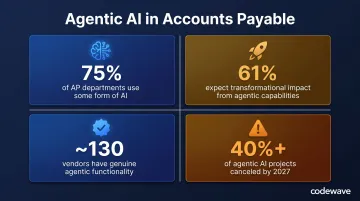
Adoption is accelerating, but the landscape is uneven. Gartner projects 33% of enterprise software applications will include agentic AI by 2028, up from less than 1% in 2024 — yet the same research predicts over 40% of agentic AI projects will be canceled by end of 2027, driven by inflated vendor claims and organizational unreadiness. Key signals from AP-specific data:
- 75% of AP departments now use some form of AI
- 61% expect transformational impact from agentic capabilities
- Only ~130 vendors have genuine agentic functionality, per Gartner estimates
- The remainder largely represent "agent washing" — legacy RPA and chatbot tools rebranded under the agentic label
How Agentic AI Orchestrates the Full AP Lifecycle
Effective agentic AP systems run on a multi-agent architecture — not a single monolithic model. Specialized agents handle discrete functions (capture, matching, exception resolution, anomaly detection, payment optimization) and share context through internal knowledge graphs or orchestration layers.
Each agent is optimized for its specific task. The orchestration layer keeps them working as a coordinated team, making the overall system more accurate and adaptive than any single model could be.
Capture Agent
The capture agent uses computer vision and large language models (LLMs) to extract invoice data from any format: PDFs, emails, handwritten notes, image-only scans, without requiring template training for each supplier. Where legacy OCR systems deliver 85-95% accuracy, machine learning-based capture systems reach approximately 99%, according to Gartner data compiled by Parseur.
That accuracy gap has a direct operational consequence: fewer extraction errors mean fewer exceptions requiring human review. Best-in-class organizations process invoices at 2.1 times the rate of their peers, largely because they've eliminated the bottleneck of manual data correction.
Matching and Exception Agent
The matching agent compares captured invoice data against purchase orders, contracts, and goods-received notes, learning fuzzy-match patterns over time to increase straight-through processing rates. When discrepancies surface (a $1,050 invoice against a $1,000 PO, a missing PO entirely), the exception-resolution agent takes over. It goes beyond routing to a human queue:
- Cross-references contract terms to determine if the variance falls within tolerance (e.g., 5% overage allowed per supplier agreement)
- Reviews vendor history to assess whether similar discrepancies occurred and how they were resolved
- Initiates supplier communication via email to request corrections or clarifications
- Escalates genuine policy breaches (unauthorized purchases, out-of-contract pricing) to AP managers with full context
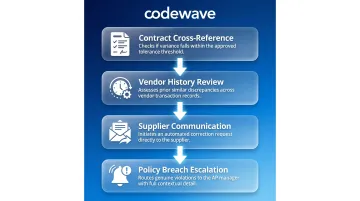
This autonomous workflow resolves most exceptions in hours rather than the days required for manual back-and-forth, enabling teams to capture early-payment discounts that would otherwise expire.
Anomaly Detection Agent
Fraud is expensive and persistent. 80% of organizations were targeted by payments fraud in 2023, according to the Association for Financial Professionals. The ACFE's 2024 Report to the Nations found that billing schemes carry a $100,000 median loss over an 18-month median duration, roughly $5,600 per month drained from the organization.
The anomaly detection agent scans every invoice in real time for patterns that signal fraud:
- Duplicate invoice numbers across different vendors
- Sudden changes to vendor bank account details
- Unusual price spikes compared to historical averages
- Round-number invoicing patterns that suggest fabricated billing
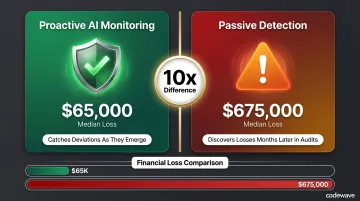
Static rule sets are predictable — and fraudsters know it. This agent learns normal behavioral patterns across vendors and flags deviations as they emerge. The ACFE research shows that proactive monitoring catches fraud at a $65,000 median loss versus $675,000 for passive detection, a 10x difference that comes down to early intervention.
Payment Optimization Agent
Most organizations leave money on the table. Ardent Partners found that only 19% of early-payment discount offers are captured, primarily because slow manual processing prevents invoices from being approved before discount windows close.
The payment agent weighs multiple variables simultaneously:
- Supplier payment terms and discount windows (e.g., 2/10 net 30)
- Cash flow forecasts and liquidity constraints
- Working capital targets set by treasury
- Strategic supplier relationships where timely payment strengthens negotiating position
The agent recommends (or in mature implementations, executes) the optimal payment date, balancing cash preservation with discount capture and supplier satisfaction. AP stops being a reactive cost center and starts functioning as a measurable working capital tool.
The Business Case: Key Benefits of Agentic AI in Accounts Payable
Cost reduction through autonomous exception handling. The $12.88-to-$2.78 cost-per-invoice gap that traditional automation delivers is well-documented. Agentic AI pushes further, targeting the remaining cost by automating not just data capture but the exception handling and vendor communication that still require manual effort. Organizations working with experienced implementation partners like Codewave have achieved **50% faster invoice processing** and 25% reduction in operational costs in client deployments.
Accuracy improvements and fraud prevention. Self-correcting capture agents eliminate the manual data entry errors that plague AP teams. Where manual processing introduces errors in 0.1-0.4% of transactions, AI-driven capture reaches 99% field-level accuracy. Pattern-learning anomaly agents detect duplicate invoices, fraudulent bank account changes, and collusion schemes that rule-based systems miss entirely, catching threats before payments execute rather than discovering losses months later during audits.
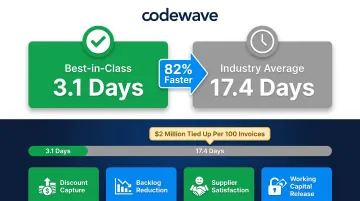
Cycle time compression unlocks working capital. Best-in-class AP teams process invoices in 3.1 days versus 17.4 days for others—an 82% speed advantage. Automated workflows reduce per-invoice handling time from 10-30 minutes to 1-2 seconds, enabling teams to:
- Capture early-payment discounts before windows close
- Reduce backlogs of unresolved exceptions
- Improve supplier relationships by avoiding late payment penalties
- Free up working capital (a 12-14 day cycle ties up nearly $2 million for every 100 invoices)
Compliance and audit readiness built in. Agentic systems maintain immutable, time-stamped logs of every action—routing decisions, exception resolutions, approval chains, payment authorizations. Auditors get a searchable trail without extra reconciliation work. Key compliance outcomes include:
- Satisfies SOX 404 and PCAOB AS 2201 requirements for documented internal controls
- Automated tax code validation reduces multi-jurisdiction compliance risk
- Explainable decision logic lets teams trace and defend autonomous approvals during audits
Strategic reallocation of AP talent. As agents absorb routine data entry and exception triage, AP professionals shift into higher-value roles:
- Governance and policy design
- Vendor strategy and relationship management
- Analytics and process optimization
This moves the AP function from reactive cost management to a strategic input for finance leadership—improving job satisfaction and expanding the team's influence across the business.
Beyond the Invoice: Extended Use Cases of Agentic AI in AP
Supplier Onboarding and Risk Screening
A conversational agent can gather tax certificates (W-9s, W-8s), validate addresses against USPS databases, and screen new vendors against OFAC sanctions lists and denied-party databases—automatically. What used to require days of manual back-and-forth, email chains, and data entry compresses into minutes. McKinsey reports that in financial services, AI has shortened KYC and client onboarding timelines by as much as 30%; the same workflow efficiency applies to AP vendor onboarding.
Real-Time Cash Flow Forecasting
J.P. Morgan reports that AI-powered forecasting models can reduce error rates by up to 50% compared to traditional statistical methods. This matters for AP teams because 65% of AP departments now actively support financial planning and forecasting (Ardent Partners, 2025). When liability data from the AP agent streams directly into treasury models—no lag between invoice receipt and financial visibility—forecast accuracy improves , enabling better liquidity planning and investment decisions.
ESG and Diversity Spend Reporting
Under the EU's Corporate Sustainability Reporting Directive (CSRD), companies must disclose Scope 3 emissions, which represent 70-90% of a corporate carbon footprint and require supplier-level data collection. Agentic AP systems can tag suppliers with environmental or diversity scores as invoices are processed, surfacing sustainability metrics alongside spend data in a single dashboard.
While the SEC ended defense of its climate disclosure rules in March 2025, multinational organizations operating in the EU still face mandatory Scope 3 reporting. For these companies, collecting supplier data through AP workflows is a compliance requirement with direct reporting consequences—not an optional enhancement.
How to Build and Implement an Agentic AI AP System
Start with an Exception Audit and Controlled Pilot
Before deploying agents broadly, document the top exception types by volume and complexity: price mismatches, missing POs, duplicate invoices, incorrect GL codes. Pick one exception category—ideally a high-volume, low-complexity type like PO mismatches within tolerance—and run the agentic workflow in parallel with your existing process for 60 days.
Measure resolution time, accuracy, and cost per invoice to build the internal business case. Partners like Codewave use an outcome-based model (ImpactIndex™) where ROI milestones are defined upfront, so pilot investments deliver measurable results before broader rollout.
Establish Data Quality and Governance Guardrails
Agentic AI needs clean, connected data to operate reliably. Before deployment:
- Standardize vendor master records: deduplicate entries, verify tax IDs, validate banking details
- Normalize GL codes and cost center hierarchies
- Digitize contract terms so agents can reference approved pricing and tolerance thresholds
- Define dollar thresholds and policy boundaries where agents must escalate to humans (e.g., invoices over $10,000, new vendors, out-of-contract purchases)
- Ensure ERP integration is real-time via APIs, not nightly batch jobs, so agents always operate on current data
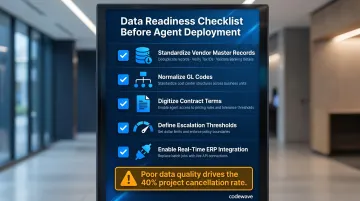
Poor data quality is the primary reason agentic projects fail. The 40% cancellation rate Gartner predicts reflects organizations that skipped this foundational step.
Plan for Human-AI Collaboration from Day One
Once your data foundation is solid, define clearly which decisions remain human — high-value payments, new vendor approvals, compliance-sensitive exceptions — and which are delegated to agents.
Invest in change management early. Reframe AP team roles from data entry to oversight, and train staff on how to supervise agent outputs, interpret decision logs, and intervene when escalations occur. According to Ardent Partners, 37% of AP strategic plans still require executive review before approval — which signals that most AP teams lack the organizational mandate needed for successful transformation.
Secure CFO sponsorship before deployment begins. Tie agentic AI goals to strategic finance metrics, and communicate progress consistently to sustain momentum through the inevitable implementation hurdles.
Frequently Asked Questions
What is the difference between agentic AI and traditional AP automation?
Traditional automation follows fixed rules and stalls on exceptions, routing them to human queues. Agentic AI reasons through context, makes decisions autonomously, and completes end-to-end tasks within defined guardrails—including resolving exceptions, communicating with vendors, and posting entries—without waiting for human approval at each step.
How does agentic AI handle invoice exceptions without human intervention?
Exception-resolution agents cross-reference invoices against PO data, contract terms, and vendor history. From there, they auto-resolve discrepancies within tolerance thresholds, initiate supplier communication to request corrections, or escalate genuine policy breaches to AP managers with full context—all without waiting for a human to step in.
Can agentic AI integrate with existing ERP systems?
Yes. Agentic AP systems connect to ERPs via secure APIs supporting real-time and bulk data exchange, enabling agents to post invoices, update master data, and track payments using current ERP data without manual re-entry or batch delays.
How does agentic AI improve fraud detection in accounts payable?
Anomaly detection agents learn normal behavioral patterns across vendors and transactions, then flag deviations—duplicate invoice numbers, changed bank details, unusual price spikes—in real time before payment execution, rather than relying on static rule sets that fraudsters can anticipate and circumvent.
Is agentic AI in AP compliant with financial regulations and audit requirements?
Yes. Agentic systems maintain time-stamped logs of every agent decision and action, satisfying SOX 404 and PCAOB AS 2201 audit requirements without extra reconciliation work. Tax code validation can also be embedded directly into agent logic for multi-jurisdiction compliance.
How long does it typically take to implement an agentic AI system for accounts payable?
A phased approach—starting with a 60-day parallel pilot on one exception category—lets organizations validate accuracy and ROI before expanding. Full deployment typically takes six months, depending on ERP complexity and vendor master data quality.