Introduction
HR has always been about people—but the administrative burden has pulled HR leaders away from people-focused work. Today's HR teams face an impossible tension: the volume of processes continues to explode while strategic expectations for workforce performance, retention, and talent development have never been higher. Only 20% of employees worldwide were engaged in 2025, costing the global economy approximately $10 trillion in lost productivity—roughly 9% of GDP.
That gap is exactly what agentic AI is designed to close. Unlike basic automation or generative AI, agentic systems autonomously plan, decide, and execute across the employee lifecycle without constant human input.
McKinsey defines agentic AI as systems that "don't just generate text or code—they take action," performing complex tasks independently, triggering workflows, and collaborating with other agents.
This article covers:
- What agentic AI actually is and how it differs from earlier tools
- Where it creates the most measurable HR value
- Productivity outcomes organizations can realistically expect
- How to avoid the most common implementation failures
- How to govern agentic systems responsibly
TLDR
- Agentic AI autonomously executes multi-step HR workflows—going well beyond what generative AI can do
- Talent acquisition, onboarding, performance management, workforce planning, and employee engagement deliver the highest ROI
- Most implementations fail because of weak data infrastructure, vague goals, and poor change management—not the technology itself
- Responsible scaling requires governance, human oversight, and process redesign before deployment
Agentic AI in HR: Beyond Automation and Generative AI
Modern AI exists along a spectrum. Predictive AI forecasts outcomes like attrition risk. Generative AI creates content—drafting job descriptions or summarizing performance reviews. Agentic AI executes: it takes instructions and autonomously carries out multi-step workflows.
Think of it this way: predictive AI tells you a new hire is at risk of disengaging, generative AI drafts their onboarding checklist, and agentic AI sends the emails, provisions the tools, and schedules training on its own.
That distinction matters because agentic AI operates across three layers that traditional tools can't reach:
- Reduces repetitive, rule-based task load across recruitment, payroll, and compliance
- Surfaces real-time insights to support human decisions on talent, development, and retention
- Coordinates complex workflows across disconnected HR systems end-to-end, with no manual handoffs
Traditional HR automation follows static, predefined rules and stalls the moment an exception appears. Agentic AI reasons through those exceptions on its own. It retains context across interactions, adjusts based on new inputs, and keeps workflows moving without waiting for a human to intervene.
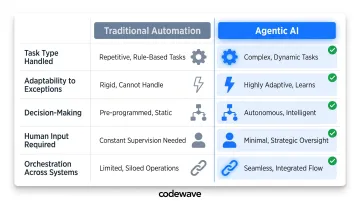
Agentic AI vs. Traditional HR Automation: A Quick Comparison
| Capability | Traditional Automation | Agentic AI |
|---|---|---|
| Task type handled | Repetitive, rule-based processes with predictable inputs | Complex, multi-step workflows requiring contextual judgment |
| Adaptability to exceptions | Requires human intervention; breaks when inputs deviate from rules | Adapts autonomously using reasoning and context |
| Decision-making | Executes predefined logic only | Makes goal-directed decisions across workflow steps |
| Human input required | Continuous oversight and manual triggers | Minimal; operates with human-at-the-helm oversight |
| Orchestration across systems | Limited to single-system workflows | Coordinates actions across HRIS, LMS, finance, and communication platforms |
5 High-Impact Applications of Agentic AI in HR
Talent Acquisition and Recruitment
Agentic AI agents autonomously screen applications against role requirements, rank candidates by skill adjacency and experience signals, schedule interviews, and generate candidate communications—without human input at each step.
Eaton achieved a 30-40% increase in candidate velocity and 4x growth in their talent network through AI-enabled talent acquisition modernization. This compresses time-to-hire, freeing recruiters to focus on relationship-building and candidate experience rather than manual screening.
In practice, agents absorb high-volume screening work and surface only the edge cases that need a human call—redirecting recruiter time toward decisions that actually require judgment.
Employee Onboarding and Learning & Development
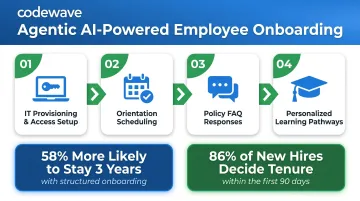
Onboarding agents orchestrate the full new-hire experience autonomously, handling:
- IT provisioning and access setup
- Orientation session scheduling
- Policy FAQ responses
- Personalized learning pathways based on role, region, and skill gaps
Research shows that employees are 58% more likely to stay three years with structured onboarding, and 86% of new hires decide how long they'll stay within their first 90 days. Agentic AI ensures that window delivers a consistent, high-quality experience—regardless of manager bandwidth or team size.