Introduction
Enterprise teams in 2026 aren't asking whether to adopt AI agents—they're asking which multi-agent platform can run reliably across departments without creating compliance blind spots or integration chaos. According to McKinsey's 2025 State of AI survey, 62% of organizations are experimenting with AI agents, yet only 23% have scaled an agentic AI system in at least one function. The real challenge isn't finding agents—it's governing them at scale.
Multi-agent platforms differ fundamentally from single AI assistants. Instead of one tool handling isolated tasks, multiple specialized agents collaborate, delegate work, and share context to complete complex enterprise workflows end-to-end. A sales agent hands off qualified leads to a marketing agent, which triggers a customer service agent — no human coordination required at each handoff.
That workflow complexity comes with real exposure. The same McKinsey survey reveals that 51% of organizations using AI report at least one negative consequence, and companies now manage an average of 4 AI-related risks — up from 2 in 2022. Most enterprises don't struggle with building pilots; they struggle with moving from proof-of-concept to production workflows that meet security, compliance, and integration standards.
TLDR
- Multi-agent AI platforms deploy networks of specialized agents that collaborate across departments—unlike single-agent tools that work in isolation
- Enterprise-grade platforms require strict governance controls: RBAC, audit logs, SSO, and compliance certifications (SOC 2, HIPAA, GDPR)
- Deployment flexibility matters too — cloud, VPC, and on-prem options separate serious enterprise tools from everything else
- Top 2026 platforms include Microsoft Azure AI Foundry, Salesforce Agentforce, Kore.ai, IBM WatsonX Orchestrate, and CrewAI Enterprise
- Evaluate on integration depth, governance maturity, deployment model, and measurable outcomes — brand recognition alone is a poor guide
- Regulated industries must prioritize on-prem/VPC deployment and compliance certifications above all other features
What Is a Multi-Agent AI Platform (and Why Enterprises Need One)?
A multi-agent AI platform is a system where multiple AI agents—each with a defined role or specialty—work together through orchestration to complete tasks spanning tools, data sources, and departments. Gartner defines multiagent systems as orchestrating collaborative, task-specialized AI agents to break complex workflows into manageable steps, improving efficiency and scalability.
This differs sharply from single-agent tools that handle isolated tasks. A single AI assistant might answer questions or draft emails. A multi-agent system coordinates a sales agent that qualifies leads, a procurement agent that checks inventory, and a finance agent that generates quotes—all working together without manual handoffs.
Why Enterprises Specifically Need Multi-Agent Infrastructure
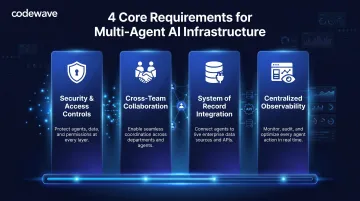
Consumer AI tools lack the security architecture enterprises require:
- Security and access controls: Role-based access control (RBAC) ensures agents only touch data their assigned roles permit, with audit logs tracking every action for compliance reviews.
- Cross-team collaboration: Agents built by one team can be shared across the organization with proper governance — marketing can deploy an IT-built agent without recreating it from scratch.
- Integration with systems of record: Enterprise agents must connect to Salesforce, SAP, ServiceNow, and legacy databases. Single-purpose tools rarely offer this breadth.
- Centralized observability: IT teams need dashboards showing which agents are running, what data they're accessing, and where errors occur — without this, troubleshooting at scale becomes unmanageable.
Research cited by Dataiku references a Cornell study where multi-agent systems achieved a 42.68% success rate on complex planning tasks versus just 2.92% for a single GPT-4 agent—a striking gap that widens as workflows grow in complexity.
That performance reality shapes how the platforms below were evaluated: production-readiness, governance depth, and verified enterprise adoption—not just feature lists or GitHub stars.
Top 5 Multi-Agent AI Platforms for Enterprise Teams in 2026
These platforms were selected based on native multi-agent orchestration capability, enterprise security standards, integration breadth, deployment flexibility, and documented enterprise adoption—not marketing claims or pilot success stories.
Microsoft Azure AI Foundry
Microsoft Azure AI Foundry is a unified platform for building, deploying, and managing multi-agent AI workflows at enterprise scale. Its tight integration with Microsoft 365, Azure OpenAI, and the Copilot ecosystem makes it the default starting point for enterprises already invested in the Microsoft stack.
Where it stands out:
- Hierarchical multi-agent orchestration, documented in Microsoft Learn training modules updated as recently as March 2026, lets a lead agent delegate tasks to role-specific connected agents
- Low-code (Prompt Flow) and pro-code paths let business and engineering teams work in the same environment without silos
- Access to GPT-4o, o1, Phi, Mistral, Anthropic Claude, Meta, and other frontier models via the Azure AI model catalog
- Built-in compliance infrastructure (SOC 2, HIPAA, FedRAMP) reduces certification lift for regulated industries
- 1,000+ connectors via the Power Platform connect agents to enterprise systems without custom development
- Responsible AI tooling covers bias detection and explainability out of the box
| Key Features | Native multi-agent orchestration, Azure OpenAI integration, Prompt Flow for workflow design, 1,000+ connectors via Power Platform, built-in responsible AI tooling |
| Deployment Options | Cloud (Azure), hybrid, and sovereign cloud; supports enterprise VPC configurations |
| Pricing | Consumption-based; tied to Azure OpenAI and Azure AI services usage. Consult the Azure pricing calculator for current rates |
Third-party research from Nucleus Research documented a 366% ROI and 9.6-month payback for Flash.co after implementing Azure AI Foundry and Azure ML to automate analytics and fraud detection.
Salesforce Agentforce
Salesforce Agentforce is a multi-agent AI layer built natively into the Salesforce platform, designed to deploy autonomous agents across sales, service, marketing, and commerce workflows using the data already inside an organization's CRM.
Where it stands out:
- Agents operate directly on CRM data (leads, cases, accounts, opportunities) with no ETL pipeline required, eliminating the sync problems common with external AI tools
- Salesforce's Einstein Trust Layer enforces zero data retention with external model providers, data masking, and policy alignment
- The Atlas Reasoning Engine handles multi-step decision-making by breaking complex tasks into subtasks and executing them sequentially
- Multi-channel deployment across Slack, email, and web means agents work where users already are
Documented customer outcomes include Fisher & Paykel increasing self-service from 40% to 70%, 1-800Accountant achieving 70% autonomous resolution during tax week 2025, and Nexo saving 1,200+ hours.
| Key Features | Atlas Reasoning Engine, pre-built agent templates for sales/service/marketing, multi-channel deployment (Slack, email, web), Einstein Trust Layer for data security |
| Deployment Options | Cloud (Salesforce infrastructure); data never leaves Salesforce's trust layer |
| Pricing | $2 per conversation for most Agentforce agents; enterprise pricing custom |
Kore.ai Agent Management Platform
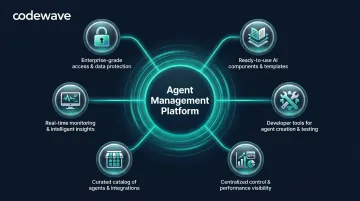
Kore.ai is an enterprise-focused agent management platform (AMP) purpose-built to govern, monitor, and orchestrate AI agents across heterogeneous frameworks and vendor ecosystems. That includes agents built outside Kore.ai entirely: LangGraph, CrewAI, AutoGen, Salesforce Agentforce, and Microsoft Foundry.
Where it stands out:
- AMP launch documentation positions Kore.ai as one of the few platforms covering all six analyst-recognized AMP elements: security, prebuilt libraries, tooling, dashboard, marketplace, and observability
- Cross-framework agent ingestion via A2A and MCP protocols (detailed here) lets enterprises consolidate governance regardless of where agents were originally built
- Pre-production evaluation studio catches hallucinations and policy violations before deployment
- Continuous policy enforcement at execution time prevents agents from drifting out of compliance
- Interaction-level token cost attribution gives finance teams the granular ROI data needed to justify ongoing spend
- 200+ pre-built agents in the Kore.ai marketplace cover the most common enterprise use cases
| Key Features | Cross-framework agent ingestion (A2A + MCP protocols), pre-production evaluation studio, real-time anomaly detection, immutable audit logs, 200+ pre-built agents in marketplace |
| Deployment Options | Cloud, VPC, and on-premises; compliant with SOC 2, HIPAA, GDPR, and EU AI Act |
| Pricing | Custom enterprise pricing; demo required. Calibrated for enterprise scale, not SMB use cases |
IBM WatsonX Orchestrate
IBM WatsonX Orchestrate is IBM's enterprise multi-agent orchestration layer, designed for large organizations with hybrid cloud environments and deep integration needs across SAP, Oracle, Salesforce, ServiceNow, and Workday. IBM's March 2026 acquisition of Confluent added real-time data streaming for event-driven agent workflows.
Where it stands out:
- WatsonX.governance pairs directly with Orchestrate to deliver behavior monitoring, RAG-based performance evaluation, drift detection, and compliance guardrails for production agents
- Hybrid and on-premises deployment across any cloud provider, without replatforming, makes it well suited for regulated industries that can't rely solely on cloud-hosted infrastructure
- Pre-built domain agents for HR, procurement, finance, customer care, and IT operations reduce deployment time for common workflows
- Real-time data streaming via Confluent lets agents respond to live events, covering fraud detection, inventory management, and similar time-sensitive use cases
| Key Features | Multi-agent orchestration, pre-built domain agents (HR, procurement, finance, customer care), real-time data streaming via Confluent, WatsonX.governance for compliance monitoring |
| Deployment Options | Cloud, hybrid, and on-premises across any cloud provider; strong fit for regulated and government environments |
| Pricing | Custom enterprise pricing; contact IBM sales. Note: full AMP capability requires both WatsonX Orchestrate and WatsonX.governance as separate products |
CrewAI Enterprise
CrewAI is the most widely adopted open-source multi-agent framework on GitHub (check live star count here), expanded into CrewAI Enterprise with a hosted platform (CrewAI AMP) offering managed deployment, tracing, hallucination detection, and a visual agent builder (CrewAI Studio).
Where it stands out:
- Role-based agent design (each agent gets a defined role, goal, and backstory) makes workflow logic straightforward to build and audit
- CrewAI Studio gives business users a visual builder while engineering teams retain full code access through the open-source framework
- Enterprise tier adds hallucination guardrails that validate outputs against reference context with configurable thresholds
- Enterprise-grade traces and centralized monitoring cover observability requirements
- Sequential, parallel, and conditional execution modes handle diverse workflow patterns
- LLM-agnostic architecture via native SDKs prevents vendor lock-in on model providers
| Key Features | Role-based multi-agent orchestration, sequential/parallel/conditional execution, CrewAI Studio (visual builder), tracing and hallucination detection, LLM-agnostic |
| Deployment Options | Open-source (self-hosted), cloud-hosted via CrewAI AMP, or hybrid; SOC 2 compliance for Enterprise tier |
| Pricing | Open-source is free; verify current Enterprise rates on CrewAI's pricing page |
How We Chose the Best Multi-Agent AI Platforms
A common enterprise mistake is evaluating platforms based on demo performance or feature checklists rather than production-readiness. A platform that works well in a proof of concept may lack the governance, compliance, or integration depth needed to scale across an organization.
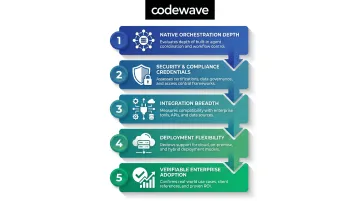
Five Evaluation Factors
1. Native multi-agent orchestration depth — Not just chaining tools, but genuine agent-to-agent delegation and shared context. Can a sales agent hand off to a procurement agent and pass along conversation history?
2. Enterprise security and compliance credentials — SOC 2, HIPAA, GDPR, RBAC, audit logs. Without these, regulated industries can't deploy agents beyond sandboxed pilots.
3. Integration breadth — How easily do agents connect to existing enterprise systems without custom development? Pre-built connectors reduce implementation timelines from months to weeks.
4. Deployment flexibility — Cloud, VPC, on-prem options for regulated or data-sensitive environments. Healthcare and finance organizations often require on-prem deployment to meet data residency rules.
5. Verifiable enterprise adoption — Real organizations running real workflows in production, not just pilots. McKinsey's survey shows only 6% of organizations attribute 5%+ of EBIT to AI, indicating most struggle to scale beyond experiments.
Tying Criteria to Business Outcomes
Each criterion above maps directly to a business outcome. The right platform should:
- Cut time from agent prototype to production by weeks, not quarters
- Lower compliance risk through built-in governance rather than retrofitted controls
- Deliver measurable improvements in productivity, cost, or revenue
Organizations that prioritize governance maturity early consistently outperform those that treat it as an afterthought. McKinsey's high-performer cohort — the 6% seeing significant EBIT impact — invests heavily in workflow redesign and leadership commitment to AI. The pattern is clear: governance and operating discipline drive scaled value, not just better technology.
Conclusion
Multi-agent AI isn't a future capability—it's already running production workflows at scale in enterprises across industries. The platforms listed here represent the current state of the art, and the competitive gap between organizations that govern agents well and those that don't is widening in 2026.
When evaluating platforms, prioritize governance maturity, deployment flexibility, and integration depth over brand name. Validate any platform against real use cases in your specific industry before committing. A platform that works for retail may fail in healthcare due to compliance requirements.
That industry-specific validation is exactly where implementation expertise matters. Codewave works with enterprise teams across 15+ industries to design and deploy custom multi-agent AI architectures—from selecting the right platform to getting agents into production. Client results have included 40% productivity gains, 25% cost reduction, and 3× faster data processing. Under Codewave's ImpactIndex™ model, fees are tied to those results, not just implementation hours.
Frequently Asked Questions
What is the best multi-AI platform?
There is no single "best" platform—the right choice depends on your tech ecosystem, compliance requirements, and whether you need a full agent management platform or a development framework. Microsoft Azure AI Foundry fits Microsoft-centric enterprises, while Kore.ai excels at cross-framework governance.
Who are the top 5 AI platforms?
The five platforms covered here—Microsoft Azure AI Foundry, Salesforce Agentforce, Kore.ai, IBM WatsonX Orchestrate, and CrewAI Enterprise—were selected based on enterprise production-readiness, governance depth, and verified adoption, not popularity metrics or feature counts.
What are the top 5 AI agents?
Enterprise AI agents and the platforms that run them are different things. The most widely deployed agents in 2026 include sales agents, support triage agents, data analysis agents, document processing agents, and IT incident response agents—all running on platforms like those covered above.
What is the best AI for Teams?
Microsoft Copilot (integrated with Microsoft Teams via Azure AI Foundry and Copilot Studio) lets agents surface directly inside chats, meetings, and workflows without leaving the Teams environment—making it the most tightly integrated option for Teams users.
What is an agentic AI orchestration platform?
Agentic AI orchestration platforms manage how multiple AI agents communicate, delegate tasks, and share context. Leading platforms include Kore.ai, Microsoft Azure AI Foundry, and CrewAI Enterprise. True orchestration using A2A and MCP protocols differs from simple workflow chaining.
Does Teams have an AI agent?
Yes. Microsoft Teams supports AI agents through Microsoft Copilot and Copilot Studio, deployable inside channels and chats to answer questions, trigger workflows, and coordinate tasks. Complex multi-agent orchestration requires Azure AI Foundry.