Introduction
Online retailers know exactly which products shoppers view, how long they linger, what they abandon in carts, and which combinations drive conversion. Physical stores historically operated in the dark — relying on delayed reports, manual audits, and gut instinct to make merchandising and operational decisions. Computer vision is closing this data gap.
According to Grand View Research, the global computer vision AI in retail market was valued at $1.66 billion in 2024 and is projected to reach $12.56 billion by 2033, growing at a 25.4% CAGR. This explosive growth reflects a fundamental shift: brick-and-mortar retailers can now extract the same rich behavioral data that e-commerce platforms have enjoyed for decades.
What follows covers the specific applications, real-world deployments, and measurable business outcomes that explain why retail's investment in computer vision is accelerating fast.
TLDR:
- Computer vision transforms passive CCTV into active intelligence engines that detect stockouts, track shopper behavior, and automate checkout in real time
- Core retail applications span shelf monitoring, cashierless payments, customer analytics, loss prevention, and virtual try-on
- Verified deployments show 2-4% availability gains (Morrisons), 83% theft reduction (Amazon/UCSD), and checkout times cut from 25 to 3 minutes
- ROI typically lands within 12-18 months via reduced shrinkage, lower labor costs, and on-shelf availability gains
What Is Computer Vision in Retail?
Computer vision in retail refers to AI systems that analyze visual data from cameras and sensors installed throughout store environments — shelves, checkout lanes, entrances, backrooms — to extract actionable insights and automate workflows. Unlike traditional CCTV, which records passively for human review after incidents, computer vision systems actively interpret what they see in real time.
The underlying technology stack feeds live video streams into deep learning models — object detection, image classification, pose estimation — that recognize people, products, behaviors, and spatial patterns. These models typically run on frameworks like TensorFlow, PyTorch, and OpenCV.
Modern deployments increasingly use Edge AI, which processes data on-device rather than sending every frame to the cloud. This approach improves response speed, reduces bandwidth costs, and keeps raw video local to minimize privacy risk.
That processing capability translates directly into store-level and digital applications across two contexts:
- In-store physical retail: Shelf monitoring, people counting, loss prevention, queue management
- E-commerce experiences: Visual search, virtual try-on, augmented reality product previews
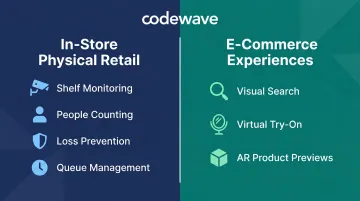
Both contexts share the same core capability: turning visual data into structured, actionable business intelligence.
Key Applications of Computer Vision in Retail
Retail's biggest operational headaches — empty shelves, long lines, shoplifting, and missed upsell opportunities — all have one thing in common: they're visible problems. Computer vision turns those visible signals into automated action across four domains: inventory management, checkout, customer analytics, and loss prevention.
Inventory Management and Shelf Monitoring
AI-powered cameras — either fixed overhead units or mounted on autonomous robots — continuously scan shelves to detect out-of-stock situations, misplaced products, and planogram violations. When an item goes missing or appears in the wrong location, the system automatically alerts staff or triggers restocking workflows.
Real-world example: Morrisons (UK) deployed Focal Systems' shelf-monitoring solution across 500 stores in 8 months, installing 200,000 shelf-edge cameras — the largest grocery computer vision deployment globally. The system delivered over 2% improvement in customer availability (up to 4% in top-performing stores), reduced waste and shrink, and cut in-day replenishment times.
Consumer behavior data underscores why this matters: IHL Group research found that 21% of shoppers will leave and buy from a competitor when facing a stockout. Harvard Business Review reports that stockouts cost retailers nearly $1 trillion worldwide annually.
Beyond shelf monitoring, computer vision extends into backrooms and supply chains:
- Reading barcodes and QR codes via optical character recognition (OCR)
- Detecting damaged packaging before products reach the floor
- Verifying price tag accuracy against POS data
- Triggering automated restocking alerts based on real-time inventory levels
Cashierless Checkout and Automated Payments
Cashierless stores use overhead cameras, computer vision algorithms, and entry-point identification (app or card) to track which products a shopper picks up, build a virtual cart in real time, and charge them automatically on exit.
Amazon Go's "Just Walk Out" technology is the most recognized example. As of January 2026, the technology operates in 360+ third-party locations across 5 countries, with 150 new stores added in the past year. Amazon has processed 36.7 million items across 17.7 million shopping sessions and reduced deployment costs by over 50% since 2018.
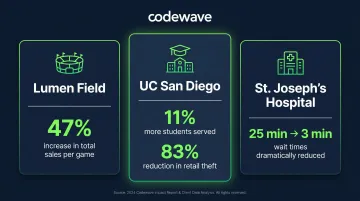
Performance benchmarks from verified deployments include:
- Lumen Field: 47% increase in total sales per game
- UC San Diego: 11% more students served, 83% reduction in retail theft
- St. Joseph's Hospital: wait times reduced from 25 minutes to 3 minutes
Aldi has also piloted cashierless technology, launching ALDIgo in Aurora, IL (April 2024) powered by Grabango, making it the first major U.S. grocery retailer to deploy checkout-free shopping in an existing full-size store.
Why does this matter? Zippin-commissioned research (survey of 1,000 U.S. consumers and 100 retail decision-makers, Dec 2022–Jan 2023) calculated that retailers face a $555 billion headwind from shoppers abandoning long lines. 92% of retailers admitted wait times negatively impact revenue.
At self-checkout stations, computer vision adds another layer: cross-referencing video feeds with POS transaction data to catch mis-scans or unscanned items and alert staff in real time — a capability covered more fully in the Loss Prevention section below.
Customer Behavior Analytics and Store Layout Optimization
Computer vision tracks foot traffic patterns, dwell times at specific shelves or displays, and customer path flows — data retailers often visualize as heat maps or spaghetti diagrams. This intelligence helps retailers:
- Reposition high-priority products to high-engagement zones
- Time promotional displays for peak foot traffic
- Optimize staff deployment based on actual customer flow
- Validate planogram changes with real shopper response data
Behavior analytics can also capture demographic signals (age range, gender distribution) and shopper-to-shelf interactions (products picked up vs. put back) to inform category management decisions.
Phillips 66's "Connected Store" initiative uses Everseen's visual AI for end-to-end monitoring from forecourt to checkout. Overhead cameras with edge computing provide real-time POS reconciliation, heatmaps, and customer path-tracking. Phillips 66 also deployed NCR Voyix Halo at checkout, decreasing checkout time by nearly 50% with an average transaction time of 8 seconds.
Loss Prevention and Security
Modern computer vision loss prevention goes beyond detecting intruders after hours. AI algorithms analyze behavioral patterns in real time (concealment of items, unusual loitering near high-value products, mis-scanning at self-checkout) and trigger staff alerts before a loss occurs.
Tesco and Lidl have both deployed AI-based "supermarket VAR" systems. BBC News reported (May 2025) that Tesco installed overhead AI cameras at self-checkouts to identify when shoppers fail to scan items, then show a live-action replay — dubbed "VAR" by customers (referencing football's Video Assistant Referee). The Independent reported (July 2025) that Lidl became the second UK retailer to introduce the technology at two London stores.
The financial stakes are substantial. According to the NRF National Retail Security Survey 2023, average shrink rate in FY 2022 was 1.6%, representing $112.1 billion in losses. Building Security Services estimates U.S. retailers lost $45 billion to shoplifting in 2024 alone.
Additional security applications include:
- Restricted area monitoring: Detecting unauthorized access to staff-only zones
- Emergency compliance monitoring: Verifying fire exit accessibility, detecting spills or falls for rapid response
Virtual Try-On and Visual Search (E-commerce Applications)
Virtual try-on uses computer vision to map facial and body features in real time via smart mirrors or mobile cameras, then overlays a 3D product model that adapts to lighting and skin tone.
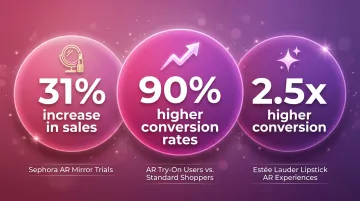
L'Oréal's ModiFace is a leading example — acquired in 2018, it enables virtual preview of lip, eye, cheek, brow, and hair color products. BrandXR Research (April 2025) reports that:
- Sephora's AR mirror trials led to an estimated 31% increase in sales
- AR try-on users demonstrate conversion rates up to 90% higher
- Estée Lauder reports AR experiences yield 2.5 times higher conversion for lipstick purchases
The Interline (March 2026) found that customers who completed a virtual try-on converted at twice the rate of standard shoppers, added items to carts 52% more often, and converted 35% more frequently.
Visual search allows shoppers to upload or capture an image, and the AI identifies shape, color, and texture to surface matching products from a catalog. Major retailers already using it include:
- Amazon: Camera-based product search in the Amazon Shopping app
- IKEA: IKEA Place app with Visual Search powered by GrokStyle (launched March 2018); IKEA Kreativ AI-driven design experience (June 2022)
- Target: "See It In Your Space" AR feature for home furnishings
For retailers, visual search removes one of the last points of friction between intent and purchase: shoppers don't need the right words — they just need a picture.
The Business Impact: Benefits Retailers Are Seeing
Retailers measure computer vision success by operational efficiency gains, cost reductions, and revenue uplift — not just technical capability.
On-shelf availability and lost sales recovery: Automated shelf monitoring reduces out-of-stock events measurably. The Morrisons/Focal Systems deployment achieved over 2% availability improvement across all stores (up to 4% in top performers). Fewer stockouts translate directly to higher basket completion rates and reduced lost sales.
Staffing efficiency gains: With AI handling shelf audits, queue monitoring, and checkout functions, employees shift from routine surveillance tasks to customer-facing roles. Simbe Robotics' Tally 3.0 autonomous inventory robot uses computer vision to scan shelves, capturing shelf tags from up to 30 inches away with real-time edge and cloud processing — eliminating manual stock-takes.
Shrinkage and loss reduction: Verified vendor claims show substantial shrinkage reductions. SeeChange states its AI self-checkout software can reduce losses by up to 50%, with 80% of shoppers self-correcting when prompted. Amazon's Just Walk Out deployment at UC San Diego achieved an 83% reduction in retail theft.
Revenue uplift from layout and merchandising optimization: Heat maps and behavior data allow merchandising teams to test and validate product placement decisions with actual shopper response data — not just intuition. This closes the loop between promotional spend and measurable customer engagement in physical stores.
Behavioral data that connects physical and digital analytics: That same shopper behavior data — foot traffic, dwell time, engagement rates, demographic signals — doesn't stop at the store floor. Connected to POS, CRM, and inventory systems, it gives physical retailers the same granular decision-making inputs that e-commerce teams have relied on for years.
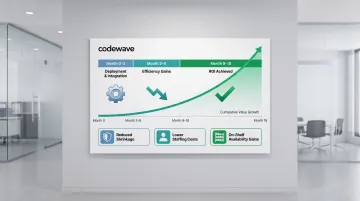
ROI timelines: A LinkedIn market outlook reports payback period benchmarks of approximately 12 months in retail for AI computer vision investments. Nexer Group notes that many successful AI initiatives show payback within 12 to 18 months, driven by reduced shrinkage, lower staffing costs, and revenue gains from improved on-shelf availability.
Customer Experience Gains from Computer Vision
Reduced Friction at Checkout
Cashierless and AI-assisted checkout systems directly reduce wait times — one of the top drivers of in-store dissatisfaction. PwC's "Experience is Everything" survey found that nearly 80% of American consumers rank speed, convenience, and knowledgeable help as the most critical elements of a positive shopping experience. 43% would pay more for greater convenience, and 32% would stop doing business with a brand they loved after just one bad experience.
Personalized In-Store Experiences
By combining foot traffic patterns, demographic analysis, and dwell time data, retailers can trigger personalized promotions on digital kiosks when a customer engages with a specific shelf or product zone. Research shows that 64% of shoppers are more engaged with brands that use digital signage strategically.
A Journal of Retailing study (Nanni et al., 2024) found that price discount promotions on digital screens have a "significant impact" on sales — closing the personalization gap between e-commerce recommendation engines and physical retail.
Proactive Customer Service
Computer vision shifts customer service from reactive to anticipatory. Key capabilities include:
- Queue analytics: Alerts managers to staff up checkout lanes before wait times spike
- Occupancy detection: Dynamically balances service desk coverage across the store
- Empty shelf signals: Flags product zones visited by customers when inventory is out, surfacing missed service moments before they drive shoppers away
Virtual and Augmented Shopping Experiences
Virtual try-on and visual search reduce return rates and lift conversion for online shoppers. Apparel return rates average 20-30% in the U.S., according to The Interline. While reduction percentages vary by implementation, multiple verified studies show conversion rate increases ranging from 35% to 90% for shoppers who use virtual try-on tools.
Challenges in Implementing Computer Vision — and How to Address Them
Environmental and Accuracy Constraints
Retail environments are dynamic — poor lighting, product occlusions, frequent store resets, and crowded aisles can reduce model accuracy. Sensor fusion — combining multiple camera angles, weight sensors, RFID tags — compensates for environmental variability. Edge AI deployment reduces latency and improves real-time performance even in connectivity-constrained store environments.
Legacy System Integration and Infrastructure Gaps
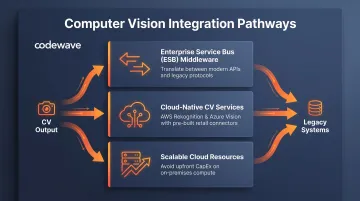
Connecting computer vision outputs to existing POS, inventory management, or ERP systems that run on older communication protocols presents integration challenges. Recommended approaches include:
- Enterprise service bus (ESB) middleware to translate between modern APIs and legacy systems
- Cloud-native CV services (AWS Rekognition, Azure Vision) that offer pre-built retail API connectors
- Scalable cloud resources to avoid upfront capital expenditure on on-premises compute infrastructure
Data Privacy and Regulatory Compliance
Video-based AI systems intersect with several biometric data regulations retailers must navigate before deployment:
GDPR (EU): Article 9 classifies biometric data used to uniquely identify individuals as a "special category" requiring explicit consent or another lawful basis. The UK's ICO mandates a Data Protection Impact Assessment before deploying facial recognition technology.
CCPA/CPRA (California): The CCPA as amended by CPRA defines biometric information — including facial imagery — as personal information, subject to full consumer rights: access, deletion, and opt-out of sale or sharing.
Enforcement precedent: In December 2023, the FTC banned Rite Aid from using facial recognition technology for surveillance purposes for five years. Rite Aid deployed AI facial recognition in hundreds of stores (2012-2020), generating thousands of false positives that disproportionately affected Black, Latino, and Asian customers.
Practical privacy recommendations:
- Implement real-time face blurring at the camera or edge level
- Apply data minimization principles — don't collect biometrics that aren't necessary for the use case
- Delete raw video feeds immediately after analysis
- Conduct Data Protection Impact Assessments before deployment
Building privacy controls into system architecture from day one — not retrofitted after deployment — is what keeps retailers compliant as regulations tighten.
How to Get Started: Building a Computer Vision Strategy for Retail
Start by identifying two or three high-impact, clearly defined use cases (e.g., out-of-stock detection + queue monitoring) rather than attempting a comprehensive system deployment from day one. Establish a Proof-of-Concept in a single store location before scaling. Define success metrics upfront — reduction in stockout frequency, checkout wait time, shrinkage rate — so ROI measurement is built into the pilot.
Computer vision in retail is rarely a standalone deployment. To generate usable insights rather than raw video feeds, it needs to connect with:
- Inventory management systems for real-time stock updates
- POS data to correlate foot traffic with sales patterns
- Analytics dashboards for operational reporting
- Data warehouses and BI tools (such as Snowflake and Power BI) for broader intelligence
Evaluate implementation partners on their ability to bridge CV outputs to this downstream infrastructure — otherwise, visual data stays siloed from the rest of your business intelligence stack.
That integration layer is where Codewave focuses. The team works with retail businesses on end-to-end computer vision implementation — from model development and deployment to connecting visual data with analytics platforms — so in-store insights feed directly into business decision-making. Explore Codewave's AI solutions for retail.
Frequently Asked Questions
What are the applications of computer vision in retail?
Computer vision in retail spans inventory and shelf monitoring (detecting stockouts and planogram violations), automated checkout (cashierless stores and self-checkout monitoring), customer behavior analytics (foot traffic, dwell time, heat maps), loss prevention (behavioral pattern detection and self-checkout fraud prevention), and e-commerce applications like virtual try-on and visual search.
How does computer vision improve inventory management in retail?
AI cameras continuously scan shelves to detect stockouts, misplaced products, and planogram violations, then automatically alert staff or trigger restocking workflows. This eliminates manual audit labor and cuts lost sales from empty shelves. Morrisons' 500-store deployment achieved over 2% availability improvement using Focal Systems' shelf-monitoring solution.
What is the ROI of implementing computer vision in retail?
ROI timelines typically fall within 12–18 months post-deployment, driven by reduced shrinkage (vendor claims range from 50-83% reduction in specific deployments), lower staffing costs for manual tasks, and revenue gains from improved on-shelf availability and faster checkout. Phillips 66 reduced checkout time by nearly 50% with AI-assisted systems.
Is computer vision technology accessible for small and mid-sized retailers?
Large-scale cashierless deployments require significant infrastructure, but modular use cases like shelf monitoring or queue detection are accessible via cloud-based or SaaS platforms. Retailers can start with single-store pilots using AWS Rekognition or Azure Vision — no large upfront capital required.
How does computer vision in retail address data privacy concerns?
Retailers must anonymize video at the edge (face blurring), collect only necessary biometric data, and delete raw feeds immediately after analysis. Compliance with GDPR, CCPA, and local biometric laws is mandatory — the FTC's 2023 enforcement action against Rite Aid confirms that privacy-by-design is non-negotiable.
How does computer vision differ from traditional retail surveillance cameras?
Traditional CCTV records passively for human review after incidents. Computer vision systems actively interpret visual data in real time — detecting patterns, triggering automated alerts, and generating structured business data like foot traffic flows, dwell times, product interaction rates, and demographic signals. The shift is from passive recording to active intelligence generation.