Introduction
Manual inspection errors cost manufacturers far more than wasted time. According to the American Society for Quality, poor quality alone generates $1.3 trillion in global annual losses each year. Add unplanned downtime—which runs upward of $1.7 million per hour for large manufacturing plants—and the cost of passive observation becomes unsustainable. Operations and technology leaders need solutions that don't just record problems, but prevent them.
Computer vision transforms how organizations detect, respond to, and prevent operational failures. By converting camera footage into real-time decision intelligence, these systems bridge the gap between observation and action. The result: measurable efficiency gains across quality control, throughput, safety compliance, and predictive maintenance.
This article covers the operational use cases delivering measurable gains, the business case for ROI across four key levers, industry-specific applications, and a practical implementation path that reduces risk and shortens the path to results.
TLDR:
- Computer vision automates quality inspection, reducing defects by 40-83% in documented deployments
- Vision-based predictive maintenance cuts unplanned downtime by 30-50% through early wear detection
- Organizations typically see measurable ROI within 8-14 months of a focused pilot deployment
- Success depends on clear KPIs, phased pilots, and integration with existing ERP/MES systems
What Computer Vision Actually Does for Operations
Computer vision isn't an abstract AI concept—it's a system that uses cameras, trained machine learning models, and processing infrastructure to interpret visual data in real time and trigger automated actions or alerts. Unlike passive surveillance that records events after they occur, computer vision systems detect, classify, and act on events as they happen.
The shift from passive to active intelligence matters for operations. Traditional security cameras capture footage for later review. Computer vision systems analyze every frame in milliseconds, identifying anomalies—surface defects, misaligned components, unsafe worker behavior, equipment wear patterns—and alerting operators or triggering corrective workflows before problems escalate.
Three core components enable this shift:
- Cameras and sensors capture visual input—standard industrial cameras, thermal imaging, hyperspectral sensors, or 3D depth cameras depending on the application
- Trained AI models recognize patterns, classify objects, and detect anomalies using deep learning frameworks like TensorFlow, PyTorch, and OpenCV
- Integration layers connect findings to operational systems (ERP, MES, SCADA) via APIs, ensuring alerts trigger workflows, update inventory systems, or halt production lines automatically
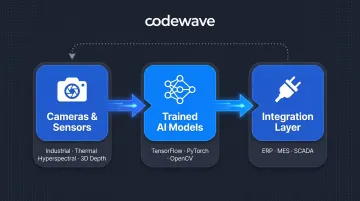
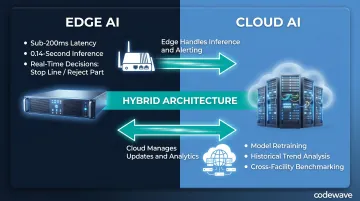
Processing can happen at the edge (on-site hardware for sub-200ms latency) or in the cloud (for complex analytics and model training). Hybrid architectures—where edge devices handle real-time inference and cloud systems manage model updates and historical analysis—now dominate production deployments, trading some cloud flexibility for the latency control that industrial environments demand.
The global machine vision market is projected to grow from $13.61 billion in 2026 to $26.88 billion by 2034, driven by manufacturing, automotive, and logistics adoption. Gartner estimates that enterprise computer vision markets will exceed $386 billion by 2031—numbers that track investment already in motion across factory floors, warehouses, and supply chains.
Key Use Cases: Where Computer Vision Drives Operational Gains
Automated Quality Control and Defect Detection
Computer vision systems inspect products at speeds and consistency levels human inspectors cannot match. These systems scan for surface defects, dimensional errors, labeling faults, and assembly misalignments in milliseconds per part, processing thousands of items per minute where human inspectors handle 10-12 images per second.
The accuracy gap is substantial. Human inspectors miss 20-30% of defects even in controlled conditions, with best-case accuracy topping out around 85%. AI systems routinely achieve 99%+ accuracy while maintaining consistent performance across shifts, eliminating the variability introduced by fatigue, lighting changes, or inspector experience.
Documented outcomes from named deployments show:
- BMW achieved a 50% faster defect detection rate and 40% reduction in surface defects (scratches, dents, dust) after deploying AIQX visual inspection
- Bosch increased defect detection accuracy from 89% to 97.6%, cutting scrap rates by 25% and saving $1.2 million annually
- Matroid's steel production client improved accuracy from 70% to 98%, generating $2 million in annual savings and 1,900% ROI within one year
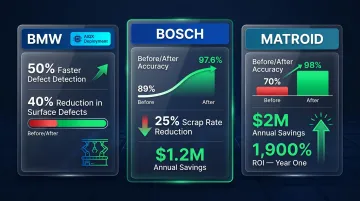
These gains translate to multiple ROI levers: reduced rework costs, lower scrap rates, fewer customer returns, and faster inspection throughput. For operations teams managing high-volume production lines, automated visual inspection eliminates bottlenecks while catching defects before they reach customers.
Predictive Maintenance and Equipment Monitoring
Computer vision enables predictive maintenance by analyzing machinery in real time for visual indicators of wear: cracks, misalignment, thermal signatures, vibration patterns, or corrosion on critical components. Unlike sensor-based monitoring that tracks single variables like temperature or vibration frequency, vision systems assess visual patterns that correlate with early-stage failure modes.
McKinsey research shows that predictive maintenance typically reduces downtime by 30-50% and extends machine life by 20-40%. Vision-specific implementations report between 20-40% less unplanned downtime, with algorithms predicting failures several weeks in advance.
A documented oil and gas case from McKinsey illustrates the financial impact: analyzing 1,000 parameters from hundreds of sensors reduced compressor downtime from 14 days to 6 days. Given that single compressor failures cost $1-2 million per day, early prediction delivered millions in avoided losses.
Vision-based systems integrate with existing SCADA and MES platforms, feeding alerts directly into maintenance workflows. When a camera detects early-stage bearing wear or belt misalignment, the system automatically generates work orders, orders replacement parts, and schedules downtime during planned windows. The result: catastrophic failures that halt production lines get avoided entirely.
Workplace Safety and Compliance Monitoring
Computer vision enforces PPE compliance, detects hazardous zone intrusions, and monitors worker posture or fatigue in real time, replacing periodic safety audits with continuous automated oversight. These systems identify when workers enter restricted areas without helmets or operate machinery without safety glasses. They also flag ergonomic risk behaviors before they compound into repetitive strain injuries.
The National Safety Council reports that work injuries cost $181.4 billion annually in the US alone, including wage losses, medical expenses, and administrative costs. Computer vision reduces these costs through early intervention rather than post-incident response.
Documented case studies show rapid improvement:
- Americold achieved a 77% injury reduction and eliminated 288 lost-time days within 12 months, generating $1.1 million in cost savings
- Piston Automotive cut overall vehicle safety incidents by 86% in 3 months using AI-powered safety monitoring
- NSG Group reduced ergonomic risk events by 57% between Q3 and Q4 2024
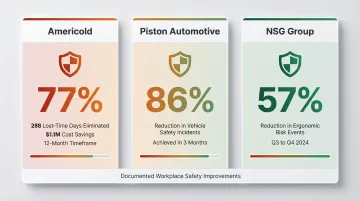
These systems deliver measurable improvements within 30-90 days, making them one of the fastest-ROI computer vision applications. For high-risk industries such as manufacturing, construction, and warehousing, automated safety monitoring transforms compliance from reactive documentation to proactive prevention.
Real-Time Inventory and Supply Chain Visibility
Vision-equipped systems track stock movement, automate cycle counts, identify misplaced items, and flag discrepancies across warehouse and factory floors without halting operations. Cameras positioned at key locations continuously monitor inventory levels, read barcodes or RFID tags visually, and update inventory management systems in real time.
A 2024 study published in Intelligent Systems with Applications documented measurable gains from computer vision inventory management:
- 9% increase in overall inventory accuracy
- 67% reduction in overcounting errors
- 85% reduction in undercounting errors
- 45% reduction in total inventory time (from 30-35 minutes to 10-12 minutes per stock update)
The cost of inventory errors compounds quickly. A single mispick ranges from $22 to $100 per incident, and high-volume facilities can lose nearly $400,000 per year from mispick costs alone. Computer vision eliminates these errors by verifying picks in real time, flagging discrepancies before they cascade through the supply chain.
For operations teams managing complex warehouses or multi-SKU production environments, continuous visual inventory monitoring provides real-time visibility that manual cycle counts and periodic audits cannot deliver.
Workforce Performance and Process Monitoring
Cycle-time tracking through computer vision helps operations managers identify bottlenecks, rebalance task loads, and measure process adherence, converting workflow data into measurable operational insight. Cameras positioned along production lines or warehouse workflows automatically time each process step, compare performance against baseline standards, and flag deviations that indicate training needs or process inefficiencies.
Unlike manual time studies or intermittent observation, computer vision provides continuous measurement across all shifts, eliminating sampling bias and capturing edge cases that periodic audits miss. When a workstation consistently exceeds target cycle times, the system alerts supervisors in real time rather than surfacing the issue weeks later.
Beyond individual task timing, vision systems map entire workflows and surface patterns that inform structural improvements:
- Track how materials move between stations and where queues form
- Identify which process sequences create delays or idle time
- Enable data-driven rebalancing by shifting resources to bottleneck stations
- Support layout redesigns that reduce travel time and smooth batch flow
The result is granular, shift-by-shift visibility into physical operations — the kind of continuous process intelligence that drives sustained efficiency gains rather than one-time fixes.
The ROI Business Case: What Organizations Actually Gain
Computer vision drives direct margin improvement through four measurable ROI levers — quality gains, throughput increases, uptime improvements, and overhead reduction. Each compounds over time.
1. Quality and Yield Gains from Defect Reduction
Automated visual inspection reduces scrap, rework, and customer returns. McKinsey estimates that AI can cut quality-related expenses by 10-20%, with scrap costs dropping 15-20% in typical deployments. For high-volume manufacturers, these savings add up fast — Intel saves $2 million annually in scrap avoidance alone from automated inspection.
Beyond direct cost avoidance, quality improvements reduce warranty claims, protect brand reputation, and enable premium pricing for defect-free products.
2. Throughput Improvement from Vision-Guided Process Optimization
Large-scale factory studies show 15-30% average throughput improvement from computer vision deployment, driven by faster inspection cycles, reduced manual audit requirements, and elimination of inspection bottlenecks. Audit and inspection labor requirements drop by around 30%, freeing skilled workers for higher-value tasks.
For production lines where inspection creates bottlenecks, automated vision systems deliver immediate capacity gains without capital investment in additional equipment.
3. Uptime Gains from Predictive Maintenance
The 30-50% downtime reduction from vision-based predictive maintenance translates to millions in avoided losses for asset-intensive operations. McKinsey research documents EBITDA margin improvements of 4-10% from advanced analytics that include predictive maintenance.
Early failure detection prevents catastrophic breakdowns that cascade across production schedules, damage adjacent equipment, and create costly emergency repair situations.
4. Overhead Reduction from Automated Inspection Replacing Manual Labor
Visual quality inspection accounts for over 60% of all quality control labor expenses in some operations. Typical mid-size implementations save $100,000 to $300,000 annually in labor costs, with per-line savings averaging $691,200 annually in labor alone.
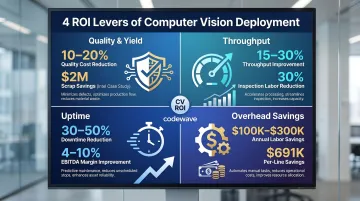
These savings don't require workforce reductions — most organizations redeploy inspection staff to higher-value quality analysis, continuous improvement projects, or production roles.
Returns Grow as Systems Mature
Unlike one-time process changes, computer vision systems improve as they accumulate data. Models retrained on production-specific defects become more accurate, edge cases get added to detection algorithms, and integration with operational systems deepens.
Organizations that deploy early build a performance advantage that widens over time. Those that wait don't just face a deployment gap — they face a maturing competitor gap that becomes harder to close.
Codewave's client deployments have documented representative outcomes: 40% productivity increases and 25% cost reductions through well-scoped AI implementations. These results reflect multiple ROI levers working simultaneously: quality improvements cut rework, predictive maintenance eliminates downtime, and process optimization increases throughput.
Timeline to ROI
Organizations typically see measurable gains within months rather than years when pilots focus on clear KPIs. Average payback periods run 8-14 months, with high-volume applications breaking even in under 6 months. First measurable ROI arrives in months four through six for well-scoped pilots, though enterprise-wide transformation takes 24-36 months.
The key difference: focused pilots with defined success metrics deliver fast returns, while broad "AI transformation" initiatives without clear targets stall in proof-of-concept phases.
Computer Vision Across Industries: Applications Beyond the Factory Floor
Manufacturing and Logistics
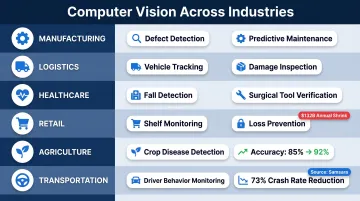
Manufacturing remains the most mature adopter, combining multiple use cases on single production lines: assembly defect detection, dimensional verification, label validation, and predictive equipment monitoring. Logistics centers add vehicle tracking in distribution yards, real-time shipment monitoring at loading docks, and automated damage inspection for incoming and outgoing freight.
These applications stack—the same camera infrastructure monitoring product quality can track equipment condition and enforce safety compliance, maximizing infrastructure ROI.
Healthcare and Retail
In healthcare, computer vision handles patient monitoring for fall detection in hospitals and elder care facilities, surgical tool verification to prevent retained instruments, and hand hygiene compliance documentation. These systems operate continuously without the alert fatigue that plagues manual observation.
Retail deployments focus on shelf availability monitoring (detecting out-of-stock conditions in real time), planogram compliance verification, checkout fraud detection at self-service stations, and customer flow analytics for store layout optimization. Retail shrink is projected to reach $132 billion globally in 2024, and computer vision now accounts for over 35% of new loss prevention implementations.
Agriculture, Energy, and Transportation
Agriculture uses drone-mounted computer vision for crop disease detection via multispectral imaging, yield monitoring across large fields, and automated sorting of harvested produce. CNN-based approaches have improved crop disease detection accuracy from 85% to 92% using hyperspectral imaging.
Energy infrastructure inspection uses drones and fixed cameras to detect pipeline corrosion, cracks in wind turbine blades, and thermal anomalies in solar panel arrays—replacing dangerous manual inspections with continuous automated monitoring.
Transportation and fleet safety applications cover three core areas:
- Driver behavior: distraction detection, drowsiness alerts, seatbelt compliance
- Vehicle condition: tire wear monitoring, damage assessment
- Logistics hub tracking: trailer positioning, loading dock occupancy
Samsara's 2025 Fleet Safety Report documents 73% crash rate reductions over 30 months using AI safety solutions across fleets.
Each of these verticals demands different model architectures, data pipelines, and compliance requirements—which is why Codewave's cross-industry implementation experience, spanning healthcare, fintech, retail, agriculture, and industrial sectors, shapes how solutions are designed from the ground up rather than adapted after the fact.
Overcoming Implementation Challenges
Three barriers appear consistently across deployments:
1. Upfront Infrastructure Investment
Hardware (cameras, edge processing units, networking), software licenses, and integration labor create initial cost hurdles. Organizations mitigate this through phased pilots—deploying on single production lines or warehouse zones before full-scale rollout. Focused pilots prove ROI on limited budgets, building the business case for broader investment.
2. Training Data Scarcity
Effective computer vision models require thousands of labeled images showing normal conditions and defect variations. New deployments often lack this data, and manual labeling costs run $20,000 to $100,000 for medium-sized projects. Partnerships with domain experts who understand what "good" and "defective" look like accelerate labeling, while synthetic data generation and transfer learning from pre-trained models reduce the data volume required.
The reality: 68% of tech executives cite poor data quality as the main reason for AI project failure, making data strategy as critical as model selection.
3. Workforce Resistance and Skill Gaps
Introducing automated monitoring systems triggers concerns about job security and surveillance. Change management approaches that position computer vision as worker support work better than top-down mandates. Effective framing includes:
- Eliminating tedious inspection tasks and reducing injury risk
- Upskilling existing quality inspectors into AI system trainers and analysts, creating career progression rather than displacement
Environmental and Integration Considerations
Beyond organizational challenges, operational and technical factors shape deployment success. Lighting variability, dust, camera positioning, and image resolution all affect model performance. Teams should plan for these during scoping — testing under actual production conditions, not controlled lab environments — to prevent post-deployment surprises.
Legacy system compatibility adds another layer. Connecting vision systems with ERP, MES, and SCADA platforms requires API integration work. Organizations with well-documented system architectures integrate faster; those running undocumented legacy systems face longer timelines.
Industry data shows that 77% of AI manufacturing pilots never progress past prototype stage. Most failures trace to unclear success metrics, weak data strategies, or insufficient integration planning — all solvable problems when addressed during scoping rather than after go-live.
Building a Computer Vision Strategy That Delivers
Define the operational problem and measurable KPIs before selecting technology. The most common failure mode: deploying computer vision systems without clear success metrics, then struggling to demonstrate value. Start with the business outcome—reduce defect escape rate by 15%, cut unplanned downtime by 40 hours per month, eliminate recordable safety incidents in a target zone—and work backward to the technical requirements.
Validate with Focused Pilots Before Scaling
Deploy on a single production line, warehouse zone, or facility for 6-12 months before enterprise rollout. Anything shorter than 6 months fails to capture seasonal variation, shift differences, and edge cases. Successful pilots prove ROI, identify integration challenges, and build internal expertise before scaling.
Codewave's QuantumAgile™ methodology applies directly here: simulate multiple deployment scenarios, ship what works, and iterate on measured outcomes. Pilots move from concept to validated result in days — not quarters — which keeps momentum without committing the full organization before proof exists.
Choose Deployment Architecture Based on Requirements
Once a pilot validates the use case, architecture choice becomes the next critical decision. Edge AI delivers sub-200ms latency for high-speed production lines where real-time decisions — stopping a line, rejecting a part — cannot wait for cloud round trips. Cloud AI excels at complex analytics, model training, and cross-facility analysis where processing power matters more than response time.
Research analyzing 50+ industrial AI patents shows edge inference achieves 0.14-second processing times — 30% faster than typical production requirements — while cloud systems handle model updates and historical trend analysis.
Hybrid architectures are emerging as the standard approach: edge devices handle real-time inference and alerting, while cloud platforms manage model retraining, performance analytics, and cross-site benchmarking. This split balances latency, cost, and scalability without forcing a trade-off between them.
Frequently Asked Questions
What are examples of operational efficiency in computer vision?
Automated defect detection on production lines catching surface flaws in milliseconds, predictive maintenance that prevents unplanned equipment failures weeks in advance, real-time inventory tracking eliminating manual cycle counts, PPE compliance monitoring reducing workplace injuries, and cycle-time analysis identifying workflow bottlenecks.
How does computer vision reduce operational costs?
Computer vision cuts costs by automating inspection labor, catching defects early, preventing equipment failures, and eliminating inventory errors that cause stockouts or excess carrying costs. Labor savings alone average $100,000–$300,000 annually for mid-size implementations.
Which industries benefit most from computer vision for operational efficiency?
Manufacturing and logistics show the most mature adoption, followed by retail, healthcare, agriculture, energy, and transportation. Key use cases by sector:
- Manufacturing: quality control and predictive maintenance
- Logistics: inventory tracking and receiving accuracy
- Retail: loss prevention and shelf monitoring
- Healthcare: patient monitoring and compliance
How long does it take to see ROI from a computer vision implementation?
Well-scoped pilots tied to clear KPIs typically break even within 8–14 months; high-volume applications often hit that mark in under 6 months. Safety monitoring shows measurable gains within 30–90 days, and returns improve as models accumulate training data.
How does computer vision integrate with existing operational systems?
Modern computer vision platforms connect to ERP, MES, and SCADA systems via APIs, with integration complexity depending on legacy infrastructure documentation and API availability. Phased pilots allow teams to validate integration approaches on limited scope before enterprise rollout.
What are the biggest challenges in deploying computer vision for operations?
The three main hurdles are upfront hardware investment, sourcing quality training data for production-level accuracy, and managing workforce adoption. Phased pilots, domain-expert labeling partnerships, and positioning vision systems as worker support — rather than replacements — directly address each one.