Introduction
Modern logistics operations face mounting pressure from multiple directions. U.S. parcel volume reached 22.37 billion shipments in 2024—a 3.4% increase year-over-year—while 76% of supply chain leaders report notable workforce shortages. Meanwhile, 68% of shoppers now demand faster delivery, compressing timelines that manual oversight simply cannot meet at scale.
Computer vision addresses this gap directly — enabling logistics companies to automate visual inspection, cut errors, and gain real-time visibility across warehouses, distribution hubs, and last-mile delivery. What follows is a practical look at how this technology works, where it's being deployed, and how to evaluate it for your own operations.
TLDR
- Computer vision automates visual tasks like inventory tracking, damage detection, and safety monitoring using AI-powered cameras and deep learning models
- CV systems achieve 98%+ defect detection accuracy—versus 80-85% for human inspectors—at speeds up to 20 items per second
- Amazon, DHL, and FedEx have already deployed CV for robotic picking, order fulfillment, and automated sortation at scale
- Edge processing delivers 1-10 ms latency vs. 50-200+ ms for cloud—critical for conveyor-line inspection and real-time decisions
- Run a focused pilot on one problem area to prove ROI before scaling enterprise-wide
What Is Computer Vision in Logistics — and How Does It Work?
Computer vision enables machines to interpret and act on visual data from cameras and sensors. Unlike basic surveillance that simply records footage, CV systems analyze images in real time, recognize objects, detect anomalies, and trigger automated actions—such as diverting a damaged package or flagging a worker entering a restricted zone.
How CV Systems Process Visual Data
Computer vision in logistics follows a three-step pipeline:
- Image capture – Cameras mounted on conveyors, forklifts, or warehouse ceilings continuously capture visual data
- AI processing – Deep learning models (such as convolutional neural networks or YOLO object detectors) analyze the images, identifying products, reading barcodes, detecting defects, or recognizing safety violations
- Automated action – The system outputs trigger warehouse management updates, alert notifications, or physical actions like rerouting a package on a sorting line
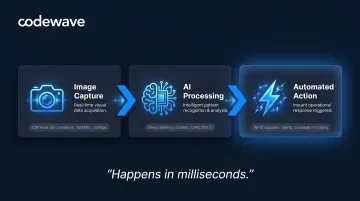
This process happens in milliseconds, enabling logistics operations to make decisions at the speed of their physical workflows.
Why Edge AI Matters for Logistics
That three-step pipeline only works if the processing is fast enough to keep pace with physical operations. Processing visual data locally—on cameras or edge devices rather than in the cloud—is what makes that possible at scale. Edge computing achieves 1–10 ms latency compared to 50–200+ ms for cloud processing, a 2x–10x improvement that enables real-time decisions on high-speed conveyor lines. At 60 packages per second, even a one-second delay means 60 items pass uninspected.
Beyond speed, edge processing delivers three operational advantages:
- Privacy: Footage is analyzed locally; only alerts or metadata leave the device—not raw video streams
- Bandwidth efficiency: Transmitting compressed metadata instead of continuous video reduces network load significantly
- Resilience: Warehouse operations continue even when network connectivity is interrupted
Key Applications of Computer Vision in Logistics
Warehouse Operations and Inventory Management
Computer vision transforms how warehouses track inventory and fulfill orders. High-resolution cameras paired with object detection models automate real-time stock counts by identifying products, reading barcodes via optical character recognition (OCR), and updating warehouse management systems without manual scanning.
Deployment examples include:
- Shelf-scanning robots that roam warehouse aisles, continuously auditing inventory levels and flagging discrepancies
- Camera-mounted forklifts that verify pallet contents during putaway and retrieval
- Ceiling-mounted systems that monitor storage zones and track product movement across the facility
Inventory errors cost businesses 10% to 30% of annual profits, while 35% of fulfillment operations experience picking error rates of 1% or higher. CV systems address these challenges by analyzing hand movements during picking, comparing selected items against order lists, and flagging misplaced or incorrect products before they ship.
Amazon's Sparrow robot demonstrates this in practice, using AI and computer vision to recognize and handle approximately 65% of the millions of individual items in Amazon's inventory, adjusting its suction-based grip based on visual identification of item type.
Quality Control and Package Inspection
CV systems deployed on conveyor belts and sorting lines automatically inspect packages for physical damage in real time. Using a combination of 2D cameras for surface defects and 3D stereo vision for depth-based anomaly detection, these systems identify dents, tears, open flaps, and bulges—then automatically divert damaged items before they reach customers.
Freight damage costs the global logistics industry $50-60 billion annually, with less-than-truckload shipments experiencing damage rates of 2-5%. Since 16% of e-commerce returns are due to product damage, intercepting damaged packages at sortation hubs prevents costly returns and customer dissatisfaction.
CV systems also verify label integrity—using OCR and barcode decoding to confirm shipping labels are correct, legible, and match order records. This prevents mislabeling errors that result in misdeliveries and reshipping costs.
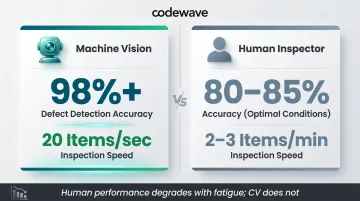
The accuracy gap is hard to ignore: machine vision systems consistently achieve over 98% defect detection accuracy compared to 80-85% for human inspectors under optimal conditions. Human performance degrades with fatigue; CV does not.
Supply Chain Visibility and Shipment Tracking
Computer vision enables end-to-end shipment traceability across logistics networks. Three capabilities drive this visibility:
- OCR-based container recognition at port terminals for automated identification
- License plate recognition (ANPR) for trucks at loading docks
- Load verification systems that confirm the right pallets board the right vehicles
CargoNet tracked 3,625 cargo theft incidents in 2024—a 27% increase from 2023—with an average stolen value of $202,364 per incident. CV-based load verification and surveillance can mitigate these losses by documenting cargo movements and flagging anomalies in real time.
At western India's port terminals, OCR deployments reduced average gate clearance times from over 20 minutes to under 7 minutes, demonstrating how automated visual recognition accelerates logistics throughput. Organizations with high supply chain visibility experience 30% lower inventory carrying costs and 20% improvement in order fulfillment efficiency.
Safety, Security, and Compliance Monitoring
Warehouse and logistics facilities face significant safety challenges. The transportation and warehousing sector recorded 232,000 injury cases in 2024 and 930 fatalities in 2023, with a fatal injury rate of 12.9 per 100,000 FTE—nearly four times the national average.
Computer vision addresses these risks by continuously monitoring warehouse floors for safety violations:
- Restricted zone detection – Identifying workers entering hazardous areas or forklift pathways
- Proximity monitoring – Tracking distance between forklifts and pedestrians to prevent collisions
- PPE compliance – Verifying workers wear required safety equipment like hard hats and high-visibility vests
- Real-time intervention – Triggering automated machine slowdowns, zone lockouts, or supervisor alerts
The results are measurable. Facilities using computer vision report injury reductions of up to 77% within 12 months. NSG Group reduced safety vest non-compliance by 62% in 30 days, while Piston Automotive cut no-stop-at-aisle-end incidents by 92%—from five per day to 0.4 per day.
Security is the other side of this equation. CV systems layer in intrusion detection and anomaly-based monitoring, flagging unusual activity patterns across logistics facilities before they escalate.
Real-World Examples: How Industry Leaders Use Computer Vision
Amazon
Amazon has deployed more than 1 million robots across its operations network since 2012, many of which rely on computer vision for navigation and package handling.
Three robots lead Amazon's CV-powered operations:
- Sparrow recognizes and handles ~65% of Amazon's individual items, adjusting its suction grip based on visual identification of item type
- Robin has processed over 1 billion packages — with 1,000+ units deployed — by identifying package shape, size, and orientation on conveyor belts
- Cardinal reads labels and sorts packages up to 50 lbs into destination carts
Amazon is also testing autonomous mobile robots that use CV and machine learning for "semantic understanding"—mapping obstacles and predicting pedestrian movement to navigate safely around human workers.
DHL
DHL's vision-picking program uses AR smart glasses integrated with computer vision to enable hands-free item location, scanning, and sorting. A 2015 pilot in Bergen op Zoom, Netherlands demonstrated a 25% efficiency increase during picking, with staff operating error-free during the three-week trial. Ten order pickers used smart glasses to fulfill 9,000 orders and pick 20,000+ items.
Following successful pilots in the USA, Europe, and the UK, DHL deployed Glass Enterprise Edition 2 globally in 2019 and now uses vision picking in most geographical regions. DHL Express freight hubs in Brussels and Los Angeles Airport use the technology, with planned expansion to New York, Cincinnati, and Chicago.
FedEx and UPS
FedEx processes an average of 16 million packages daily. AI-powered sorting robots at key APAC facilities in South China and Singapore sort up to 1,000 packages per hour across 100 destinations simultaneously, using barcode readers and adaptive AI.
UPS has taken a different angle: UPS Flight Forward received FAA Part 135 certification — the first granted for drone delivery in the U.S. — and now operates drone delivery for Atrium Health Wake Forest Baptist in Winston-Salem, North Carolina. Those drones rely on sensor arrays and computer vision for navigation, obstacle avoidance, and identifying safe landing zones.
Business Benefits of Computer Vision in Supply Chains
Cost Reduction Through Automation
Computer vision replaces labor-intensive manual scanning, cycle counting, and inspection tasks with automated systems that operate continuously without fatigue. 30% of modern logistics spaces include automation as of 2025, projected to reach 50% by 2035. Top retail adopters of automation gained more than 700 basis points of market share between 2019 and 2025.
Modular automation systems like autonomous mobile robots (AMRs) require approximately one-third the capital of fully automated solutions while delivering 1.5x more throughput gain per dollar invested, putting CV-based automation within reach for mid-sized operations that can't justify large upfront capital commitments.
Error Reduction and Quality Assurance
CV systems consistently outperform human inspectors for repetitive quality control tasks. Machine vision achieves over 98% accuracy for trained defect types compared to 80-85% for human inspectors, with inspection speeds of up to 20 items per second versus a few per minute manually.
Well-implemented CV systems routinely deliver 90% fewer data errors and 95%+ accuracy—outcomes that translate directly to reduced returns, fewer customer complaints, and lower operational overhead.
Since 19.3% of online sales are estimated to be returned in 2025 and 16% of returns are due to damage, intercepting defects before shipment prevents costly reverse logistics.
Operational Scalability Without Proportional Headcount Growth
With global parcel volume projected to reach 225 billion by 2028 at a 6% CAGR, logistics operators face a straightforward problem: inspection and sorting capacity must grow with volume. CV systems absorb that growth without equivalent increases in headcount—critical during e-commerce peak seasons when hiring and training timelines are too slow to help.
Real-Time Visibility and Proactive Decision-Making
Live data from CV systems feeds into dashboards and digital twins, enabling managers to spot bottlenecks, reroute deliveries, and resolve issues before they cascade. 40%+ of large enterprises will use digital twins by 2027, according to Gartner. Companies using technology for compliance report 64% better risk visibility and 53% faster issue identification, per PwC research.
That same data compounds in value over time. CV systems surface recurring failure patterns — damage concentrated on specific routes, congestion building at the same dock every Tuesday morning — giving operations teams the lead time to act rather than react.
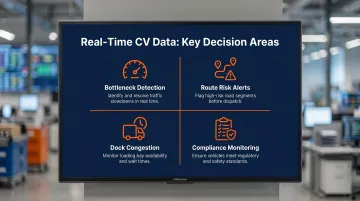
Key areas where real-time CV data drives decisions:
- Bottleneck detection: Flagging slowdowns at specific sort points before throughput drops
- Route risk alerts: Identifying damage-prone lanes based on historical shipment data
- Dock congestion: Predicting queue buildup from incoming vehicle and volume patterns
- Compliance monitoring: Tracking handling procedures and documentation gaps in real time
Challenges in Implementing Computer Vision in Logistics
Data Quality and Model Training
CV systems require large volumes of high-quality labeled training images to perform reliably. Generic, off-the-shelf models rarely work well in specific logistics environments—unusual warehouse lighting, partially occluded package labels, or non-standard product packaging all degrade performance.
Roboflow's logistics pre-trained model was trained on 99,238 images across 20 classes (including barcodes, QR codes, forklifts, pallets, PPE items, and containers) and achieved 76% mean average precision—up to 3.8% higher than generic COCO baseline models on these targeted applications. Domain-specific training clearly outperforms generic models—but it also illustrates the scale of data collection required before a system is ready for production.
Integration Complexity
CV systems must integrate with existing warehouse management systems (WMS), enterprise resource planning (ERP) platforms, and analytics infrastructure to deliver value. Data silos and legacy infrastructure often create friction. 98% of manufacturers have started digital transformation efforts, but integration with legacy systems remains a primary barrier.
Beyond integration, the true cost of CV deployment covers more than camera hardware:
- Edge computing devices and infrastructure
- Ongoing model maintenance and retraining
- Workforce upskilling for new tooling
- System integration labor across WMS, ERP, and analytics platforms
Each of these factors must be accounted for in any realistic ROI calculation.
Privacy, Cybersecurity, and Regulatory Compliance
Camera-based systems capturing images of employees raise GDPR and employee privacy concerns. Under Article 6 of the GDPR, every video recording activity must have a valid lawful basis. Article 35 requires a Data Protection Impact Assessment (DPIA) if surveillance creates a "high risk" to individuals' rights. Clear signage and privacy notices are mandatory.
Building privacy-by-design into the system architecture—such as anonymizing worker images via edge processing and limiting data retention periods—is the most practical path to compliance.
Cybersecurity exposure is a separate but related concern. Common risks include:
- Ransomware attacks locking manufacturers out of vision systems
- Data breaches exposing sensitive operational parameters
- IoT endpoint vulnerabilities from unpatched firmware or weak default credentials
How to Get Started with Computer Vision in Your Logistics Operations
Start with a High-Impact, Bounded Use Case
Rather than attempting to deploy CV everywhere at once, identify one specific pain point where visual automation delivers measurable ROI—such as package damage detection on a sorting line or inventory discrepancy reduction in a high-throughput warehouse. Pilot there first, demonstrate value, then scale.
Targeted pilots can be deployed in weeks, while enterprise-wide deployments across multiple facilities typically take several months, especially when custom model training and system integration are involved.
Choose the Right Development Partner
Successful CV deployments require a partner who can assess existing infrastructure, build or fine-tune custom models, and integrate with your operational systems. When evaluating partners, look for:
- Demonstrated experience with CV model training and fine-tuning on real logistics datasets
- Ability to integrate with existing WMS, ERP, or conveyor control systems
- Edge AI deployment capability for low-latency, on-site processing
- An outcome-focused engagement model tied to measurable results—error reduction rates, throughput improvements, or cost savings
Codewave works with logistics teams using frameworks like TensorFlow, YOLO, and OpenCV for object detection and defect identification, with edge deployment experience on Intel Movidius hardware optimized through OpenVINO. Their ImpactIndex™ model ties project scope to business outcomes, not just software delivery, and their direct-build team structure (no account management layers) keeps execution fast.
Plan for Iteration
A strong partner gets you to launch—but the real gains come after. CV systems improve with more data and real-world feedback, so the right mindset treats implementation as an evolving capability, not a one-time project. As product mixes shift, facility layouts change, or throughput scales, models need retraining and performance monitoring to stay accurate. Build that ongoing optimization into your plan from day one.
Frequently Asked Questions
What is computer vision in logistics?
Computer vision in logistics refers to AI systems that use cameras and deep learning models to interpret visual data across warehouses and supply chains. These systems automate tasks like inventory tracking, package inspection, and safety monitoring that previously required human operators.
What are the most common use cases of computer vision in warehouses?
The top warehouse CV applications include real-time inventory tracking and barcode reading, picking/packing error detection, package damage inspection on conveyor lines, worker safety monitoring, and autonomous robot or forklift navigation.
How does computer vision improve supply chain visibility?
CV systems at distribution hubs and transit points capture shipment status, verify loads, and flag anomalies in real time—feeding live data into control towers and digital twins that give operations teams end-to-end visibility from warehouse to delivery.
What are the biggest challenges of implementing computer vision in logistics?
Most implementations run into sourcing large, high-quality training datasets, integrating CV outputs with existing WMS/ERP systems, and navigating privacy, cybersecurity, and workforce adoption concerns.
How long does it take to implement a computer vision system in a logistics operation?
Timelines vary based on scope and complexity—a targeted pilot (e.g., damage detection on one conveyor line) can be deployed in weeks, while enterprise-wide deployments across multiple facilities typically take several months, especially when custom model training and system integration are involved.
Is computer vision in logistics only viable for large enterprises like Amazon or DHL?
While large players were early adopters, falling hardware costs, pre-trained models, and modular deployment options have made CV accessible for mid-sized logistics and e-commerce companies, particularly those starting with one well-defined use case.