Introduction
Manufacturers have invested heavily in AI-based defect detection systems, yet the outcomes remain frustratingly incomplete. Defective products still reach customers, recall rates remain stubbornly high, and quality teams remain overwhelmed by manual handoffs and fragmented workflows. Detecting a defect is only half the problem. What happens after the alert is where most systems break down.
A vision model identifies a surface crack. That signal then passes through manual reviews, email chains, QMS ticket creation, and manager escalations before anyone acts. By then, the defect has compounded and corrective actions vary wildly across shifts.
AI orchestration addresses this gap directly. It connects detection, diagnosis, and corrective action into closed-loop workflows across teams, systems, and production lines — without waiting for human handoffs. This article covers how orchestrated defect management works, what it enables, where it's being applied, and how to implement it.
TLDR:
- Orchestration connects detection, root cause analysis, routing, and compliance agents into end-to-end defect workflows — no manual handoffs
- Integrates vision models, IoT sensors, MES, ERP, and QMS into a unified execution layer that adapts by defect context
- Delivers 20-35% defect reduction, up to 80% documentation time savings, and automatic audit-ready traceability
- Automotive, pharma, and electronics sectors benefit most, where batch-level quality escapes carry significant cost exposure
- Pilot on a single production line can be operational within 4-8 weeks
The Gap Between Detecting a Defect and Resolving It
Most AI defect detection systems end at the alert. A surface anomaly is flagged. A confidence score appears on a dashboard. Then the workflow collapses into manual chaos: a QA engineer reviews the image, creates a ticket in the quality management system, emails the production manager, and waits for someone to decide whether to hold the line. Only 24% of manufacturing facilities have completely automated quality management operations, and 62% experience work delays related to manufacturing throughput, equipment effectiveness, and inventory data. This detection-to-action gap—the elapsed time between identifying a defect and executing corrective action—is where quality escapes occur.
A computer vision model that identifies a weld defect cannot simultaneously:
- Check whether the same batch passed supplier inspection
- File a non-conformance report in the QMS
- Trigger a production hold in the MES
- Notify the shift supervisor
It detects. It does not coordinate. Without an orchestration layer, each downstream action requires human intervention at every handoff—creating delays, inconsistencies, and incomplete audit trails.
The downstream effects accumulate fast. Contaminated batches spread across multiple production runs. Corrective actions are inconsistently applied across shifts, with decision quality varying based on operator experience and fatigue. Documentation becomes fragmented across emails, spreadsheets, and disconnected systems.
The financial exposure is significant: poor quality costs manufacturers 2% to 4% of annual revenue, translating to $200M–$400M annually for a $10 billion operation. Scrap and rework alone account for up to 2.2% of annual revenue. This is the coordination problem that orchestration solves.
What Is AI Orchestration for Product Defect Detection?
AI orchestration is the governed runtime layer that coordinates multiple specialized AI agents—detection agents, root cause analysis agents, routing agents, and compliance agents—along with data systems and enterprise tools, to drive defect management from identification through resolution as a single continuous workflow.
What orchestration is NOT:
- Not the detection model itself — it sits above detection, coordinating everything that happens after a defect is flagged
- Not fixed-rule automation — unlike hardcoded workflows, orchestration adapts based on what each agent discovers: severity, defect type, affected batch, downstream impact
- Not a single all-purpose agent — it manages multiple specialized agents working in concert, each handling a distinct function
The role of specialized agents:
Within the orchestration layer, each agent has a specific function:
- Detection agent flags the anomaly with defect type, location, confidence score, and affected unit identifier (via computer vision or sensor data)
- Root cause agent correlates the defect against production parameters, supplier records, and historical drift patterns
- Routing agent decides the response: line hold, rework instructions, engineering escalation, or low-priority log
- Compliance agent drafts the non-conformance record, generates audit logs, and files regulatory documentation automatically
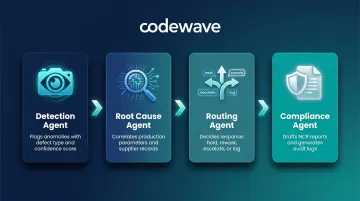
The orchestrator sequences these agents and passes context between them without requiring human intervention at each handoff. The system adapts based on what it finds: a low-confidence surface anomaly routes to a human-in-the-loop review queue, while a confirmed critical defect simultaneously triggers a line hold, root cause analysis, and a new QMS case.
State management for long-running workflows:
Many defect workflows require human approval: quality engineer sign-off, supplier notification, regulatory filing. Because these pauses can span hours or shifts, the orchestration layer preserves context so the workflow resumes exactly where it left off rather than restarting from scratch. This durable state management ensures continuity across approvals, shift changes, and system downtime.
Orchestration vs. AI agent frameworks:
Frameworks like LangChain or LlamaIndex help build individual agents. Orchestration platforms handle the production runtime: deployment, execution state, governance, retries, observability, and lifecycle management. Both are needed — they solve different problems. Frameworks build the agents; orchestration runs them reliably at scale.
| Layer | Tool Examples | Primary Role |
|---|---|---|
| Agent frameworks | LangChain, LlamaIndex | Build and configure individual agents |
| Orchestration platforms | Production runtime tools | Deploy, govern, and manage agents in production |
How an AI-Orchestrated Defect Detection System Works
Data Intake Layer
The system ingests multimodal inputs simultaneously: high-resolution camera feeds, IoT sensor readings (vibration, temperature, torque), historical quality records, supplier batch data, and production parameters. An event-streaming layer—such as Apache Kafka—routes this data in real time to the appropriate detection agents. Each input stream is timestamped and tagged with production line context, batch identifiers, and equipment metadata.
Detection and Analysis Stage
Computer vision models (CNNs for surface defects, OCR for label verification) and time-series models (for process drift) analyze incoming data streams. Detection outputs include:
- Defect type and classification
- Spatial location and severity
- Confidence score
- Affected unit or batch identifier
- Associated production parameters at time of detection
All outputs are passed as structured context to the orchestrator, enabling downstream agents to make informed decisions.
Orchestrator's Coordination Logic
Based on defect severity and type, the orchestrator selects the next execution path dynamically. For example:
- A low-confidence surface anomaly routes to a human-in-the-loop review queue for expert validation
- A confirmed critical defect triggers automatic line hold, initiates root cause analysis via a reasoning agent, and opens a non-conformance case in the QMS—all simultaneously, not sequentially
- A recurring pattern across multiple units triggers predictive maintenance alerts and process parameter adjustments
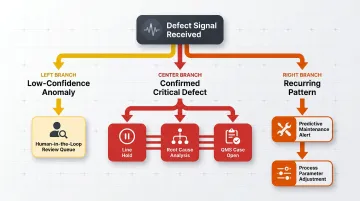
This adaptive routing eliminates hardcoded decision trees entirely — meaning the system handles edge cases and novel defect combinations that rule-based logic would miss, without requiring any engineering changes to the workflow.
Integration with Enterprise Systems
The orchestration layer connects to:
- MES (Manufacturing Execution Systems) — to issue production holds and rework orders
- ERP — to log scrap, update inventory, and track cost of quality
- QMS — to file deviations and corrective action requests
- Communication tools — to alert relevant teams in real time via Slack, Teams, or SMS
REST/GraphQL APIs and message queues (MQTT, AMQP) enable this connectivity. Selecting the right integration protocols depends on latency requirements and existing enterprise architecture — a decision that shapes how quickly the orchestration layer can act on detection signals.
Feedback and Continuous Learning Loop
Once a defect case is resolved, the outcome data — corrective actions taken, root cause confirmed, false positive or true positive — feeds directly back into the detection and reasoning models. The orchestration layer manages model versioning and retraining schedules automatically, so accuracy improves without manual intervention at each cycle.
This closed loop has a compounding effect: each production run gives the system sharper pattern recognition, fewer false positives, and tighter alignment with the specific conditions of your line.
What AI Orchestration Enables That Detection Alone Cannot
Detection flags a defect. Orchestration decides what happens next — and makes sure it actually happens. Without coordination across systems and teams, even the most accurate detection model creates a bottleneck rather than a solution.
Closed-Loop Corrective Action
Orchestration closes the gap between identifying a defect and resolving it. When a detection model flags an anomaly, an orchestration layer triggers downstream actions automatically — pausing a production line, routing the defective unit, alerting quality engineers, and logging the incident in your ERP system.
This closed loop means corrective action starts in seconds, not hours. Manual handoffs are eliminated, and every step is tracked with a full audit trail for compliance and process review.
Cross-System Coordination
Detection tools operate in isolation by default. An AI orchestration layer connects them to the broader operational stack — linking quality control systems with supply chain platforms, maintenance scheduling, and supplier communication tools.
Key coordination capabilities this enables:
- Routes defective batches to rework queues without manual intervention
- Triggers supplier notifications when incoming material quality falls below threshold
- Syncs defect data with predictive maintenance models to catch root causes earlier
- Updates production schedules in real time when a line halt is required
- Feeds inspection results back into procurement and vendor scoring systems
Adaptive Learning Across the Quality Pipeline
A standalone detection model improves only when retrained. An orchestrated system learns continuously from outcomes across the entire pipeline — what defects were confirmed, how long resolution took, and whether corrective actions were effective.
This feedback loop lets the system refine detection thresholds, prioritize high-risk inspection points, and surface patterns that static models miss. Over time, the orchestration layer doesn't just respond to defects — it helps prevent them.
| Capability | Detection Alone | AI Orchestration |
|---|---|---|
| Flags defects | ✓ | ✓ |
| Triggers automated response | ✗ | ✓ |
| Coordinates across systems | ✗ | ✓ |
| Learns from resolution outcomes | ✗ | ✓ |
| Provides audit trail | Limited | Full |
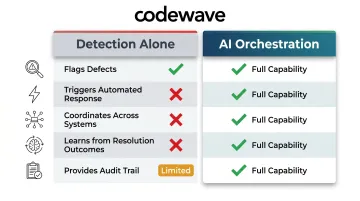
The difference isn't detection accuracy — it's operational velocity. Orchestration turns a quality signal into a coordinated response before a defect compounds into a larger production or compliance problem.